
For generations, the foundational dogma of paleontology rested on a simple, seemingly immutable premise: dinosaur fossils are rocks. According to this long-standing view, the dynamic processes of fossilization—diagenesis—replaced every original organic molecule with minerals over millions of years, leaving behind inert stone replicas shaped like ancient bones. This paradigm treated fossils as architectural blueprints of long-dead organisms, completely devoid of their original biological material. However, an extraordinary multi-institutional study centered on a remarkably preserved Edmontosaurus fossil has systematically dismantled this assumption, offering compelling evidence that the biochemical echoes of the Cretaceous period can survive deep into the modern era.
In findings published in the journal Analytical Chemistry under the title "Evidence for Endogenous Collagen in Edmontosaurus Fossil Bone," an international research team led by the University of Liverpool has confirmed the presence of original organic molecules, including degraded fragments of collagen, trapped inside dinosaur bones dating back approximately 66 million years. This discovery does more than merely add a fascinating footnote to the annals of paleontology; it provides powerful, empirical support to a controversial hypothesis that has fiercely divided the scientific community for more than three decades. By utilizing advanced, high-resolution analytical techniques to rule out modern contamination, the researchers have opened a transformative new chapter in the study of prehistoric life, turning select fossils from mere stone casts into molecular time capsules.
Anatomy of a Discovery: The Edmontosaurus of Hell Creek
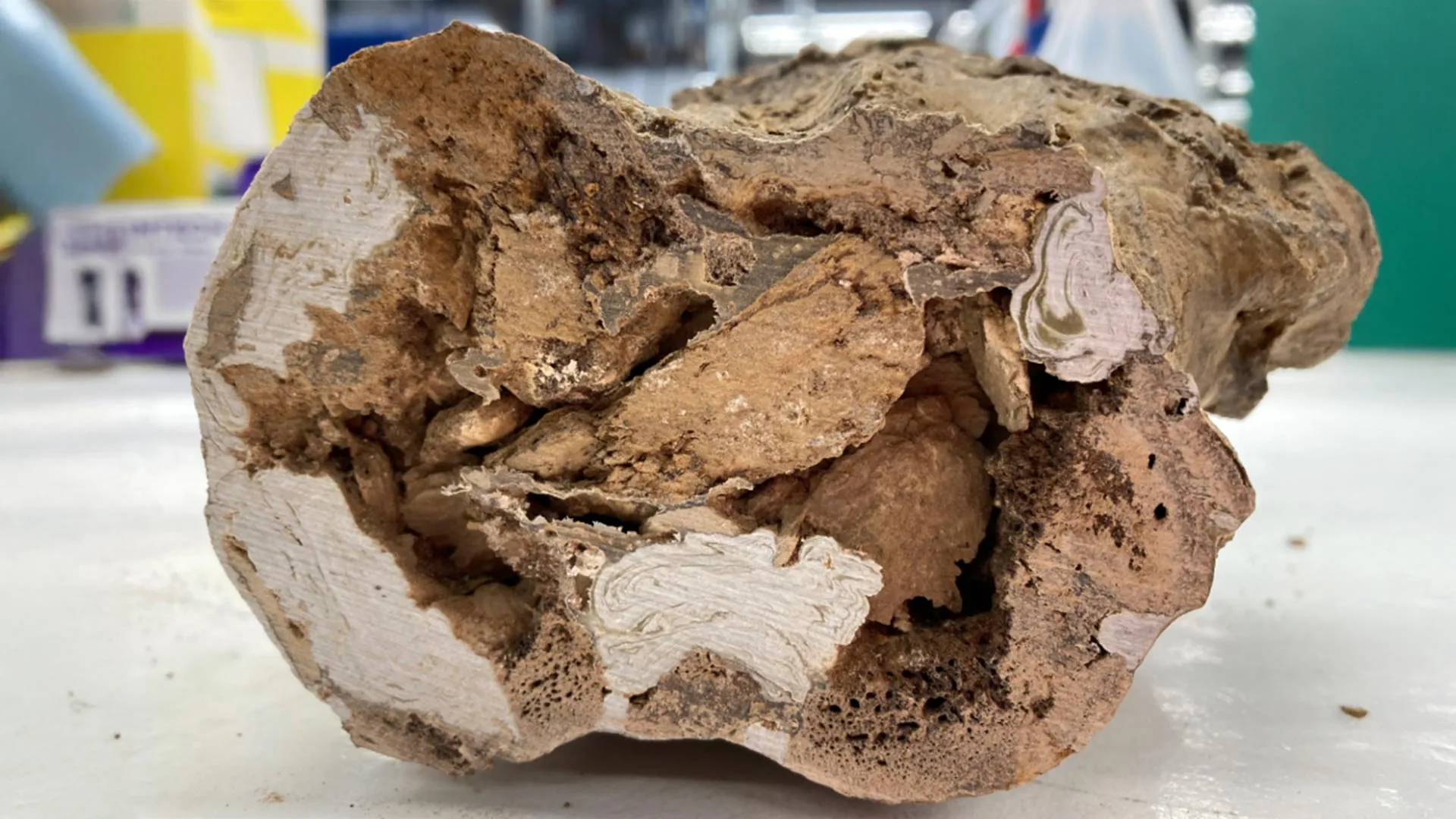
The focal point of this landmark research is a heavy, 22-kilogram sacrum—a section of the hip region—belonging to an Edmontosaurus, a massive duck-billed, plant-eating dinosaur that roamed the floodplains of North America during the late Cretaceous Period. Recovered from the fossil-rich Hell Creek Formation in South Dakota, this particular specimen lived during the twilight of the dinosaur age, sharing its ecosystem with apex predators like Tyrannosaurus rex before the catastrophic asteroid impact wiped out non-avian dinosaurs 66 million years ago.
Edmontosaurus is no stranger to exceptional preservation. Over the past century, paleontologists have occasionally unearthed Hell Creek hadrosaur specimens exhibiting such pristine preservation—including fossilized skin impressions, tendons, and muscular outlines—that researchers affectionately dubbed them "dinosaur mummies." Yet, while macroscopic soft tissue impressions have fascinated scientists for decades, the interior microscopic landscape of these bones remained largely unexplored for authentic biochemical traces until the advent of ultra-sensitive laboratory instrumentation.
To probe the microscopic architecture of the Edmontosaurus sacrum, the research team deployed a cutting-edge suite of analytical technologies. Rather than relying on a single testing method, which has historically left previous soft-tissue claims vulnerable to skepticism, the scientists combined advanced protein sequencing, multi-form mass spectrometry, and high-resolution microscopy. This rigorous multi-pronged approach was specifically designed to isolate and interrogate the organic constituents hidden deep within the mineralized matrix of the bone.
Crucially, researchers from the University of California, Los Angeles (UCLA) joined the effort to identify hydroxyproline, a specialized amino acid that plays a foundational role in stabilizing the triple-helix structure of collagen. Because hydroxyproline is heavily concentrated in collagen and exceedingly rare in environmental contaminants or bacterial biofilms, its detection deep within the mineralized bone structure served as a vital biochemical fingerprint. It provided the definitive confirmation that fragmented, degraded remnants of authentic dinosaur collagen were indeed preserved within the 66-million-year-old matrix.
Professor Steve Taylor, chair of the Mass Spectrometry Research Group at the University of Liverpool’s Department of Electrical Engineering & Electronics, emphasized the definitive nature of the team’s data. "This research shows beyond doubt that organic biomolecules, such as proteins like collagen, appear to be present in some fossils," Taylor stated. "Our results have far-reaching implications. Firstly, it refutes the hypothesis that any organics found in fossils must result from contamination."
A Decades-Long Scientific Schism
The publication of these findings marks the latest chapter in a turbulent debate that has polarized the paleontological community since the early 2000s. For generations, standard biochemical theory dictated that proteins, DNA, and other complex organic molecules were thermodynamically unstable over geological timescales. Standard biochemical decay models predicted that proteins should completely hydrolyze and degrade into constituent amino acids within a few hundred thousand years at most, even under optimal preservation conditions.
Consequently, when pioneering paleontologist Mary Schweitzer and her colleagues published sensational papers in 2005 reporting the recovery of flexible, transparent blood vessel-like structures and cellular microstructures inside a Tyrannosaurus rex femur from the Hell Creek Formation, the scientific community reacted with intense skepticism. Subsequent studies by Schweitzer and other research groups claimed to have identified microscopic traces of collagen and other proteins in various Cretaceous specimens, including hadrosaurs and ceratopsians.
However, these claims immediately ran into a wall of intense scientific criticism. Mainstream skeptics argued that the reported soft tissues and organic residues were not authentic dinosaur molecules at all. Instead, critics posited that the materials were modern bacterial biofilms—often referred to as slime layers—or organic contaminants introduced during excavation, preparation, or laboratory handling. Because earlier studies often relied on a limited range of analytical techniques, proving the endogenous (native) origin of the proteins remained a formidable hurdle, leaving the field deadlocked between orthodox geochemical theory and paradigm-shifting empirical observations.
The 2025 Edmontosaurus study breaks this long-standing stalemate by deploying the kind of rigorous, cross-verified analytical protocol that critics demanded. By combining high-precision mass spectrometry with amino acid profiling and structural microscopy on the exact same fossil samples, the Liverpool-led team effectively closed the loopholes exploited by past skeptics. The convergence of multiple independent analytical lines of evidence points inescapably to a single conclusion: under exceptional circumstances, fragile organic molecules can endure across tens of millions of years.
The Enigma of Molecular Survival
The confirmation of ancient proteins forces a radical reassessment of taphonomy—the study of how organisms decay and become fossilized. It revives a profound and perplexing scientific question: How can complex biological macromolecules, which are chemically prone to degradation, survive intact across geological epochs spanning tens of millions of years?
Proteins are large, folded polymers made up of amino acid chains held together by peptide bonds. Over time, ambient heat, background radiation, and microbial activity inevitably break these bonds. Yet, nature occasionally operates outside standard laboratory decay curves. Scientists are now directing intense investigative focus toward the micro-environmental conditions of fossilization, exploring how specific geological settings and mineral interactions can act as chemical armor for ancient biomolecules.
Current working hypotheses suggest that the intricate, porous architecture of bone itself may provide a protective micro-environment. When bone mineralizes, hydroxyapatite crystals—the calcium phosphate mineral that forms the inorganic matrix of vertebrate bones—can intimately bind to organic molecules like collagen. This mineral shielding appears to physically restrict access to water and microbes, two primary catalysts of protein decay. Furthermore, certain burial environments characterized by rapid sedimentation, low oxygen levels, and specific geochemical pH balances may quench free radicals and arrest the chemical reactions that drive molecular degradation.
The exceptional preservation seen in Edmontosaurus specimens suggests that the biological and geological variables operating in the Hell Creek ecosystem may have been uniquely aligned to foster long-term molecular stability. As researchers continue to analyze these "dinosaur mummies," the boundary between geology and biochemistry is beginning to blur, encouraging a broader view of fossils not as inert stones, but as complex geochemical vaults capable of retaining fragile echoes of prehistoric life.
Broader Impact and Future Implications for Paleontology
The validation of endogenous collagen in dinosaur bones promises to fundamentally alter how paleontologists approach their discipline, bridging the traditional gap between gross skeletal morphology and molecular biology. For over two centuries, our understanding of dinosaur evolution, phylogeny, and physiology has been derived almost entirely from hard anatomical features—bones, teeth, and skin impressions. While immensely valuable, morphology alone can sometimes obscure evolutionary relationships, particularly when convergent evolution leads unrelated species to develop similar physical traits.
The advent of paleoproteomics—the study of ancient proteins extracted from fossils—opens up a revolutionary avenue of research. Because amino acid sequences are dictated by genetic codes, surviving protein fragments can be sequenced and compared across species in much the same way modern DNA is used to construct phylogenetic trees. Although ancient proteins are heavily degraded compared to modern genetic material, they are vastly more stable than DNA, which typically degrades beyond recognition within a few million years at most. Collagen sequencing could soon allow paleontologists to place dinosaurs within precise molecular family trees, clarifying evolutionary lineages that have remained opaque based on bone structure alone.
Beyond phylogenetics, the preservation of original proteins offers an unprecedented window into the actual physiology, metabolic processes, and pathologies of extinct animals. Future biochemical analyses could potentially reveal insights into dinosaur growth rates, thermal regulation, immune system responses, and even specific diseases that afflicted individual specimens millions of years ago.
Significantly, this discovery may also prompt a sweeping retrospective re-evaluation of existing museum collections worldwide. Professor Taylor noted that the implications of the Liverpool study extend directly to fossil archives accumulated over the past century. Standard cross-polarized light microscopy images and histological slides of fossil bone, many of which have languished in university drawers and museum vaults for decades, may contain overlooked signatures of preserved organic matrix.
"These images may reveal intact patches of bone collagen, potentially offering a ready-made trove of fossil candidates for further protein analysis," Taylor explained. "This could unlock new insights into dinosaurs, for example revealing connections between dinosaur species that remain unknown."
As the scientific community digests these findings, the philosophical definition of a fossil is undergoing a quiet revolution. No longer viewed strictly as petrified silhouettes carved in stone, select fossils from the depths of geological time are being re-envisioned as resilient molecular archives. By unlocking the secrets trapped within the mineralized matrix of an Edmontosaurus bone, researchers have demonstrated that deep time does not entirely erase the biological signature of life on Earth, leaving modern science standing on the threshold of a vibrant new era in paleontological discovery.
