
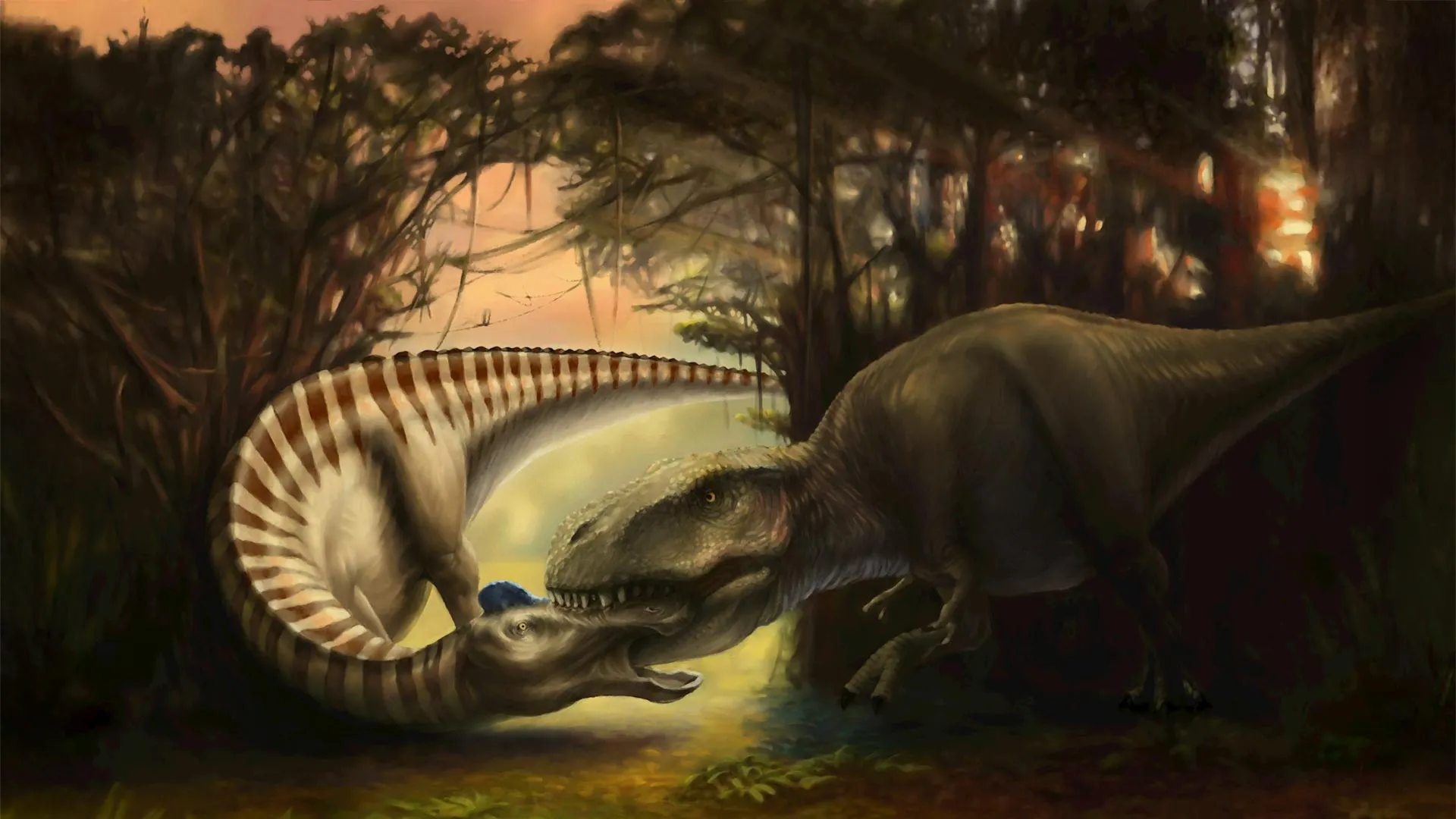
A remarkable fossil housed within the paleontology collections of Montana State University’s Museum of the Rockies is offering the scientific community an exceptionally detailed glimpse into the predatory behavior of the Late Cretaceous period’s most formidable apex carnivore, Tyrannosaurus. Featuring a tyrannosaur tooth physically embedded within the facial structure of a contemporary herbivorous dinosaur, the specimen has become the focal point of a comprehensive new research study led by paleontologists from Montana State University and Canada’s University of Alberta. This rare find bridges millions of years of evolutionary history, providing empirical evidence that illuminates how these massive theropods interacted with, subdued, and potentially consumed their prey across the ancient landscapes of North America.
Main Facts and the Discovery of the Hell Creek Specimen
Roughly 66 million years ago, near the absolute twilight of the Age of Dinosaurs, the ecological hierarchy of what is now the American West was dominated entirely by Tyrannosaurus. Thriving in a lush, sub-tropical floodplain environment characterized by winding river systems and dense coastal vegetation, this apex predator shared its geographic territory with an array of massive megafauna. Among its contemporaries were heavily armored, horned ceratopsians such as Triceratops and large, duck-billed hadrosaurs known as Edmontosaurus, which formed the primary dietary base for large carnivorous theropods in the region.
The specific specimen at the center of the recent study was unearthed in 2005 during a systematic paleontological expedition in the famed Hell Creek Formation of eastern Montana. Located on public lands managed by the United States Department of the Interior’s Bureau of Land Management, the site yielded a nearly complete Edmontosaurus skull. Transported to the Museum of the Rockies in Bozeman, Montana, the fossil was eventually incorporated into the institution’s permanent paleontology catalog.
Upon closer inspection, researchers identified an extraordinary and anomalous anatomical feature: the broken crown of a tyrannosaur tooth remained firmly and permanently lodged within the facial bones of the duck-billed dinosaur. This specimen is now publicly exhibited in the museum’s renowned Hall of Horns and Teeth, serving as a physical archive of ancient predation. The collaborative investigation into the fossil was spearheaded by Taia Wyenberg-Henzler, a doctoral student at the University of Alberta, alongside Dr. John Scannella, the Curator of Paleontology at the Museum of the Rockies. Their methodical findings and anatomical breakdown were subsequently peer-reviewed and published in the scientific journal PeerJ, drawing international attention from the global paleontology community.
Chronology of Events: From Discovery to Publication
The journey of the Hell Creek Edmontosaurus skull spans millions of years of geological preservation, decades of modern excavation, and cutting-edge laboratory analysis. Understanding the trajectory of this research requires examining the chronological milestones that transformed a jumble of ancient bone into a published scientific breakthrough.
Approximately 66 million years ago, during the late Maastrichtian age of the Cretaceous period, the interaction between the Tyrannosaurus and the Edmontosaurus occurred in the floodplains of Laramedia. Whether the event represented a direct ambush by a living predator or scavenging upon an already deceased carcass remains a critical point of scientific inquiry. Following the lethal or post-mortem encounter, the remains of the Edmontosaurus were rapidly buried in sediment, protecting the delicate skull bones and the embedded tooth from immediate surface weathering and scavengers.
Fast-forwarding to the summer of 2005, field paleontologists working within the badlands of the Hell Creek Formation located the fossilized skull fragments eroding from a hillside. Recognizing the scientific potential of the strata, the team carefully excavated the cranium, documented its stratigraphic context, and transported the fossil blocks to the Museum of the Rockies. For nearly two decades, the skull remained a part of the museum’s extensive repository, waiting for the right combination of analytical technology and specialized researchers to unlock its secrets.
By the early 2020s, a research partnership formed between the University of Alberta and the Museum of the Rockies. Taia Wyenberg-Henzler and Dr. John Scannella initiated a formal investigation into the skull’s unique dental anomaly. Between 2023 and 2024, the researchers utilized advanced computed tomography (CT) scanning technology at Bozeman Health Deaconess Hospital to peer inside the bone matrix without damaging the fossil. By late 2024, the team compiled their comparative morphology data, confirming the tooth’s provenance, and submitted their manuscript to PeerJ, culminating in its publication and public dissemination in late 2024 and early 2025.
Supporting Data and Technological Analysis
In paleontology, isolated bite marks on dinosaur bones—ranging from shallow scores to deep gouges and puncture wounds—are documented with relative frequency across various Cretaceous formations. However, the preservation of an actual tooth fragment embedded deep within the bone of the victim is an exceptionally rare taphonomic occurrence.
"Although bite marks on bones are relatively common, finding an embedded tooth is extremely rare," stated Taia Wyenberg-Henzler during the release of the study. "The great thing about an embedded tooth, particularly in a skull, is it gives you the identity of not only who was bitten but also who did the biting. This allowed us to paint a picture of what happened to this Edmontosaurus, kind of like Cretaceous crime scene investigators."
To rigorously verify the identity of the biter, the research team conducted a comprehensive comparative analysis. They measured and cataloged the morphology, serration density, and cross-sectional geometry of the embedded tooth fragment, comparing it against the dentition of every known carnivorous dinosaur species inhabiting the Hell Creek ecosystem. The geometric and structural match pointed exclusively to Tyrannosaurus.
To uncover the mechanics of the bite, the researchers partnered with Advanced Medical Imaging at Bozeman Health Deaconess Hospital. High-resolution CT scans were performed on the Edmontosaurus skull, allowing the scientific team to generate detailed, three-dimensional digital models of the internal bone structure. These scans revealed the precise angle of entry, the depth of penetration, and the structural stress fractures radiating through the duckbill’s nasal bones, shedding light on the immense mechanical forces at play during the interaction.
Official Responses and Expert Perspectives
The publication of the PeerJ study has generated significant commentary from leading figures in vertebrate paleontology, highlighting how a single fossil can inform broader debates regarding dinosaur behavior. The intersection of predator-prey dynamics, bone modification, and pathology forms the crux of the institutional response to the discovery.
Dr. John Scannella emphasized the behavioral implications captured by the fossilized remains. "A fossil like this is extra exciting because it captures a behavior: a tyrannosaur biting into this duckbill’s face," Scannella noted. Addressing the timing of the trauma relative to the Edmontosaurus’s death, he added, "The skull shows no signs of healing around the tyrannosaur tooth, so it may have already been dead when it was bitten, or it may be dead because it was bitten."
Wyenberg-Henzler expanded on the physical orientation of the wound and what it implies about the nature of the encounter. "Looking at the way the tooth is embedded inemies of the Edmontosaurus suggests that it met its attacker face-to-face, something that usually happens to an animal that was killed by a predator," Wyenberg-Henzler explained. "The amount of force necessary for a tooth to have become broken off in bone also points to the use of deadly force. For me, this paints a terrifying picture of the last moments of this Edmontosaurus."
The absence of bone remodeling—such as osteological healing or callous formation around the embedded tooth—indicates that the victim did not survive long after the trauma occurred, supporting the hypothesis of an active predatory attack rather than a healed defensive encounter or post-mortem scavenging where the bone was already dry and brittle.
Broader Impact and Paleontological Implications
For decades, the scientific community has engaged in rigorous debate regarding the precise feeding habits, hunting strategies, and ecological roles of Tyrannosaurus. While its massive size, binocular vision, and bone-crushing bite force—estimated by biomechanical studies to exceed 12,000 pounds of force—are well-established, whether these animals were active apex predators, opportunistic scavengers, or a combination of both remains a central theme of ongoing research.
This rare Hell Creek fossil contributes vital physical evidence to the active predator hypothesis. By demonstrating that a Tyrannosaurus delivered a catastrophic, bone-penetrating bite to the facial region of a large, living or freshly killed Edmontosaurus, the specimen reinforces the view that these theropods possessed both the anatomical weaponry and the behavioral inclination to aggressively dispatch large-bodied prey.
Furthermore, the study underscores the value of interdisciplinary collaboration between academic institutions, medical facilities, and museum repositories. By applying modern medical imaging diagnostics to ancient paleontological specimens, researchers can extract micro-anatomical data that were entirely inaccessible to previous generations of scientists. As museum collections continue to be re-examined with advanced technologies, specimens like the Hell Creek Edmontosaurus skull ensure that the fossil record will perpetually yield new chapters in the story of Earth’s prehistoric inhabitants.
