
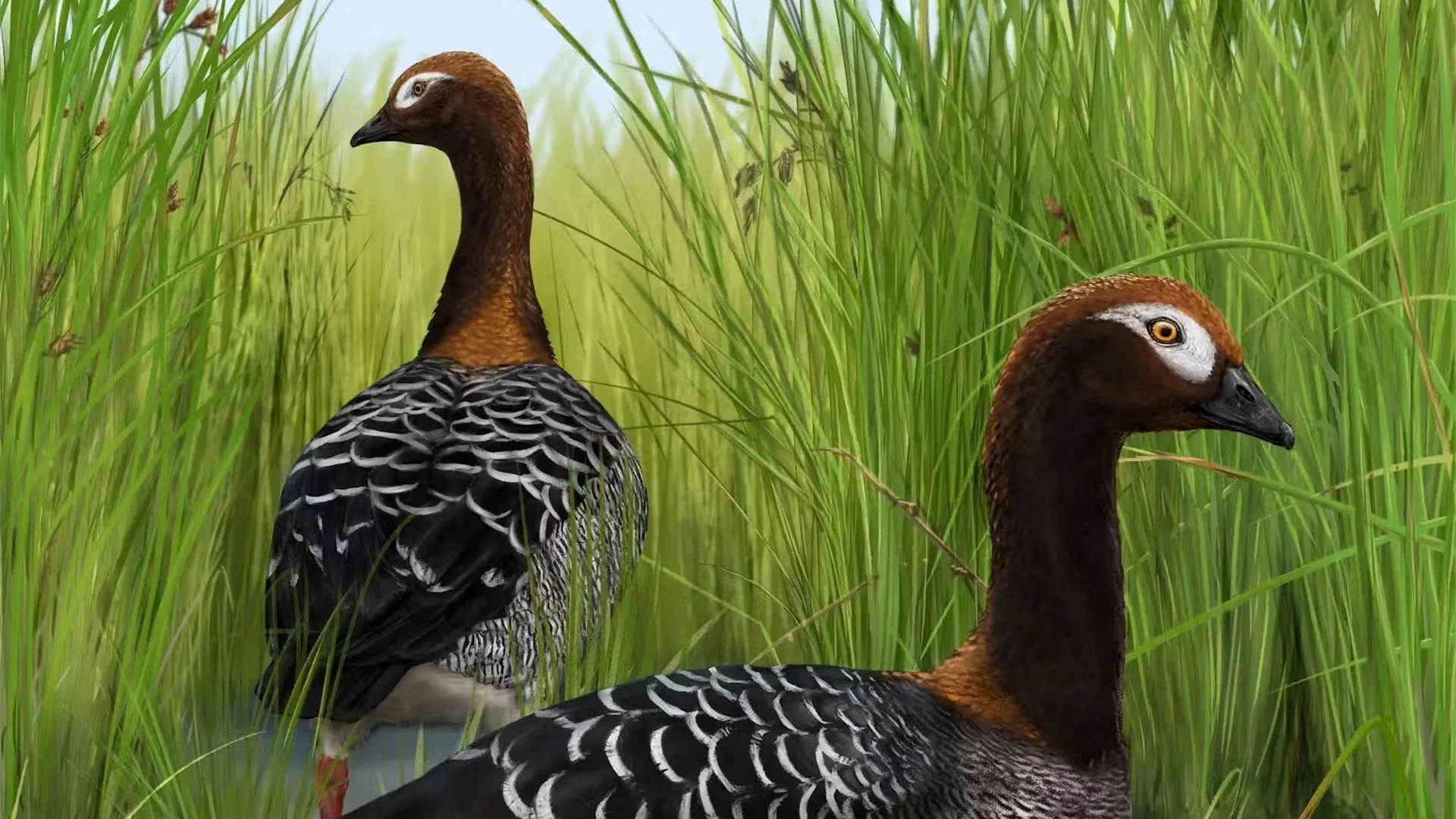
The discovery of a rare fossil goose within the ancient lake remnants of Central Otago is fundamentally transforming scientific understanding of how New Zealand’s uniquely isolated bird life evolved over millions of years. Recovered from the globally significant St Bathans fossil deposits by an international research collective, the newly identified species—formally named Meterchen luti—adds compelling weight to a growing body of evidence indicating that the origins of Aotearoa’s avian fauna are far more dynamic, wave-driven, and complex than previously theorized by paleontologists.
Published in the peer-reviewed journal Historical Biology, the breakthrough research was spearheaded by a multidisciplinary team representing the University of Otago (known in te reo Māori as Ōtākou Whakaihu Waka), the Museum of New Zealand Te Papa Tongarewa, and the University of Cambridge in the United Kingdom. By meticulously re-evaluating decades-old fossil collections and pairing morphological analysis with modern paleogenetic data, the researchers have resolved a long-standing debate concerning the lineage of New Zealand’s prehistoric waterfowl.
Unearthing a Hidden Species in the St Bathans Deposits
The St Bathans Fauna represents a unique window into the Miocene epoch of New Zealand, roughly 16 to 19 million years ago, when much of modern-day Central Otago was covered by a vast, shallow body of water known as Lake Manuherikia. While paleontologists have spent decades unearthing a wealth of fossilized remains from this prehistoric ecosystem—ranging from miniature bats and unique land mammals to primitive crocodiles, diverse fish, and an abundance of waterfowl—complete or diagnostic goose remains have historically remained scarce.
Associate Professor Nic Rawlence, Director of the Otago Palaeogenetics Laboratory and co-author of the new study, noted that while generic waterfowl bones are frequently recovered at St Bathans, bones specifically attributable to geese were rarely found and often misclassified due to their fragmented nature.
To resolve these ambiguities, the research team initiated a comprehensive review of every fossil bone previously categorized as belonging to geese within the St Bathans archive. These ancient specimens were subjected to exhaustive comparative analysis, measured against other fossil waterfowl unearthed at the site, and cross-referenced against an extensive repository of modern and extinct bird skeletons from global collections.
"We determined that the bones included an undescribed species, the size of a small goose," Rawlence stated, highlighting the meticulous nature of the anatomical review.
The newly authenticated species has been formally designated Meterchen luti. The nomenclature bridges scientific taxonomy with cultural whimsy; the genus name Meterchen translates from ancient Greek as "mother goose," a direct nod to the nursery rhyme Old Mother Goose and the poetic imagery of an ancient waterfowl surfacing from the primordial mud. The specific epithet luti is derived from the Latin word for "of the mud," honoring the preservation environment of the fossil beds.
Crucially, morphological analysis revealed that the St Bathans goose bears no direct evolutionary kinship with the recently extinct, giant flightless New Zealand geese of the genus Cnemiornis, nor is it closely related to their modern Australian ecological counterpart, the Cape Barren goose (Cereopsis novaehollandiae).
Rewriting the Chronology of Zealandia’s Avian Inhabitants
The identification of Meterchen luti forces a major paradigm shift in how scientists interpret the timeline of colonization and speciation across Zealandia—the largely submerged continent that encompasses New Zealand.
For decades, paleontologists debated the deep-time continuity of New Zealand’s fauna. An entrenched school of thought previously argued that the St Bathans goose served as the direct evolutionary ancestor of the giant, flightless Cnemiornis geese that later dominated the prehistoric landscape. If validated, this hypothesis would have implied that a continuous goose lineage maintained an uninterrupted presence in Zealandia for a span of at least 14 million years, weathering dramatic tectonic upheavals, climatic shifts, and landscape fragmentation.
However, this long-held hypothesis sat in sharp contradiction with modern genetic evidence. Recent DNA studies indicate that the true ancestors of the giant Cnemiornis geese actually arrived via trans-oceanic dispersal from Australia comparatively recently—roughly seven million years ago. Proponents of the older continuous-lineage theory had previously dismissed these genetic markers, arguing that morphological continuity in the fossil record trumped molecular clocks.
Lead author Alan Tennyson of the Museum of New Zealand Te Papa Tongarewa explained that the new research finally bridges this longstanding gap between fossil morphology and genetic data.
"Many bird species have reached New Zealand over millions of years, but the ancestors of some of the country’s best known large birds arrived surprisingly recently," Tennyson observed.
This wave of more recent arrivals—dating back just four to five million years—includes iconic native and endemic species such as the takahē (Porphyrio hochstetteri), Forbes’ harrier (Circus dossenus), and the colossal Haast’s eagle (Hieraaetus moorei). The rigorous reassessment carried out by the Otago-Te Papa-Cambridge team strongly validates this later-arrival framework, demonstrating that Zealandia’s fauna was repeatedly shaped by successive waves of immigration rather than a single, ancient, static population.
The Intersection of DNA, Fossils, and Island Evolution
The integration of ancient DNA extraction techniques and high-resolution morphological analysis has revolutionized the field of Australasian paleontology. Rawlence emphasizes that unlocking the secrets of species like Meterchen luti requires utilizing every available scientific instrument.
"Using all the tools in the toolbox, including DNA and fossils, we can reconstruct how the dynamic geological, climatic and human history of Zealandia has shaped the evolution of Aotearoa fauna in ever more detail," Rawlence said.
The evolutionary trajectory of the St Bathans goose indicates that its ancestors successfully colonized Zealandia more than 14 million years ago, establishing a thriving lineage. Yet, unlike the survivors of later migratory pulses, this ancient goose lineage eventually suffered complete extinction, leaving no living descendants to populate modern ecosystems. This pattern highlights the vulnerability of endemic island populations to long-term environmental shifts, volcanic activity, and climate change during the Miocene epoch.
Conversely, the subsequent evolution of the giant flightless Cnemiornis geese presents an extraordinary case study in rapid island-driven morphological adaptation. Standing approximately one meter tall and tipping the scales at up to 18 kilograms, these formidable birds held the title of the largest geese in the world.
"The relatively recent evolution of the giant flightless Cnemiornis geese offers another striking example of rapid morphological change that can occur within a short timeframe on islands," Rawlence noted. Within a geological blink of an eye, avian ancestors arriving from across the Tasman Sea underwent profound physical transformations, shedding their capacity for flight and scaling up dramatically in body mass to exploit vacant ecological niches in the absence of mammalian herbivores.
Broader Implications for Conservation and Biodiversity Science
The publication of this study arrives at a critical juncture for biodiversity research in New Zealand and the wider South Pacific. As conservation biologists grapple with the ongoing extinction crisis and the management of endangered endemic species, understanding the deep historical baseline of island ecosystems provides essential context.
The research underscores that New Zealand’s biodiversity is not a static relic of ancient Gondwanan supercontinent breakup—a classic biogeographical theory that dominated mid-20th-century science—but rather a fluid, highly adaptable mosaic of ancient lineages and surprisingly recent, highly dynamic colonizations.
By demonstrating that even specialized groups like waterfowl experienced multiple distinct waves of arrival, extinction, and rapid adaptation, the study reinforces the importance of preserving contemporary habitats against rapid anthropogenic change. Island species, while capable of astonishingly fast evolutionary innovations—such as gigantism and flightlessness—are simultaneously exceptionally vulnerable when their specialized ecological niches are disrupted.
As the international research team continues to sift through the rich, mud-preserved layers of the St Bathans fossil deposits, expectations remain high for further discoveries. Each recovered bone from ancient Lake Manuherikia adds another precise brushstroke to the portrait of prehistoric Aotearoa, offering modern science a clearer window into a lost world where giant waterfowl once walked the muddy shores of a dynamic, evolving continent.
