
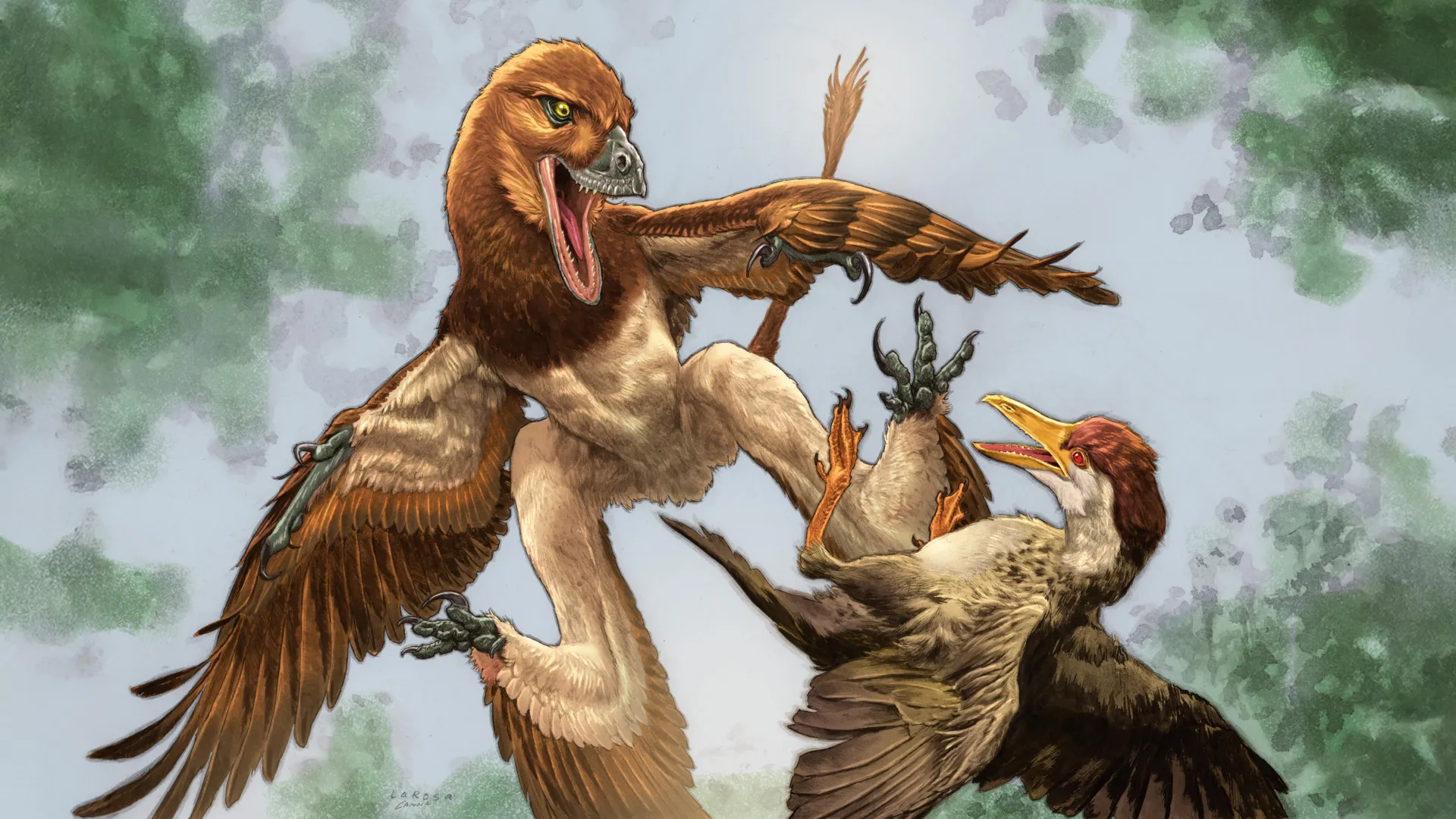
Paleontologists working in the hyper-arid badlands of northwestern China have solved a long-standing ecological puzzle that has vexed researchers for decades. At a remarkably rich fossil site in the Changma Basin of Gansu province, scientists have unearthed the skeletal remains of a previously unknown dinosaur species. This newly described creature, a feathered carnivorous dromaeosaur named Jian changmaensis, provides the missing link in a prehistoric murder mystery involving hundreds of crushed and fragmented bird bones compressed into pellet-like masses eerily similar to the regurgitated pellets of modern owls.
The discovery, detailed in a recent study published in the Annals of Carnegie Museum, introduces a formidable new predator into an ecosystem previously thought to be dominated almost exclusively by primitive, early Cretaceous birds. Measuring roughly the size of a modern barn owl with an estimated four-foot wingspan, Jian changmaensis now stands accused by science of being the apex predator that preyed upon the ancient avians of Changma, leaving behind a trail of digested or compressed skeletal debris that has puzzled generations of fossil hunters.
The Main Facts of the Discovery
The excavation and subsequent analysis of Jian changmaensis mark a major milestone in Mesozoic paleontology. For years, the Changma fossil bed has yielded an abundance of prehistoric avian remains—over a hundred fossilized birds have been cataloged from the site alone. Yet, despite this rich accumulation of bird life, researchers were baffled by the total absence of non-avian dinosaur fossils at the location. Compounding the mystery were bizarre, compacted clusters of shattered bird bones discovered throughout the strata, bearing all the physical hallmarks of regurgitated pellets produced by modern raptor species.
The discovery of a partial upper arm bone—measuring approximately four inches in length—shattered this ecological vacuum. Morphological analysis of the arm and shoulder bones immediately flagged the specimen as belonging to a dromaeosaur, a family of agile, feathered theropod dinosaurs colloquially and popularly linked to the famous Velociraptor. However, unlike its cinematic counterpart, Jian changmaensis belonged to a specialized subgroup known as microraptors.
Most known microraptors were diminutive creatures, often scaling down to the size of a common crow. Jian, by contrast, represents one of the largest specimens of its kind ever documented. Armed with distinctive skeletal architecture optimized for gripping and slashing, and boasting a body size that dwarfed the local bird population, this newly minted species fits the profile of the mysterious Changma bird-hunter with mathematical precision.
Chronology of the Changma Basin Investigations
The unearthing of Jian changmaensis is the culmination of decades of systematic exploration in China’s Gansu province, a region internationally recognized for its exceptionally preserved Cretaceous strata.
During the Early Cretaceous epoch, roughly 145 to 100 million years ago, the Changma Basin was not the arid desert landscape seen today. Instead, it was a dynamic, wetland-rich environment teeming with life. It supported vast populations of early birds—the precursors to modern avian species that would eventually weather the catastrophic asteroid impact 66 million years ago.
For years, field expeditions led by international and Chinese institutions recovered countless bird specimens from the Changma mudstones and shales. Paleontologists continually noted the anomalous clusters of broken bird bones, hypothesizing the presence of a larger, unseen carnivore. However, the fossil record remained stubbornly silent regarding the identity of this predator.
The breakthrough occurred when a collaborative team of researchers—comprising specialists from the Gansu Geological Museum, the Carnegie Museum of Natural History, the University of Nebraska State Museum, the Institute of Vertebrate Paleontology and Paleoanthropology of the Chinese Academy of Sciences, and the Field Museum in Chicago—identified the diagnostic dromaeosaur arm bone among the regional finds. Subsequent osteological study confirmed that the bone belonged to an entirely new genus and species, bridging a critical gap in the chronology of the site.
Anatomy and Morphology: The Four-Winged Glider
While researchers have recovered only a fraction of the total Jian changmaensis skeleton, comparative anatomy with closely related microraptors allows for a highly accurate reconstruction of the animal’s physical appearance and biomechanics.
Like its smaller relatives, Jian was a four-winged dinosaur. Long, aerodynamic feathers extended not only from its forelimbs but also from its hind legs, creating a dual-airfoil surface area. Despite these adaptations, biomechanical models indicate that Jian was incapable of powered, flapping flight in the manner of modern sparrows or pigeons.
Instead, the dinosaur was an arboreal or semi-arboreal glider. Scientists suggest that Jian would have scaled the prehistoric trees of the Changma Basin and launched itself into the air, using its four-winged configuration and long tail for stability to glide between canopies, much like a modern flying squirrel. This aerial agility would have made it an exceptionally stealthy and effective hunter, perfectly positioned to ambush unwary birds resting in the branches or skimming the surface of local waterways.
The binomial nomenclature of the species honors both its mythical attributes and its geographic origin. Jian references a legendary Chinese mythological bird-like creature characterized by having only one wing and one eye, requiring two of them to cooperate to fly—a poetic nod to the creature’s asymmetrical or specialized morphology. The specific epithet changmaensis serves as a permanent geographical marker, denoting the Changma Basin where the type specimen was unearthed.
Official Responses and Expert Analysis
The inclusion of a terrestrial carnivore into the previously bird-dominated Changma ecosystem has profound implications for how paleontologists reconstruct early Cretaceous food webs.
"Scientists have found these weird, broken-up clusters of bird bones at this site, and we didn’t know what made them. This new microraptor dinosaur, Jian changmaensis, is our best guess," explains Jingmai O’Connor, associate curator of fossil reptiles at the Field Museum in Chicago and senior author of the descriptive study. Highlighting the ecological anomaly of the find, O’Connor notes, "It’s the only dinosaur found at this site that wasn’t a bird, it was a carnivore, and it was much bigger than everything else that we’ve found there."
Dr. Matt Lamanna, the Mary R. Dawson Curator of Vertebrate Paleontology at the Carnegie Museum of Natural History and corresponding author of the study, emphasizes the rarity and value of the discovery. "Jian changmaensis reveals that non-avian dinosaurs lived in what is now the Changma Basin, an area famous for its fossil birds," Lamanna states. Pointing out the stark statistical disparity at the site, he adds, "Our team has recovered more than a hundred bird fossils at Changma, but only this single non-avian dinosaur specimen. Jian provides critical new insight into the biological history of the Changma region and the ecological context of the ancestors of today’s birds."
The collaborative nature of the research underscores the globalized framework of modern paleontology. Co-authors Ling-Qi Zhou of the Gansu Geological Museum, Ashley Poust of the University of Nebraska State Museum and University of California Museum of Paleontology, Da-Qing Li of Gansu Agricultural University, and Hai-Lu You of the Chinese Academy of Sciences all contributed vital regional and comparative data necessary to validate the new species.
Broader Impact and Evolutionary Implications
Beyond solving the mystery of the compressed bone pellets, the discovery of Jian changmaensis touches upon fundamental questions regarding the evolutionary trajectory of vertebrates.
Modern birds represent the most successful and diverse group of land-dwelling vertebrate animals on Earth today, having successfully navigated the Cretaceous-Paleogene extinction event that wiped out their non-avian dinosaur cousins. Understanding the evolutionary pressures, predatory threats, and ecological niches that shaped the ancestors of modern birds is critical to comprehending this biological triumph.
"You cannot understand life on the planet today without looking at its origins," O’Connor observes. "Learning about early birds and their close non-bird dinosaur relatives gives us a better understanding of what made the group of birds that survived so special."
By identifying Jian changmaensis as the apex predator of the Changma ecosystem, researchers gain a clearer picture of the hostile, competitive pressures under which early avian species evolved. The constant threat of an agile, four-winged gliding ambush predator like Jian undoubtedly influenced the behavioral, physiological, and perhaps even neurological development of the primitive birds sharing its habitat.
As laboratory analysis of the existing material continues and additional field surveys are planned for the Gansu province badlands, paleontologists hope to unearth more complete skeletal remains of Jian changmaensis. For now, this four-winged predator stands as a testament to the complex, interconnected predator-prey dynamics of the Cretaceous world—and provides a satisfying conclusion to a paleontological mystery that has spanned decades.
