
The international community gathered for the United Nations Convention on Biological Diversity (CBD) COP17 faces a stark reality check regarding the state of the planet’s most vital aquatic ecosystems. According to a joint briefing paper released on September 25, 2026, by the six International Organization Partners (IOPs) of the Ramsar Convention on Wetlands—comprising BirdLife International, the International Water Management Institute (IWMI), the International Union for Conservation of Nature (IUCN), Wetlands International, the World Wide Fund for Nature (WWF), and the Wildfowl & Wetlands Trust (WWT)—inland waters and coastal ecosystems are severely lagging behind in both policy ambition and on-the-ground implementation.
The warning coincides with the release of the Global Review of the Kunming-Montreal Global Biodiversity Framework (KMGBF), which underscores an urgent requirement to accelerate conservation actions and scale up financial investments. While global leaders have made sweeping commitments to halt and reverse biodiversity loss, the IOPs stress that current national strategies are systematically failing to prioritize the very environments that underpin global water security, climate resilience, and biodiversity.
Main Facts and the Core Problem
Wetlands, encompassing both inland freshwater systems such as rivers, lakes, peatlands, and marshes, as well as coastal habitats like mangroves, seagrasses, and salt marshes, cover a fraction of the Earth’s surface yet harbor a disproportionate amount of global biodiversity. They provide critical ecosystem services, including water filtration, flood mitigation, coastal protection, and massive carbon sequestration.
Despite these indispensable functions, the Global Review indicates that inland waters and coastal ecosystems are experiencing accelerated degradation. Freshwater species populations have plummeted by over 80 percent globally over the last half-century, far outpacing declines in terrestrial and marine biomes. The IOP briefing paper emphasizes that without a course correction, the overarching goals of the KMGBF—including the landmark target to protect 30 percent of the planet’s lands and inland waters by 2030 (Target 3)—will remain entirely out of reach.
The coalition of conservation organizations argues that the traditional siloing of biodiversity policy must end. Inland waters and coastal zones act as the primary nexus connecting three major global environmental crises: biodiversity loss, climate change, and land degradation. Consequently, failing to protect these ecosystems undermines not only the Convention on Biological Diversity but also the United Nations Convention to Combat Desertification (UNCCD) and the United Nations Framework Convention on Climate Change (UNFCCC).
Background Context of the Event and the Ramsar Partnership
The Ramsar Convention on Wetlands, adopted in the Iranian city of Ramsar in 1971, stands as the sole global intergovernmental treaty dedicated specifically to the conservation and wise use of wetland resources. While governments are the Contracting Parties responsible for implementing the treaty, the six IOPs play a vital consultative and technical role, bridging science, policy, and field implementation.
As CBD COP17 unfolds, delegates are tasked with evaluating the mid-term progress of the KMGBF, which was triumphantly adopted at COP15 in Montreal in December 2022. The framework set forth four overarching goals for 2050 and 23 action-oriented targets for 2030. However, as subsequent National Biodiversity Strategies and Action Plans (NBSAPs) have been submitted by governments, environmental scientists and NGOs have noted a recurring deficiency: national targets for freshwater and coastal restoration are frequently vague, underfunded, or entirely absent.
The release of the IOP briefing paper is strategically timed to influence negotiations at COP17, pushing delegates to translate high-level rhetoric into binding, measurable commitments for aquatic ecosystems during the remainder of the summit and in national post-COP implementation phases.
Chronology of the Kunming-Montreal Global Biodiversity Framework

To understand the urgency of the current intervention at CBD COP17, it is necessary to examine the timeline of global biodiversity governance leading up to this juncture:
- October 2021 (Part 1 of CBD COP15 in Kunming, China): World leaders adopted the Kunming Declaration, committing to negotiate an ambitious post-2020 global biodiversity framework that would halt and reverse biodiversity loss by 2030.
- December 2022 (Part 2 of CBD COP15 in Montreal, Canada): Following intense negotiations, the Kunming-Montreal Global Biodiversity Framework was formally adopted, establishing the 30×30 target and calling for mobilized financial resources of at least $200 billion per year by 2030 for biodiversity.
- Throughout 2023–2025: Contracting Parties began the arduous task of revising and updating their National Biodiversity Strategies and Action Plans (NBSAPs) to align with the KMGBF. Early independent analyses by conservation groups highlighted a concerning gap in how inland water ecosystems were addressed in these national plans.
- Late 2025 (Pre-COP17 Scientific Assessments): Various scientific bodies and UN panels gathered data indicating that while terrestrial reforestation and marine protected areas were receiving dedicated policy focus, freshwater systems were continuing to experience unmitigated degradation from dam construction, over-abstraction, pollution, and climate change.
- September 25, 2026 (CBD COP17): The six IOPs of the Ramsar Convention release their comprehensive briefing paper, formally alerting Contracting Parties that wetlands are the primary weak link in the global biodiversity architecture and outlining seven concrete actions to rectify the deficit.
Supporting Data and Ecological Significance
The empirical data underpinning the IOPs’ warning paints a grim picture of systemic neglect. According to recent scientific assessments cited in biodiversity monitoring reports, wetlands are disappearing three times faster than forests. Since 1970, an estimated 35 percent of the world’s natural wetlands have been lost, driven by agricultural expansion, urbanization, infrastructure development, and drainage.
Inland water systems—rivers, lakes, and wetlands—account for less than 1 percent of the Earth’s surface, yet they support more than 10 percent of all known animal species and roughly half of all fish species. Their degradation triggers a cascade of negative effects across entire ecological webs. Furthermore, coastal wetlands such as mangroves and tidal marshes are among the most intensive carbon sinks on the planet, capturing and storing carbon—often referred to as "blue carbon"—up to ten times faster per hectare than tropical rainforests.
When these ecosystems are degraded or drained, they transition from being major carbon sinks to massive carbon sources, releasing centuries of stored greenhouse gases back into the atmosphere. This dual role as both biodiversity hotspots and critical climate regulators makes their protection non-negotiable for achieving the goals of both the UNFCCC and the KMGBF.
Seven Strategic Actions Proposed by the International Organization Partners
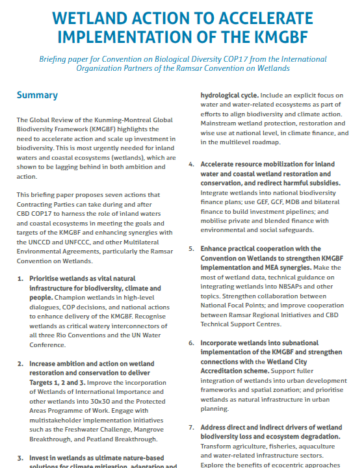
To bridge the gap between global ambition and local reality, the briefing paper puts forward a targeted agenda. The six IOPs propose seven concrete actions that Contracting Parties to the CBD and the Ramsar Convention can enact during and immediately following COP17:
- Integrate Inland Waters into Revised NBSAPs: Governments must explicitly incorporate comprehensive, measurable targets for the conservation, sustainable use, and restoration of inland waters and coastal wetlands within their national biodiversity strategies.
- Align Multilateral Environmental Agreements (MEAs): Enhance institutional synergies between the CBD, the Ramsar Convention, the UNFCCC, and the UNCCD to ensure that national climate action plans (NDCs) and land degradation neutrality (LDN) targets fully account for wetland health.
- Scale Up Dedicated Financing: Redirect domestic budgets and international climate and biodiversity finance toward wetland restoration, moving away from harmful subsidies that incentivize the drainage, over-extraction, and pollution of freshwater systems.
- Strengthen Transboundary Water Governance: Because rivers and lake basins routinely cross international borders, nations must commit to cooperative, ecosystem-based management frameworks to prevent upstream degradation from crippling downstream biodiversity.
- Prioritize Free-Flowing Rivers: Implement policies to protect and restore the natural flow regimes of major river systems, recognizing that structural blockages like dams and poorly planned hydropower projects are primary drivers of freshwater species decline.
- Empower Local and Indigenous Communities: Recognize and legally secure the rights of Indigenous Peoples and local communities who serve as the most effective stewards of wetlands and traditional water management systems.
- Implement Robust Monitoring and Accountability Systems: Establish transparent, science-based indicators to track the ecological health of wetlands, ensuring that national reporting under the KMGBF accurately reflects progress on the ground.
Official Responses and Stakeholder Reactions
While formal negotiations at CBD COP17 remain ongoing, early reactions from delegates, scientific observers, and civil society organizations indicate widespread agreement with the core thesis of the briefing paper.
Representatives from developing nations, particularly within river basins in Africa, Latin America, and Southeast Asia, have echoed the call for enhanced international financial support. Many developing countries argue that while they possess the highest concentrations of freshwater biodiversity and critical wetlands, they lack the economic resources required to implement large-scale restoration projects without external assistance.
International conservation bodies have strongly backed the IOP initiative. In statements released alongside the briefing, environmental policy experts noted that governments have historically treated water as an infinite resource to be exploited rather than an interconnected ecosystem requiring active stewardship. By tying wetland health directly to the success of the Kunming-Montreal Global Biodiversity Framework, the IOPs have effectively shifted water security from a peripheral environmental concern to the very center of global biodiversity diplomacy.
Broader Impact and Implications
The implications of the CBD COP17 discussions on wetlands extend far beyond conservation circles. Water scarcity is intensifying globally due to climate change, population growth, and unsustainable agricultural practices. As aquifers deplete and major river systems face unprecedented stress, the health of natural wetlands becomes directly linked to human survival, food security, and economic stability.
If Contracting Parties heed the recommendations outlined by BirdLife International, IWMI, IUCN, Wetlands International, WWF, and WWT, the second half of the decade could witness a transformative shift in how humanity manages water and land. Conversely, ignoring these warnings risks locking in the collapse of freshwater ecosystems, rendering global biodiversity targets unattainable and severely undermining the resilience of human societies against climate-induced disasters such as floods and droughts.
As COP17 progresses, the onus is squarely on national delegations to move beyond rhetorical commitments, integrate the seven proposed actions into policy frameworks, and recognize that the path to a biodiversity-secure future runs directly through the world’s rivers, lakes, peatlands, and coasts.
