

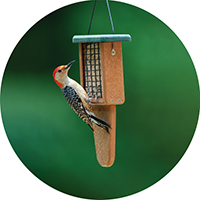
Woodpeckers are truly wonderful. They are some of our most loyal feeder visitors and always bring an entertaining array of activities and excitement to our backyards. But you might also call them wondrous. This is due in no small part to their amazing assortment of adaptations which allow them to live a punishing existence that most other birds would probably think of as a life condemned to hard labor.
The Astonishing Resilience of the Woodpecker: A Masterclass in Biological Engineering
The common perception of woodpeckers as charming backyard visitors, a consistent presence at bird feeders, belies an extraordinary biological resilience that allows them to thrive in an environment of constant, high-impact activity. These birds, renowned for their distinctive drumming and tree-excavating habits, are not merely resilient; they are biological marvels, possessing a suite of specialized adaptations that enable them to withstand forces that would be catastrophic to most other avian species, and indeed, to humans. Their ability to repeatedly strike tree surfaces at high velocities is a testament to millions of years of evolutionary refinement, transforming what would be a life of debilitating injury for any other creature into a daily routine.
Extreme Impacts: A Daily Reality for Woodpeckers
The primary driver of this remarkable toughness is the woodpecker’s unique method of foraging and cavity creation. When excavating a tree, a woodpecker’s head can make contact with the wood at speeds reaching up to 13 miles per hour. The physiological shock of such impacts is immense, registering approximately 10 G-forces. For context, a force of just 3 Gs can cause disorientation and temporary impairment in humans. At 10 Gs, the impact would be sufficient to cause severe brain trauma in most birds. Scientific studies suggest that the human brain is approximately three times more susceptible to concussion than a woodpecker’s brain when subjected to similar speeds. This constant, forceful hammering, equivalent to a human running headfirst into a solid object at full sprint, would be a death sentence for most animals.
Anatomical Ingenuity: The Skull’s Protective Architecture
The survival of woodpeckers through this punishing regimen is attributed to a unique cranial structure that has evolved to absorb and dissipate the immense forces generated by their drumming. Their skulls are characterized by lightweight, spongy bone that is interwoven with a dense meshwork of bony support struts. This intricate design provides exceptional strength while minimizing overall weight. Crucially, a woodpecker’s skull is proportionally small relative to the size of its brain. This anatomical feature significantly reduces the space within the skull, thereby limiting the brain’s ability to move and oscillate during impact. This restricted movement is a key factor in preventing the brain from suffering the kind of damage that would lead to concussions or other neurological injuries in species with larger, more loosely housed brains.
The Self-Sharpening Chisel: A Bill Built for Durability
Beyond the protective cranial architecture, the woodpecker’s bill itself is a marvel of engineering designed to withstand constant abrasion and impact. While the bill does experience wear, specialized cells at its tip are continuously regenerating lost material. This regenerative process ensures that the bill remains strong and resilient, effectively maintaining its chisel-like sharpness. Each strike against a tree not only serves its primary purpose of excavation but also contributes to the bill’s self-sharpening, a continuous cycle of wear and renewal that allows for sustained efficacy in their arduous work.
Advanced Sensory Protection: Nature’s Safety Gear
The frenetic activity of woodpeckers in search of food and shelter generates considerable airborne debris. To mitigate the risks associated with this, woodpeckers have evolved a sophisticated set of protective mechanisms. Tufts of stiff feathers grow around their nostrils, acting as a natural "dust mask" that prevents small wood particles from entering their respiratory system. Furthermore, they possess a unique adaptation in the form of a nictitating membrane, often referred to as a third eyelid. This transparent membrane sweeps across the eye during impacts, shielding the cornea from flying debris and preventing eye injuries, effectively serving as built-in safety goggles.

Attracting These Remarkable Birds to Your Backyard
The captivating resilience and engaging behaviors of woodpeckers make them a highly sought-after addition to any backyard ecosystem. Fortunately, attracting these fascinating birds is achievable with the right provisions. Wild Birds Unlimited (WBU) offers a range of specialized food options designed to appeal to various woodpecker species. These include high-energy suet, no-melt dough formulations that remain palatable in warmer weather, and Bark Butter products, a nutrient-rich spread that mimics the insects woodpeckers seek. Additionally, shelled peanuts, the TreeNutty® Plus Blend, and the specifically formulated Woodpecker Cylinder provide essential fats and proteins that woodpeckers require for their demanding lifestyle.
A Deeper Dive into Woodpecker Wonders: The Nature Centered Podcast
For those seeking to deepen their understanding of these extraordinary birds, the "Nature Centered" podcast, produced by WBU Inc., offers an entire episode dedicated to "Wonderful Woodpeckers." This episode delves into the fascinating biology, behavior, and ecological roles of woodpeckers, providing listeners with expert insights and further appreciation for these resilient creatures. The podcast is accessible via the WBU website, offering an educational resource for bird enthusiasts and nature lovers alike.
WBU Inc.: Fostering Connections Between People and Nature
Wild Birds Unlimited (WBU) stands as the premier franchise system dedicated to backyard bird feeding and nature specialty retail, with over 350 locations across the United States and Canada. The company’s mission is to foster a connection between people and nature by providing high-quality bird feeding products, expert advice, and engaging educational events. Through their extensive network of stores and online resources, WBU empowers individuals to create vibrant, nature-friendly habitats in their own backyards. Their commitment extends to informing the public about the importance of avian conservation and the intricate wonders of the natural world, exemplified by their in-depth explorations of species like the woodpecker. WBU also extends opportunities for aspiring entrepreneurs to join their successful franchise model, contributing to the growth of nature-based businesses.

The Ecological Significance of Woodpeckers
Beyond their captivating presence, woodpeckers play a vital role in their ecosystems. Their excavation activities create cavities that serve as essential nesting sites and shelters for a multitude of other bird species, small mammals, and insects. These abandoned nest holes, often referred to as "woodpecker condos," are a critical resource in many forest environments. By creating these artificial shelters, woodpeckers contribute significantly to biodiversity and the overall health of woodland habitats. Their role as insectivores also helps to control populations of wood-boring insects, thereby protecting trees from significant damage. The constant drumming, while appearing solely as a means of communication or excavation, also serves to signal territory and attract mates, contributing to the intricate social dynamics of avian populations. The durability and specialized adaptations of woodpeckers allow them to exploit an ecological niche that few other species can, making them indispensable components of healthy forest ecosystems. Their existence is a powerful illustration of how extreme environmental pressures can drive the evolution of incredible biological solutions, offering a compelling case study in adaptation and survival.
