
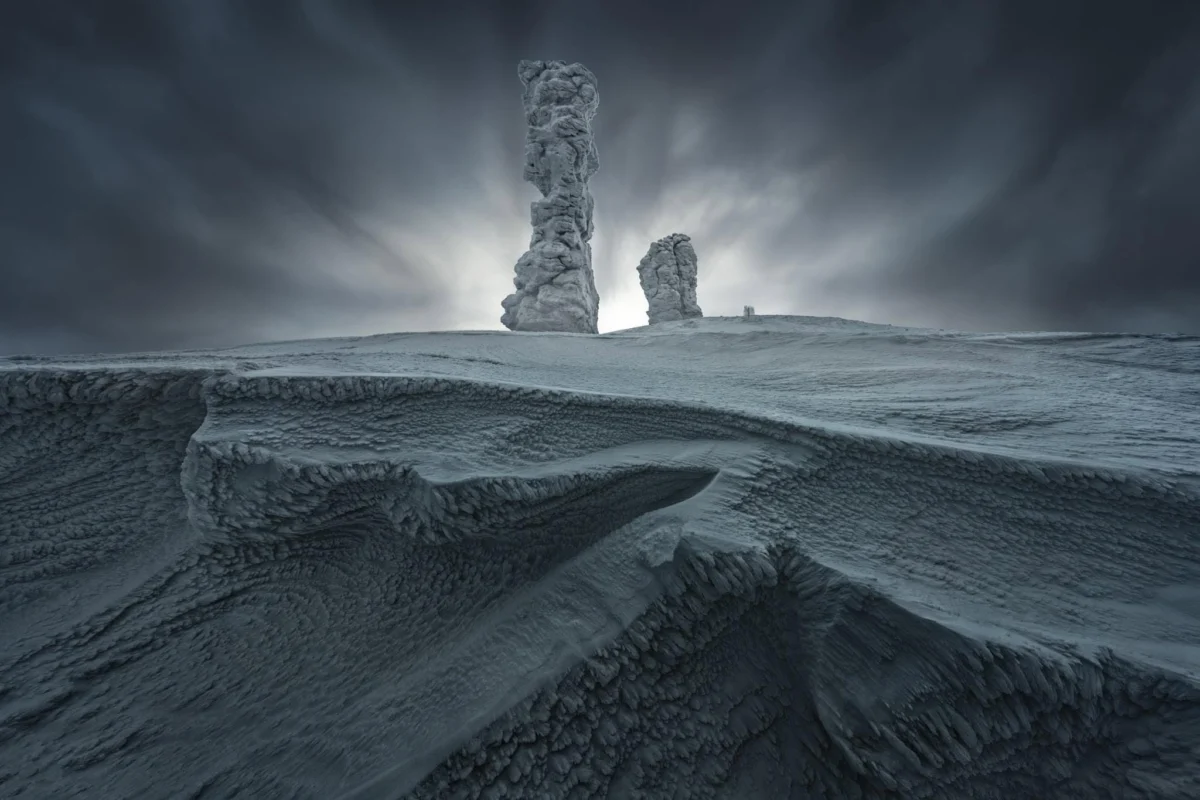
The pursuit of fine-art landscape photography often leads practitioners to well-trodden paths: the dramatic coastlines of Iceland, the rugged peaks of the American Southwest, or the fjords of Norway. Yet, a select group of visual artists continues to seek out environments untouched by commercial tourism and pre-existing aesthetic templates. In February 2022, an Italian photographer embarked on a grueling, multi-stage expedition to the Manpupuner rock formations—a cluster of seven colossal geological monoliths situated deep within the remote Troitsko-Pechorsky District of the Komi Republic in Russia.
The resulting portfolio represents a rare artistic documentation of one of the planet’s most inaccessible sub-Arctic landscapes. By combining a foundational background in classical oil painting and hyperrealistic drawing with modern photographic techniques, the expedition bridges the gap between documentary geography and fine-art expression, offering new insight into how extreme northern environments can be interpreted visually.

The Expedition: A Logistical Odyssey into the Sub-Arctic Taiga
Reaching the Manpupuner plateau, formally known as the Man-Pupu-Nuner (derived from the Mansi language, translating roughly to "Small Mountain of the Gods"), requires navigating some of the most unforgiving terrain in northern Russia. Located within the Pechora-Ilych Nature Reserve, the site has historically seen few visitors due to strict environmental protections and a profound lack of infrastructure.
The journey undertaken in February 2022 exemplifies the sheer difficulty of accessing the region. Departing from Italy, the expedition routed through Moscow before boarding a domestic flight to Syktyvkar, the capital city of the Komi Republic. From Syktyvkar, the traveler journeyed approximately 500 kilometers by automobile through deteriorating road networks toward Troitsko-Pechorsk, pushing further still to the remote settlement of Ust-Unya—a village marking the literal end of the paved road system. Beyond Ust-Unya, travel into the sub-Arctic taiga requires specialized winter transport, such as snowmobiles or tracked vehicles, crossing frozen river systems and trackless wilderness where winter temperatures regularly plunge below -30 degrees Celsius.
Geologically, the Manpupuner monoliths stand between 30 and 42 meters tall. Formed over 200 million years ago, these towering pillars are the remnants of ancient mountain ranges that were gradually eroded by wind, rain, freeze-thaw cycles, and snow over millennia. Because the rock varies in durability, the softer surrounding strata weathered away, leaving behind these surreal, pillar-like structures perched high on a desolate mountain plateau. Despite their geological significance and inclusion on lists of the Seven Wonders of Russia, the site remains largely absent from international fine-art photography due to the extreme hazards of winter access and strict ecological permits required to enter the protected nature reserve.

Artistic Roots: From Classical Oils to Hyperrealism and Digital Landscapes
The visual approach brought to the Manpupuner plateau is deeply rooted in a non-traditional artistic evolution. Unlike many contemporary landscape photographers who begin their careers purely through technical camera operations, this body of work stems from a lifelong immersion in visual arts.
Beginning with oil painting at the age of seven, the artist later spent eight formative years dedicated to hyperrealistic drawing during adolescence. This intense discipline ingrained an obsessive focus on detail, light mechanics, and spatial depth. When the transition to photography occurred later in life—initially as a casual tool to document international travel—this painterly foundation remained intact. Shadows were not merely dark areas, but structural elements of the composition; contrasts operated as the architecture of the frame.
Over subsequent years, this aesthetic evolved through various artistic movements. Influences ranged from the minimalist compositions of modern visual arts to the sweeping, imaginative vistas found in Japanese animation, particularly the works of Hayao Miyazaki and visits to the Ghibli Museum. Later exposure to advanced color theory—studying luminance, saturation, and the complex interplay of color frequencies—transformed the photographer’s workflow. Rather than relying on simple snapshot documentation, every frame is conceptualized through a rigorous pre-visualization process, imagining the final color palette and tonal range before the shutter is even released.

Field Conditions: Embracing Chaos and Improvisation on the Plateau
Arriving at the Manpupuner plateau during the dead of winter offered no guarantees of predictable weather or classic golden-hour lighting. The reality of sub-Arctic field work demanded complete flexibility and an abandonment of rigid shooting schedules.
During the first day on location, the expedition was met by a severe windstorm. The resulting atmospheric conditions produced a flat, milky light devoid of traditional shadows or sharp contrasts. Rather than viewing this as a disadvantage, the photographer utilized the extreme weather to capture the raw essence of the taiga. High-velocity winds had coated every branch and surface in thick layers of rime frost and wind-packed ice, transforming the surrounding forest into natural sculptures. The silhouettes of the ancient stone monoliths barely pierced the swirling fog, creating an ethereal sense of ambiguity.
Amidst the howling wind and biting cold, a profound sense of calm settled over the creator. Free from technical preoccupations, the experience yielded moments of deep emotional resonance. Among the most indelible memories of the expedition was observing a local forest ranger approach the most isolated stone pillar and quietly begin to pray—a silent, powerful testament to the spiritual gravity that the indigenous Mansi people and local inhabitants have long attributed to the sacred site.

The following morning brought a dramatic meteorological shift. Dawn broke over the plateau with an explosion of vibrant, unearthly colors, painting the snowfields and sky in deep hues of orange, magenta, and fiery red. Recognizing the limitations of wide-angle lenses in conveying the vast scale of the landscape, the photographer integrated drone technology to capture aerial perspectives. These overhead shots revealed the true isolation of the seven geological giants standing as lonely sentinels amid a boundless, white desert. In the span of just forty-eight hours, the expedition experienced a microcosm of sub-Arctic meteorological extremes: blinding sun, ferocious windstorms, dense fog, and flat overcast light.
Post-Production Philosophy: Recreating the Truth of Human Perception
The technical execution of winter landscape photography presents unique digital challenges. Snowfields under extreme sub-zero lighting conditions frequently push camera sensors to record unwanted purple and magenta color casts, distorting the pristine white tones perceived by the human eye.
The post-production phase of the Manpupuner project was dedicated to neutralizing these color shifts through meticulous calibration. Working primarily with desaturated blues, darkened midtones, and subtle green accents, the photographer sought to reconstruct the authentic color palette witnessed in the field. Rather than applying global filters that compromise image integrity, the workflow utilized luminosity masks—a precise digital editing technique that allows targeted adjustments to specific tonal ranges without altering neighboring pixels.

This surgical approach ensures that the final images maintain a clean, natural aesthetic while honoring the original lighting conditions captured on location. The overarching objective is not to manufacture a fictional reality, but to evoke the emotional truth of the landscape: portraying the scene as it felt in its most transcendent moments.
Implications and Broader Impact on Nature Photography
The successful documentation of the Manpupuner monoliths in winter carries significant implications for the genre of remote nature and adventure photography. As popular natural landmarks around the globe suffer from over-saturation and repetitive digital tourism, artists are increasingly challenged to venture beyond established travel corridors to find virgin visual territory.
Furthermore, the project highlights the vital intersection between environmental conservation and artistic exploration. Operating within the Pechora-Ilych Nature Reserve requires strict adherence to ecological protocols, ensuring that human presence leaves no permanent trace on fragile sub-Arctic ecosystems. By bringing global attention to one of Russia’s most hidden geological treasures through high-end fine art, the work underscores the fragile beauty of remote wilderness areas facing changing global climates.

Ultimately, the expedition to Ust-Unya and the windswept plains of Manpupuner transcended technical achievement. It served as a meditative exercise in patience, resilience, and visual humility—a reminder that the most profound artistic breakthroughs occur not when a photographer imposes their will upon a landscape, but when they learn to observe the natural world without haste.
