
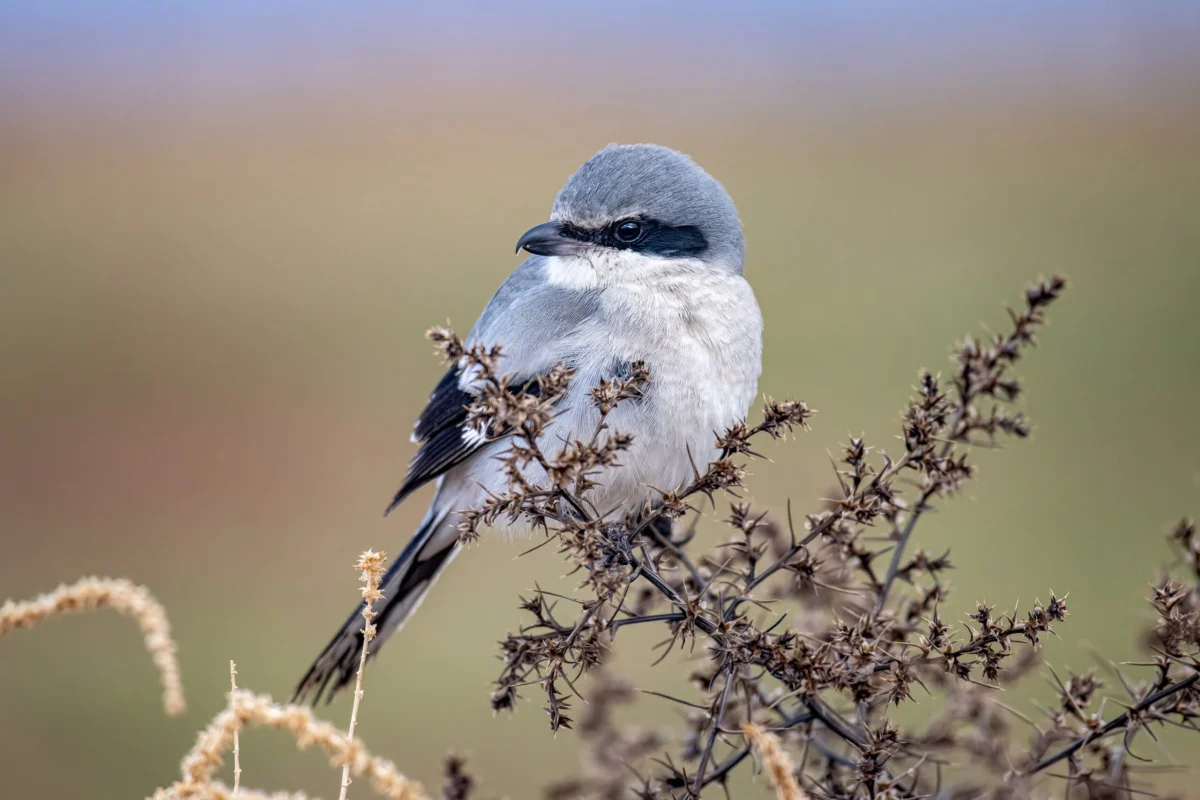
Dapperly dressed in a minimalist palette of charcoal, slate, and snow-white, the Northern Shrike (Lanius borealis) bears the outward appearance of an unassuming songbird. However, beneath this refined exterior lies the temperament of a lethal predator. While most of their avian peers spend their days foraging for seeds, nectar, or small insects, the Northern Shrike has evolved into a formidable carnivore. Often referred to by ornithologists and birders alike as the "butcher bird," this species occupies a unique ecological niche, bridging the gap between delicate songbirds and the fierce, hooked-beak raptors that dominate the sky.
An Evolutionary Anomaly
The Northern Shrike is a true passerine—a perching bird—yet its biology and behavioral patterns defy the traditional constraints of its order. While raptors such as hawks and eagles possess the muscular talons necessary to grapple and kill prey, the shrike is equipped with relatively weak, delicate feet. To compensate for this anatomical disadvantage, the shrike has developed specialized weaponry on its face. It features a prominent "tomial tooth," a sharp, triangular projection on the upper mandible that corresponds to a notch on the lower. This biological tool allows the bird to deliver a precision bite to the spinal cord of its prey, inducing paralysis instantly.
This predatory adaptation is reinforced by a neck musculature that allows for violent, rapid movements. Once prey is secured, the shrike will often shake its head at forces reaching up to six g-forces, a physical feat comparable to the intensity of a high-speed rollercoaster, ensuring the prey’s neck is fully fractured before the bird begins to consume its meal.
Geographic Range and Seasonal Migration
The life cycle of the Northern Shrike is defined by its movement between the extremes of the North American wilderness. During the breeding season, these birds are masters of the boreal forests that span across northern Canada and Alaska. This vast, rugged terrain provides the necessary isolation and high-density insect populations required to raise a brood.
As winter approaches and the subarctic temperatures become untenable, the shrike initiates a southward migration. They typically relocate to southern Canada and the northern regions of the contiguous United States. Unlike their close relative, the Loggerhead Shrike, which maintains a year-round presence in the southern United States, the Northern Shrike is a strictly seasonal visitor to more temperate latitudes. For birders, the arrival of a Northern Shrike is a significant event; the bird is often spotted perched motionless at the very tops of trees or on fence lines, scanning the landscape with the patience of a seasoned hunter.
The Macabre Practice of Impalement
Perhaps the most distinctive trait of the shrike—and the origin of its grim nickname—is its habit of impaling prey on thorns, jagged branches, or even barbed wire. This behavior is not merely a display of morbid curiosity, but a functional necessity. Because the bird lacks the talons to hold a carcass in place while it feeds, the environment serves as a makeshift "butcher’s block."
Ecological studies suggest that this behavior serves multiple purposes beyond immediate sustenance. By pinning prey to thorns, the shrike creates a cache of food that can be stored for future consumption, particularly during the lean months of winter when prey density decreases. Furthermore, researchers have noted that these larders may function as territorial signals, with well-stocked branches serving as advertisements of a male’s health and hunting prowess to potential mates.
Digestive Efficiency and Pellet Formation
The Northern Shrike’s digestive system is another point of scientific interest. Lacking a crop—the food-storage pouch common in many other bird species—and possessing a relatively small gizzard, the shrike is unable to process all the materials it consumes. Consequently, they regurgitate pellets composed of indigestible bone, fur, feathers, and insect exoskeletons.
While this process is frequently associated with owls, it is a common, if under-reported, biological necessity for many predatory birds, including herons and gulls. For the shrike, which occasionally swallows the heads of its prey whole, the egestion of these pellets is a vital daily function that prevents gastrointestinal blockage.
Hydration and Metabolic Strategies
A remarkable physiological aspect of the Northern Shrike is its independence from standing water. Much like many raptors, the shrike extracts the entirety of its necessary hydration from the tissues of its prey. This evolutionary adaptation allows the species to thrive in climates where water sources may be frozen or otherwise inaccessible for long stretches of time. While they have been observed drinking water in captive settings, wild specimens are rarely seen at water sources, save for the occasional bath.
Behavioral Development and Social Dynamics
The predatory instincts of the Northern Shrike are not merely innate; they are refined through complex social play. Much like the predatory behaviors seen in mammalian carnivores like lions or seals, shrike nestlings engage in mock combat. They launch aerial strikes against inanimate objects such as leaves, flowers, and feathers, and chase one another in high-energy games that simulate the demands of the hunt.
Even as juveniles, these birds display a surprising level of fearlessness. Observers have documented young shrikes harassing animals of significantly larger proportions, including caribou and moose, as they test the limits of their boundaries. This aggressive demeanor persists into adulthood. Northern Shrikes are notoriously solitary and fiercely territorial. They have been recorded aggressively defending their nesting sites against intruders far larger than themselves, including Rough-legged Hawks, Golden Eagles, and Great Gray Owls.
The Auditory Lure
Beyond their physical hunting methods, Northern Shrikes are also adept vocal mimics. Both males and females possess a complex song repertoire that shifts from melodic warbles to harsh, mechanical screeches and buzzing tones. During the spring, they frequently integrate the calls of neighboring species into their own songs.
Historical accounts from the 15th century, such as those found in the Book of Saint Albans, suggest that this mimicry might be a deliberate lure designed to draw curious or unsuspecting songbirds into range. While this remains a subject of ongoing ornithological debate, the "butcher bird" has been recognized for centuries as a deceptive and highly successful avian predator.
Implications of the "Masked" Hunter
The distinctive black band across the eyes of the Northern Shrike—which gives the bird the appearance of a masked bandit—serves a dual purpose. Beyond providing the bird with a tactical advantage through the element of surprise, the mask functions as an anti-glare device. By absorbing sunlight, the dark feathers allow the bird to keep its focus on its surroundings even when scanning the horizon while facing directly into the sun.
This physiological feature has drawn comparisons to the eye-black used by professional athletes to improve visual clarity under stadium lights. By positioning itself on an exposed perch and facing away from its own shadow, the shrike maximizes its visibility while remaining nearly invisible to its target.
A Complex Ecological Role
The presence of the Northern Shrike within an ecosystem serves as a barometer of environmental health. As top-tier avian predators, they play a crucial role in controlling populations of small mammals and insects. However, their future, like that of many boreal-dependent species, remains tied to the stability of their northern habitats.
As climate change continues to impact the boreal forests of North America, the shift in seasonal temperatures and the resulting alteration in prey availability could influence the migratory patterns and breeding success of these birds. Conservationists continue to monitor the species, noting that the Northern Shrike’s ability to adapt to human-altered landscapes—such as using barbed wire fences for prey storage—demonstrates a level of behavioral flexibility that may assist in their survival.
Ultimately, the Northern Shrike is a testament to the diversity of avian evolution. By balancing the delicate, complex songs of a passerine with the brutal, efficient hunting strategies of a raptor, the species maintains a singular position in the natural world. Far from being a simple songbird, the "butcher bird" remains a fascinating subject of study, representing the relentless, often uncompromising nature of survival in the wild. Whether it is the precision of its strike, the complexity of its social bonds, or the grim efficiency of its larders, the Northern Shrike continues to captivate those who witness its life in the field, reminding us that nature’s most effective predators often arrive in the most unassuming of packages.
