

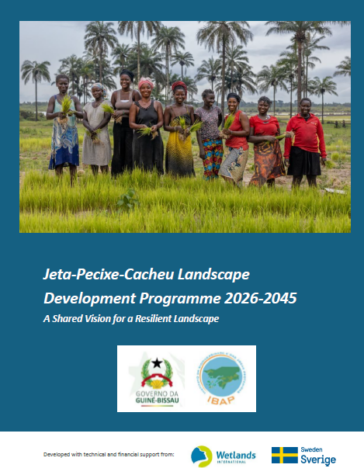
Guinea-Bissau has taken a monumental step toward safeguarding its ecological and socio-economic future by officially signing the Jeta-Pecixe-Cacheu (JPC) Landscape Development Programme 2026–2045. This ambitious 20-year roadmap, backed by Wetlands International, represents a binding institutional commitment to harmonizing environmental preservation with sustainable development across nearly half a million hectares of vital West African ecosystems.
The formal signing ceremony brought together key regional and national stakeholders, solidifying a unified governance structure for the region. Ms. Aïssa Régala de Barros, Director-General of the Institute for Biodiversity and Protected Areas (IBAP), and Ms. Honorina Vasconcelos, Governor of the Cacheu region, put pen to paper alongside Mr. Ibrahima Thiam, Executive Director of Wetlands International West Africa. This high-level coalition underscores a growing recognition that protecting complex, interconnected ecosystems requires transcending administrative boundaries and shifting away from fragmented, short-term project cycles.

Main Facts and Geographic Scope of the JPC Landscape
Spanning an impressive 446,731 hectares, the Jeta-Pecixe-Cacheu landscape is a cornerstone of Guinea-Bissau’s natural and cultural heritage. The region is home to approximately 245,000 residents whose daily livelihoods are deeply intertwined with the health of the local environment. Dominated by expansive mangrove forests, intricate estuarine networks, terrestrial woodlands, and vital wetlands, the JPC landscape serves as a multi-functional ecosystem.
Beyond supporting local fisheries, agriculture, and forestry, the area acts as a crucial buffer against the escalating impacts of climate change, mitigating storm surges and preventing coastal erosion. Furthermore, the landscape harbors exceptional biodiversity of global significance. It provides a sanctuary for numerous migratory waterbirds, the endangered West African manatee (Trichechus senegalensis), and the vulnerable Atlantic humpback dolphin (Sousa teuszii).
Despite its ecological richness, the JPC landscape faces a compounding array of contemporary pressures. Unsustainable resource extraction, shifting land-use patterns, accelerating infrastructure development, and the worsening impacts of climate variability threaten the long-term viability of both the natural habitats and the communities that rely upon them. Historically, conservation efforts in the region have been hindered by isolated planning, uneven institutional capacities, and a heavy reliance on short-term funding streams. The newly enacted 20-year programme is specifically designed to dismantle these silos, establishing a permanent, coordinated framework for action.

Chronology and Development of the Initiative
The inception of the Jeta-Pecixe-Cacheu Landscape Development Programme is the culmination of years of collaborative groundwork, stakeholder dialogue, and strategic institution-building.
- Foundational Phase under the W4R Initiative: The programme was developed as a core component of the Wetlands for Resilience (W4R) initiative, a broader regional effort supported by the Swedish International Development Cooperation Agency (Sida). W4R focuses on reinforcing the resilience of vulnerable wetland ecosystems and local communities across West Africa.
- Inclusive Stakeholder Engagement: Rather than being imposed from the top down, the 20-year framework emerged from a broad, highly participatory process spearheaded by the JPC Landscape Stakeholder Platform. This coalition brought together public institutions, grassroots community organizations, civil society groups, academic researchers, and international development partners to co-design the vision.
- October 2, 2026 – Cross-Border Momentum: Momentum for regional conservation accelerated dramatically when Guinea-Bissau’s Minister for the Environment and Climate Action joined Senegal’s Minister for the Environment and Ecological Transition to sign a bilateral cross-border cooperation agreement. This pact specifically targets the integrated management of the Cacheu-Basse-Casamance cross-border coastal zone, paving the way for a joint transboundary biosphere reserve.
- October 12, 2026 – Institutional Ratification: The formal signing of the Jeta-Pecixe-Cacheu Landscape Development Programme 2026–2045 by IBAP and Cacheu regional authorities cemented the governance structure required to operationalize the 20-year vision domestically, directly aligning with ongoing efforts to secure official UNESCO Biosphere Reserve designation for the JPC territory.
Five Pillars of the Strategic Framework
To achieve its overarching goal of balancing ecological health with community wellbeing, the JPC Landscape Development Programme is structured around five strategic priority areas:
- Governance: Strengthening institutional coordination, empowering local governance structures, and ensuring that policies are implemented cohesively across municipal, regional, and national levels.
- Communication and Environmental Education: Raising local and national awareness regarding the intrinsic value of wetlands and mangroves, fostering a culture of environmental stewardship among younger generations.
- Conservation and Restoration: Actively protecting vulnerable habitats while initiating targeted ecological restoration projects to rehabilitate degraded mangrove stands and depleted fisheries.
- Sustainable Livelihoods: Promoting green economies, climate-resilient agriculture, and sustainable fishing practices that improve household incomes without depleting the natural resource base.
- Financing: Diversifying and securing long-term funding streams, moving away from project-to-project volatility by attracting sustained investments from international donors, climate funds, and private-public partnerships.
Official Statements and Stakeholder Perspectives
The signing ceremony elicited strong statements from key leaders, emphasizing the collaborative ethos driving the initiative.

Reflecting on the necessity of unity, Ms. Aïssa Régala de Barros, Director-General of IBAP, noted: "The future of the Jeta-Pecixe-Cacheu landscape depends on our ability to work together beyond administrative boundaries and individual projects. This 20-year programme provides a common vision to coordinate our efforts, strengthen the sustainable management of natural resources and place local communities at the heart of conservation. It is an important step towards ensuring that our ecosystems and the people who depend on them can thrive together."
Echoing this sentiment, Mr. Ibrahima Thiam, Executive Director of Wetlands International West Africa, emphasized the transition from planning to implementation, while issuing a call to action for the international donor community: "Through the JPC Landscape Stakeholders’ Platform, partners are now committed to turn this shared vision into coordinated action for healthy ecosystems, resilient communities and a natural and cultural heritage stewarded for generations to come. With a clear programme and shared priorities in place, we invite donors and development partners to invest in this joint effort and help unlock the resources needed to deliver meaningful, lasting results across the landscape."
Broader Impact, Regional Implications, and Future Outlook
The ratification of the JPC Landscape Development Programme carries significant implications for both Guinea-Bissau and the wider West African coastal region. By establishing a predictable, 20-year framework, the country demonstrates a mature, long-term approach to environmental governance that is increasingly attractive to international climate and biodiversity funds.
Furthermore, the domestic framework dovetails seamlessly with international conservation milestones. Most notably, the programme acts as a vital stepping stone toward achieving official UNESCO Biosphere Reserve status for the Jeta-Pecixe-Cacheu landscape. When viewed in tandem with the newly signed Senegal-Guinea-Bissau cross-border cooperation agreement for the Cacheu-Basse-Casamance zone, the JPC programme contributes to a much larger geopolitical mosaic of connected, transboundary conservation areas.
As climate change continues to intensify pressures on West Africa’s coastal zones—manifested through rising sea levels, shifting precipitation patterns, and marine resource degradation—locally rooted, long-term initiatives like the JPC programme offer a viable blueprint for survival and adaptation. By placing local communities at the center of resource management and aligning regional institutions behind a shared 20-year horizon, Guinea-Bissau is actively forging a sustainable path where biodiversity conservation and human prosperity advance hand in hand.
