
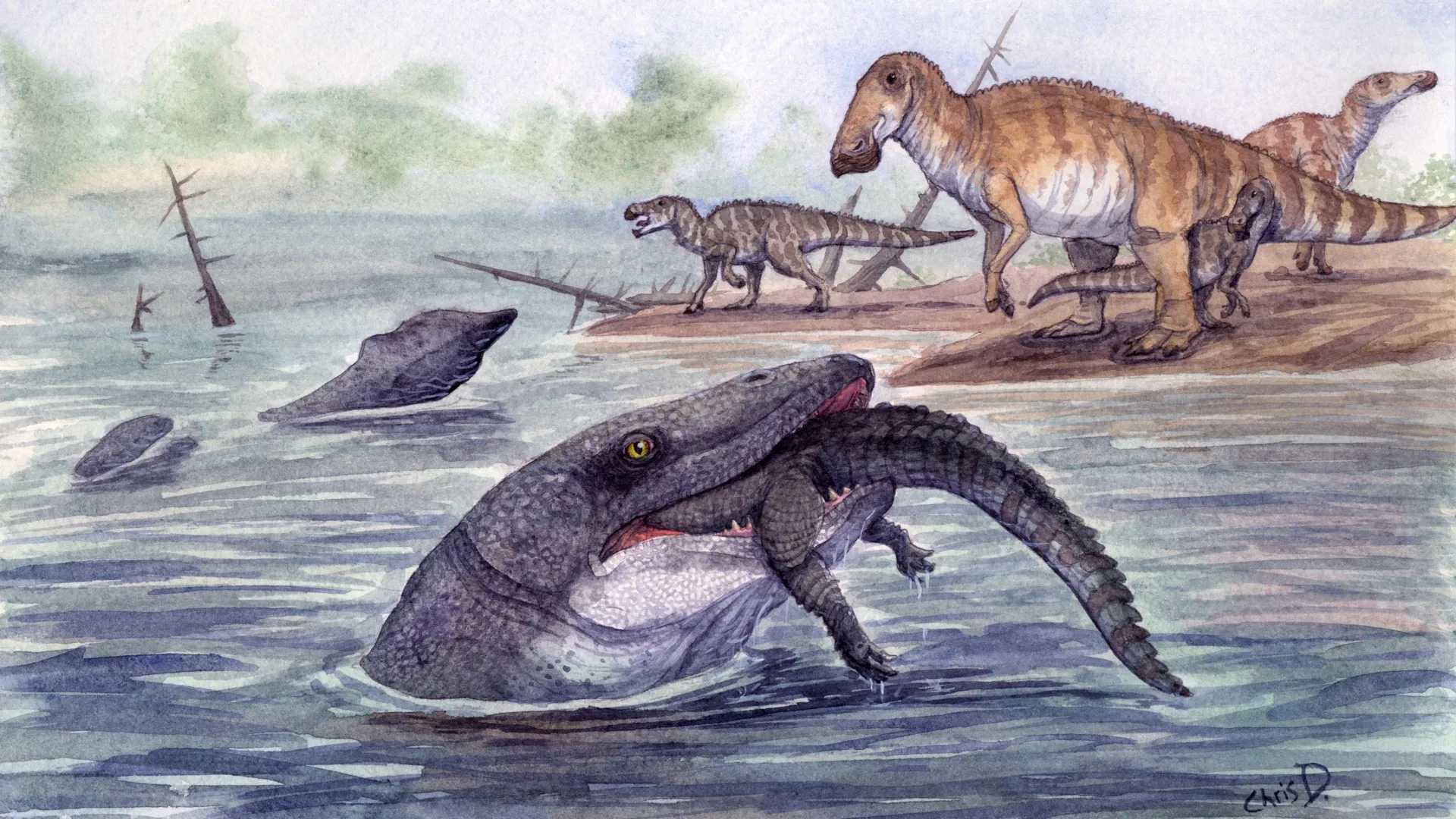
Mosasaurs, the colossal marine reptiles that dominated ancient oceans more than 66 million years ago, were not exclusively creatures of the deep blue, according to groundbreaking new evidence. Researchers analyzing a mosasaur tooth unearthed in North Dakota have uncovered compelling signs that some of these formidable predators ventured into, and even thrived within, freshwater river systems during the final epoch of the Cretaceous period. The tooth, belonging to an individual estimated to be up to 11 meters long – roughly the size of a modern city bus – suggests a remarkable degree of adaptability in these apex predators. This international research, spearheaded by scientists at Uppsala University, fundamentally redefines our understanding of mosasaur ecology and the dynamic paleoenvironments of Late Cretaceous North America, indicating that these giant reptiles successfully colonized freshwater habitats in the critical million years leading up to their extinction.
The startling discovery began in 2022 when the mosasaur tooth was unearthed from a river deposit in North Dakota. This particular locale, situated within the famed Hell Creek Formation, is renowned for its rich fossil record, including specimens of the iconic Tyrannosaurus rex and the duck-billed dinosaur Edmontosaurus. What made this find particularly extraordinary was the unusual assemblage of fossils discovered alongside the mosasaur tooth: a tooth from a Tyrannosaurus rex and a jawbone from a crocodylian. The co-occurrence of terrestrial dinosaurs, known river-dwelling crocodiles, and a supposed giant marine reptile immediately presented a profound paleontological puzzle. If mosasaurs were exclusively ocean-dwelling animals, as conventionally understood, how did one of their teeth come to be preserved in a riverine setting, amidst creatures characteristic of terrestrial and freshwater ecosystems? This unprecedented mix ignited a scientific investigation aimed at unraveling the mystery of the mosasaur’s unexpected presence.
Unlocking Ancient Secrets: The Power of Isotope Analysis
To decipher the enigma presented by the North Dakota mosasaur tooth, an international team of researchers from the United States, Sweden, and the Netherlands turned to the sophisticated technique of isotope analysis. This method involves examining the chemical makeup of biological tissues, specifically the enamel of the mosasaur tooth, to gain insights into the animal’s ancient environment and diet. Isotopes are atoms of the same element that possess different numbers of neutrons, resulting in slight variations in their atomic mass. Stable isotopes, which do not undergo radioactive decay, are incorporated into an organism’s tissues from the water it drinks and the food it consumes. By analyzing the ratios of these stable isotopes, scientists can reconstruct an organism’s past ecological niche with remarkable precision.
Given that the mosasaur tooth, the T. rex tooth, and the crocodylian jawbone were all dated to approximately 66 million years ago – the very end of the Cretaceous period, just before the cataclysmic K-Pg extinction event – the scientists were able to conduct direct chemical comparisons between these co-occurring fossils. The intricate analytical work was primarily carried out at the Vrije Universiteit (VU) in Amsterdam, focusing on the stable isotopes of oxygen (¹⁸O and ¹⁶O), strontium (⁸⁷Sr and ⁸⁶Sr), and carbon (¹³C and ¹²C). Each of these isotopic systems provides unique and complementary information about an animal’s habitat and dietary habits. The meticulous examination of these atomic signatures proved instrumental in revealing the mosasaur’s surprising freshwater adaptation.
A Chemical Blueprint of Freshwater Life
The results of the isotope analysis were unequivocal and highly compelling. The mosasaur tooth contained unusually high levels of the lighter oxygen isotope (¹⁶O). In natural environments, the ratio of ¹⁸O to ¹⁶O varies predictably: freshwater bodies, due to preferential evaporation and precipitation processes, tend to be enriched in ¹⁶O compared to marine environments, which are typically richer in the heavier ¹⁸O. The pronounced ¹⁶O enrichment in the mosasaur tooth enamel was a strong geochemical indicator of a prolonged presence in a freshwater environment, a stark contrast to the isotopic signatures expected from an exclusively marine creature. This finding alone presented a significant challenge to the long-held assumption of mosasaur marine exclusivity.
Further corroboration came from the strontium isotope ratios. The ratio of ⁸⁷Sr to ⁸⁶Sr in water varies significantly depending on the geological composition of the rocks through which the water has flowed. Marine strontium isotope ratios are globally homogenous due to the extensive mixing of ocean waters, whereas freshwater systems, particularly rivers, exhibit much more variable ratios influenced by local geology and continental runoff. The strontium isotope ratios in the mosasaur tooth provided a distinct signature consistent with a freshwater habitat, diverging from typical marine strontium values. This dual isotopic evidence from oxygen and strontium painted a clear picture of the mosasaur’s environmental preference.
Melanie During, one of the study’s corresponding authors, elaborated on the fascinating insights derived from carbon isotopes: "Carbon isotopes in teeth generally reflect what the animal ate. Many mosasaurs have low ¹³C values because they dive deep into the ocean, where the carbon isotopic signature of prey differs. The mosasaur tooth found with the T. rex tooth, on the other hand, has a higher ¹³C value than all known mosasaurs, dinosaurs, and crocodiles previously analyzed. This higher ¹³C value is particularly significant because it suggests that this individual did not dive deep into marine waters but rather inhabited shallower environments. Moreover, it strongly implies a different dietary intake, potentially even suggesting that it may sometimes have fed on drowned dinosaurs or other terrestrial prey that had fallen into the river system. This distinct carbon signature further solidifies the argument for a non-marine, surface-feeding lifestyle."
During further emphasized the broader implications of these findings: "The isotope signatures definitively indicated that this mosasaur had inhabited this freshwater riverine environment. To ensure this wasn’t an isolated anomaly, we expanded our investigation to include two additional mosasaur teeth discovered at nearby, slightly older, sites also within North Dakota. Remarkably, these additional analyses yielded similar freshwater isotopic signatures. These consistent results across multiple specimens from different sites strongly demonstrate that mosasaurs were not just occasional visitors but genuinely lived in riverine environments in the final million years before their ultimate extinction." This sustained presence suggests a more profound ecological shift than a mere temporary excursion.
When Seas Slowly Turned Into Rivers: The Western Interior Seaway
The findings also provide crucial context for understanding how such a dramatic lifestyle shift became ecologically possible. The Late Cretaceous period in North America was characterized by the presence of the Western Interior Seaway (WIS), a vast, shallow inland sea that bisected the continent from the Arctic to the Gulf of Mexico. For millions of years, this epicontinental sea was a dominant feature, supporting a rich and diverse marine ecosystem, including countless mosasaurs. However, towards the very end of the Cretaceous, profound geological and climatic changes began to transform this immense body of water.
Increasing amounts of freshwater, derived from continental runoff and intensified precipitation, flowed into the Western Interior Seaway. This influx was exacerbated by the ongoing Laramide Orogeny, a period of intense mountain building that uplifted the Rocky Mountains, increasing erosion and directing vast quantities of freshwater into the seaway. As this freshwater input grew, the salinity of the seaway gradually decreased. It transitioned from fully marine to brackish (a mix of fresh and saltwater) and eventually, in certain regions and at certain depths, to conditions that were predominantly freshwater. This process created environmental gradients similar to those seen today in modern estuaries and semi-enclosed seas.
The researchers suggest that this extensive freshwater input led to the formation of a pronounced ‘halocline’ within the Western Interior Seaway. A halocline is a strong vertical gradient in salinity within a body of water, where lighter, less dense freshwater forms a surface layer above denser, more saline saltwater. The isotopic data gathered from other marine animals found alongside the mosasaur tooth strongly supports this idea of a stratified water column.
Per Ahlberg, a coauthor of the study and Dr. During’s doctoral supervisor, elaborated on this critical distinction: "For comparison with the mosasaur teeth, we also measured fossils from other marine animals – specifically, those that breathed through gills, such as fish and ammonites. We found a clear difference in their isotopic signatures. All gill-breathing animals had isotope signatures linking them to brackish or salty water, consistent with their dependence on the lower, more saline layers. In stark contrast, all lung-breathing animals, including the mosasaur, lacked such signatures, instead showing freshwater indicators. This differential isotopic patterning is crucial: it shows that mosasaurs, which needed to come to the surface to breathe air, inhabited the upper freshwater layer of the seaway, effectively exploiting a distinct ecological niche, while the lower layers remained more saline and were populated by marine invertebrates and fish." This stratification allowed for the coexistence of freshwater-adapted lung-breathers and saltwater-dependent gill-breathers within the same overall geographic area.
Adapting to a Changing World: Evolutionary Flexibility
The researchers contend that the teeth studied unequivocally belonged to mosasaurs that had not merely passed through but had genuinely adjusted to these new, lower-salinity conditions. The phenomenon of large predators shifting between different habitats is not unprecedented in the grand tapestry of evolutionary history, underscoring the remarkable adaptability of life.
During highlighted a key evolutionary principle: "Unlike the complex physiological and morphological adaptations required to transition from freshwater to fully marine habitats, the reverse adaptation – from marine to freshwater – is generally considered simpler from an evolutionary standpoint. Marine animals often possess osmoregulatory mechanisms to cope with high salinity, which can be ‘dialed back’ or modified to handle lower salinity, whereas freshwater organisms face the constant challenge of preventing water from flooding their cells, a more fundamental physiological hurdle when moving to saltwater." This inherent physiological flexibility likely facilitated the mosasaurs’ colonization of freshwater systems.
Modern animals offer compelling parallels to this ancient flexibility, demonstrating the enduring power of natural selection to drive such transitions. River dolphins, for instance, are cetaceans whose ancestors were undoubtedly marine, yet they have evolved to live entirely within freshwater river systems, such as the Amazon, Ganges, and Yangtze. These highly specialized mammals exhibit adaptations to their specific riverine environments, including reduced eyesight (due to murky waters), longer beaks, and more flexible necks. Similarly, the estuarine crocodile (Crocodylus porosus), famously known in Australia as the saltwater crocodile, exemplifies a predator that regularly moves between freshwater rivers, estuaries, and the open ocean, hunting wherever prey is most abundant. These crocodiles possess specialized salt glands and kidney functions that enable them to osmoregulate effectively in a wide range of salinities, highlighting a physiological versatility that may have been mirrored, to some extent, in the mosasaurs.
A Bus-Sized Predator in Unexpected Places
Mosasaur fossils are common and globally distributed, found in marine deposits across North America, Europe, Africa, and beyond, dating from approximately 98 to 66 million years ago. Their abundance in marine sediments has historically cemented their image as quintessential ocean predators. In stark contrast, discoveries of mosasaur fossils in North Dakota, particularly in non-marine contexts, are exceedingly rare, making this particular find especially striking and significant.
The sheer size of the mosasaur tooth recovered in North Dakota suggests it belonged to an enormous individual, estimated to have been up to 11 meters (approximately 36 feet) long. This colossal size is roughly equivalent to the length of a modern city bus or a large killer whale (Orcinus orca). Earlier discoveries of mosasaur bone fragments at a nearby site in North Dakota further support this estimate of a truly gigantic river-dwelling predator. While the exact genus of this specific mosasaur cannot be definitively identified from a single tooth, its morphology strongly suggests it belonged to a prognathodontine mosasaur. Close relatives within the genus Prognathodon are known for their massive, robust heads, incredibly powerful jaws, and exceptionally strong, conical teeth, which were well-suited for crushing shells and bones. They are thought to have been opportunistic predators, capable of attacking and consuming a wide variety of large prey.
Ahlberg underscored the sheer impressiveness of such a creature in a freshwater setting: "The size of this mosasaur means that the animal would rival the largest killer whales in terms of length and likely predatory prowess. Encountering such an extraordinary predator in riverine environments, which were not previously associated with giant marine reptiles of this caliber, truly reconfigures our understanding of Late Cretaceous ecosystems. It paints a picture of a dynamic and dangerous freshwater world, quite unlike what we had imagined." The presence of such a formidable apex predator in freshwater would have had significant implications for the food web and ecological dynamics of these river systems, potentially preying on large fish, crocodiles, and even terrestrial dinosaurs that ventured too close to the water’s edge.
Broader Implications for Paleontology and Evolutionary Biology
This discovery carries profound implications for several fields within paleontology and evolutionary biology. Firstly, it fundamentally alters the prevailing paradigm of mosasaur ecology, expanding their known environmental range beyond purely marine habitats. This challenges scientists to reconsider previous interpretations of mosasaur fossil distribution and to scrutinize other "out-of-place" finds with fresh eyes.
Secondly, the adaptation of mosasaurs to freshwater environments during the final million years before the K-Pg extinction event offers new avenues for understanding the pressures and responses of life during this tumultuous period. Was this an opportunistic expansion into an unexploited niche, driven by the changing conditions of the Western Interior Seaway, or a last-ditch effort for survival as marine environments globally faced increasing stress? It suggests a remarkable evolutionary resilience even in the face of profound environmental shifts that ultimately culminated in one of Earth’s largest mass extinctions.
Thirdly, this research provides a more nuanced understanding of Late Cretaceous paleoenvironments. The Western Interior Seaway was not a monolithic body of saltwater but a dynamic system with complex salinity gradients, supporting distinct ecological communities. This highlights the importance of detailed geochemical analysis in reconstructing ancient ecosystems with greater fidelity. The co-occurrence of marine-derived mosasaurs with freshwater crocodiles and terrestrial dinosaurs in the Hell Creek Formation paints a picture of a highly interconnected and fluid landscape where marine, brackish, and freshwater environments seamlessly blended.
Finally, the study reinforces the principle of evolutionary adaptability. The ability of a dominant marine predator to transition to and thrive in freshwater environments underscores the remarkable capacity of life to respond to environmental change. It encourages a broader perspective when studying extinct animals, moving beyond simplistic categorization to embrace the full spectrum of their potential ecological roles. Future research might explore whether this freshwater adaptation was widespread among other mosasaur lineages, how long these freshwater populations persisted, and what specific physiological mechanisms allowed them to thrive outside the ocean.
This pioneering research was a collaborative effort, carried out by scientists from Uppsala University in conjunction with Eastern West Virginia Community and Technical College, Moorefield, West Virginia, Vrije Universiteit Amsterdam, and the North Dakota Geological Survey. The groundbreaking article draws directly on a pivotal chapter from Melanie During’s doctoral thesis, which she successfully defended at Uppsala University in November 2024, marking a significant milestone in the field of vertebrate paleontology.
