
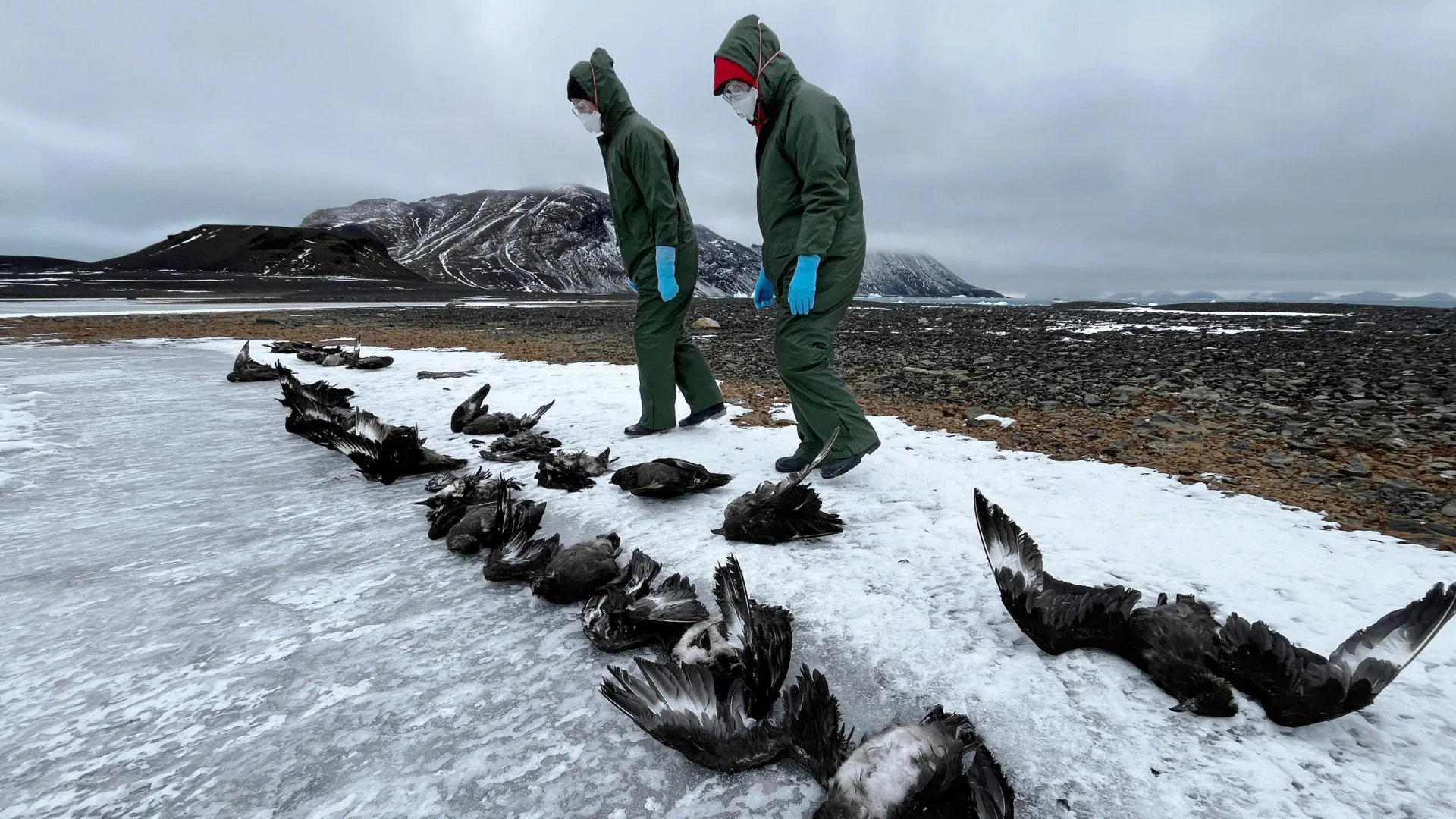
More than 50 skuas perished in the pristine Antarctic environment during the austral summers of 2023 and 2024, succumbing to the highly pathogenic avian influenza (HPAI) virus H5N1. This grim discovery marks a pivotal and concerning moment, representing the first confirmed large-scale wildlife die-off attributed to the virus on the remote continent. The definitive findings emerged from a collaborative study spearheaded by Erasmus MC in The Netherlands and the University of California, Davis, with their research recently published in the esteemed journal Scientific Reports. This development escalates long-standing fears among scientists and conservationists regarding the potential ecological catastrophe should the virus become endemic in Antarctica’s unique and vulnerable ecosystems.
Skuas, large brown seabirds closely related to gulls, are iconic inhabitants of polar and subpolar regions. Distinguished by their predatory and scavenging behaviors, they occupy a crucial ecological niche akin to birds of prey, playing an indispensable role in maintaining ecosystem health by cleaning up carrion. However, this very scavenging propensity, which makes them vital to the Antarctic food web, also renders them highly susceptible to contracting and, critically, spreading pathogens like H5N1 across the continent’s vast and interconnected marine environments. Their opportunistic feeding habits often bring them into close contact with infected carcasses or excretions, creating a direct pathway for viral transmission.
Chronology of a Spreading Threat
The specter of H5N1 reaching Antarctica had loomed for several years, following its relentless global spread. Earlier in 2024, preliminary detections of H5N1 were made in a kelp gull and two skuas found deceased in January and February. While these findings were alarming, they did not definitively establish H5N1 as the direct cause of death. Scientific rigor demanded conclusive evidence to link the viral presence to mortality. "We knew there were animals with the infection, but this is the first study to show they died of the viral infection," affirmed co-senior author Ralph Vanstreels, a wildlife veterinarian with the UC Davis One Health Institute within the Weill School of Veterinary Medicine. He emphasized this distinction as critical in the nascent stages of an outbreak, providing a clear understanding of the virus’s impact.
The confirmed die-off follows a disturbing global trajectory of H5N1, which has decimated bird populations and affected numerous mammal species across continents. The current clade 2.3.4.4b of H5N1, highly transmissible and virulent, has been particularly effective in crossing species barriers and adapting to wild bird populations, making it exceptionally challenging to control. Its arrival in South America in late 2022 and subsequent devastating impact on marine mammal colonies, particularly elephant seals and sea lions along the coasts of Argentina, Peru, and Chile, signaled an imminent threat to the Antarctic Peninsula, given the migratory links between these regions.
The Antarctic Expedition: Uncovering the Scale of Loss
In response to the escalating concerns, a dedicated research team embarked on an expedition to Antarctica in March 2024, immediately following the breeding season for skuas and penguins. Their mission was urgent: to investigate the presence and impact of avian influenza on wildlife across ten strategic sites within the South Shetland Islands, the northern Weddell Sea, and the Antarctic Peninsula – regions known for their dense wildlife populations and accessibility for scientific research.
The methodology employed by the researchers was meticulous. Whenever sick or deceased animals were encountered, scientists diligently collected tissue and environmental samples. Crucially, comprehensive necropsies were performed to ascertain the precise cause of death, distinguishing between various potential threats. While the team examined the remains of gentoo penguins, Adélie penguins, and Antarctic fur seals, H5N1 was not identified as the primary cause of mortality in these species during this specific investigation. This observation, while somewhat reassuring for these particular populations, simultaneously highlighted the acute vulnerability of skuas.
As the expedition progressed, a stark pattern emerged. "As the expedition progressed, it became obvious quickly that skuas were a major victim," stated Vanstreels, underscoring the disproportionate impact on these scavengers. The virus was conclusively detected in skuas at three distinct locations: Hope Bay, Devil Island, and most notably, Beak Island. It was at Beak Island where a significant and localized die-off of south polar skuas was observed, providing irrefutable evidence of the virus’s lethal effects.
"We diagnosed high pathogenicity avian influenza as the cause of death for nearly all of the dead skuas we found at Beak Island," confirmed first author Matteo Iervolino, a Ph.D. candidate at Erasmus MC in Rotterdam, The Netherlands. His firsthand account painted a vivid picture of the devastation: "There, I could really see with my eyes the impact this virus can have on these populations." The clinical presentation in infected birds was harrowing. Vanstreels described the situation as a "crisis in animal suffering," detailing how H5N1, a neurotropic virus, primarily attacks the brain. This assault manifests in severe neurological symptoms, including grotesque twisted necks, unusual body stretching, disorientation, and impaired coordination. Infected birds were observed walking or swimming in circles, colliding with objects, and in some tragic instances, even falling out of the air. These overt signs of neurological distress provided critical diagnostic clues during the field investigation.
The Global Arc of H5N1: From Farm to Farthest Continent
The current H5N1 pandemic strain has a well-documented and concerning history, serving as a stark reminder of the interconnectedness of global health and environmental systems. The virus was first identified in 1996 on a domestic goose farm in Southeast China. For several years, it circulated largely unchecked within poultry populations, evolving and mutating in an environment of intensive farming. This prolonged circulation eventually facilitated a critical spillover event into wild bird populations, marking a turning point in its epidemiology.
Once established in wild birds, the virus leveraged their migratory patterns to embark on a relentless global expansion. From its origins in Asia, it systematically spread across Europe, the Middle East, and Africa, causing widespread outbreaks in both domestic poultry and wild avian species. Its arrival in North and South America in 2021 and 2022, respectively, was met with alarm, given the continent’s rich biodiversity and significant poultry industry. By early 2024, the final frontier had been breached, with confirmed cases reaching Antarctica, signaling a truly pan-continental presence.
The same virulent strain now confirmed in Antarctic skuas has been responsible for devastating outbreaks worldwide. In addition to the massive losses among elephant seals and sea lions in Argentina, the virus has led to the culling or death of more than 400 million poultry globally, causing immense economic damage and food security concerns. Its ability to cross species barriers is particularly troubling, with documented infections in a wide array of mammals, including dairy cows, mink, foxes, bears, otters, and various other wild carnivores. This broad host range complicates control efforts and raises concerns about further viral evolution.
Crucially, H5N1 is not merely an animal health crisis; it poses a significant zoonotic threat. Of the approximately 1,000 reported human cases globally, about half have unfortunately proven fatal, underscoring the virus’s high pathogenicity when it infects humans. While human-to-human transmission remains rare and inefficient, the widespread circulation in wild animals and spillover into domestic livestock increases the probability of human exposure and the potential for the virus to adapt further.
"We let the virus slip out through our fingers when it first emerged in the poultry industry," lamented corresponding senior author Thijs Kuiken, a professor at Erasmus MC, reflecting on the missed opportunities for containment. "Once it got into wild bird populations, we lost ability to control this virus. Now it’s established in wild bird populations in all the continental regions of the world except Oceania." His statement highlights a critical lesson in pandemic preparedness: the initial containment of novel pathogens, particularly at the animal-human interface, is paramount.
Antarctica’s Compounding Vulnerabilities and the Call for Vigilance
The arrival of H5N1 in Antarctica adds yet another severe pressure to an ecosystem already grappling with a multitude of existential threats. Antarctic wildlife faces an increasingly complex web of challenges, including the accelerating impacts of climate change, which manifest as sea ice loss, altered prey availability, and habitat degradation. Growing tourism, while vital for scientific exploration and public awareness, also introduces risks of pathogen transmission and environmental disturbance. The presence of invasive species, overfishing in surrounding waters, and persistent pollution further weaken the resilience of Antarctic fauna. The introduction of a highly pathogenic disease like H5N1 into this already stressed environment has the potential for catastrophic, cascading effects on populations and ecosystem dynamics.
The study unequivocally emphasizes the urgent need for stronger surveillance and monitoring efforts across the continent to mitigate the risk of further spread and to understand the long-term ecological consequences. A significant complication in assessing the true impact of this die-off is the glaring lack of contemporary population data for Antarctic skuas. The last comprehensive census of these birds dates back to the 1980s, when researchers estimated approximately 800 breeding pairs. Without updated baseline figures, accurately measuring the significance of the loss of 50 or more birds, or indeed any future losses, becomes exceedingly difficult. This data deficit hampers conservation efforts and our ability to understand population trends and resilience.
"Everything points toward this virus spreading further," warned Professor Kuiken, painting a sobering picture of the future. "If nobody is watching, we won’t know what is happening." This underscores the critical importance of sustained, robust monitoring programs, involving international collaboration and dedicated resources. Without a coordinated and proactive approach, the long-term impact of H5N1 on Antarctica’s unique biodiversity could remain largely unseen and unaddressed until it is too late.
The "One Health" approach, which recognizes the intricate connections between human, animal, and environmental health, is particularly relevant in the Antarctic context. Protecting human researchers and tourists requires stringent biosecurity protocols, including disinfection of clothing and equipment, avoiding contact with wildlife, and prompt reporting of sick or dead animals. Similarly, understanding the dynamics of H5N1 in Antarctic wildlife is crucial for global health security, as the continent could serve as a reservoir or an evolutionary crucible for new viral variants.
The HPAI Australis Expedition, a critical initiative in addressing this unfolding crisis, received essential funding from a consortium of international organizations, including the International Association of Antarctica Tour Operators (IAATO) and Ocean Expeditions. Further support for the study was provided by the European Union, Consejo Superior de Investigaciones Científicas (CSIC), and PTI Global Health. These funding bodies play a vital role in enabling the scientific community to respond to emerging threats in this globally significant yet incredibly fragile ecosystem. The confirmed H5N1 die-off in Antarctic skuas serves as a potent reminder of humanity’s global footprint and the imperative for sustained scientific vigilance and international cooperation to safeguard Earth’s last great wilderness.
