
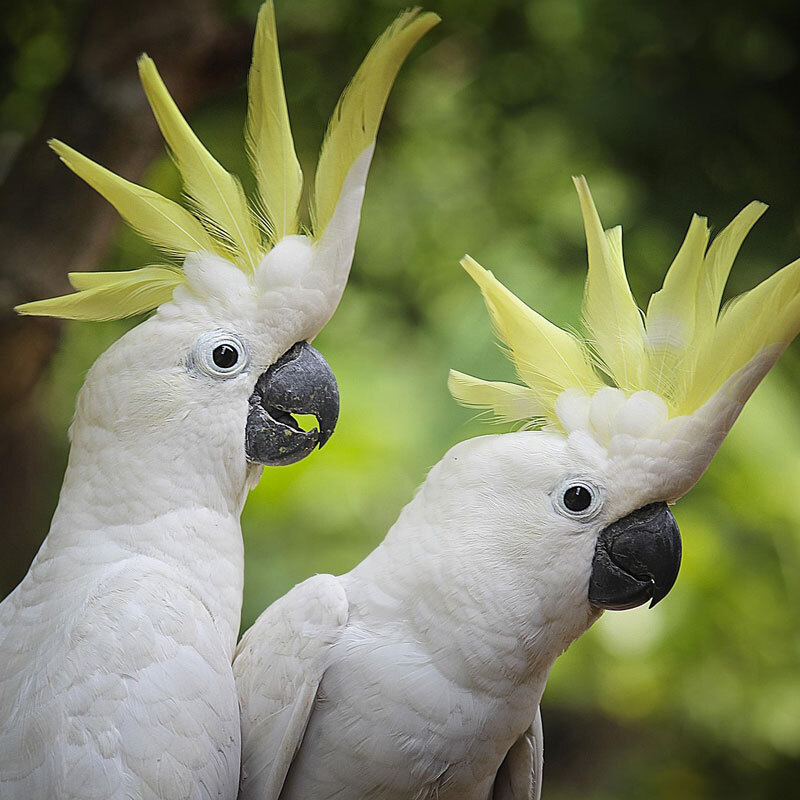
Researchers are delving deeper into the complex cognitive landscapes of avian species, with recent findings illuminating the sophisticated social learning behaviors observed in urban populations of sulphur-crested cockatoos. Far from being simple instinctual creatures, these intelligent birds exhibit a remarkable capacity for observation, evaluation, and adoption of new behaviors, mirroring human social dynamics in their quest for novel resources. This intricate dance of information exchange within flocks underscores the nuanced ways in which animal communities adapt to their ever-changing environments.
The groundbreaking study, published in the esteemed journal PLOS Biology, was spearheaded by a multinational team of five researchers hailing from prestigious institutions including the University of Konstanz in Germany, The Australian National University, the University of California, Davis, and The University of Sydney in Australia. Their collective focus was to unravel the mechanisms behind social learning in wild parrots, with a particular emphasis on how these birds develop an appetite for previously unencountered food sources. The implications of this research extend beyond ornithology, offering valuable insights into the broader principles of social influence and information diffusion across various species, including our own.
The Genesis of a New Appetite: An Observational Study
The core of the research revolved around a meticulously designed experiment involving groups of wild sulphur-crested cockatoos. The researchers ingeniously employed almonds, a novel food item for these particular urban populations, to observe the adoption process. To facilitate tracking and differentiation, the almonds were presented in their shells and artificially colored, with blue and red hues serving as distinct markers. This deliberate manipulation allowed the scientists to gauge which food sources were being explored and by whom.
The experimental setup involved introducing four pre-trained birds to these colored almonds in a specific roosting area. These trained birds acted as initial innovators, demonstrating the acceptance and consumption of the novel food. The critical phase of the study then focused on the reactions of other cockatoos within the same roost, as well as those in neighboring roosts, to this emergent behavior. The findings were striking: the observing cockatoos did not immediately flock to the new food. Instead, they engaged in a period of observation, watching the actions of the trained individuals. This period of watchful waiting is a hallmark of social learning, where individuals assess the outcomes and potential risks associated with a new behavior before committing to it themselves.
In one particularly revealing observation, a roost located at a greater distance from the initial experimental site did not begin to consume the colored almonds until a bird from the actively participating roost arrived. This inter-roost transfer of knowledge highlights the interconnectedness of these avian communities and the potential for rapid information dissemination when social links are established. Within mere minutes of the new bird’s arrival and immediate acceptance of the almonds, the other birds in the distant roost began to follow suit. This rapid adoption suggests that once a perceived "social cue" or successful example is present, the barrier to trying something new is significantly lowered.
Young Innovators, Cautious Elders: A Familiar Dynamic
The study’s duration spanned 20 days, during which researchers meticulously documented the dietary shifts across five marked roosts, encompassing a total of 349 sulphur-crested cockatoos. By the conclusion of the experiment, a significant majority of these birds were actively foraging on and consuming the colored almonds. This widespread adoption was not the result of individual discovery but a testament to the power of social learning. The birds had learned by observing, evaluating, and ultimately imitating the behaviors of their flock mates.
A fascinating parallel to human social dynamics emerged when the researchers analyzed the age demographics of the adopting birds. It was consistently observed that younger cockatoos were more prone to adopting the new behavior – in this case, eating the colored almonds – at a quicker pace than their older counterparts. This pattern suggests that younger individuals, perhaps less set in their ways or more open to novel experiences, often act as the initial adopters, effectively setting a precedent for the rest of the flock. The older birds, conversely, tended to adopt a more cautious approach, preferring to observe the actions and outcomes of their younger, more adventurous flock mates before venturing into the new behavior themselves. This indirect influence of the younger generation on the older generation is a subtle yet powerful aspect of social learning.
The Ripple Effect: Community Dynamics and Adaptation
The implications of this study extend to the broader understanding of societal behavioral changes within animal groups. The research indicates that the ongoing adoption of new behaviors by a segment of a community can indeed lead to a wider and more widespread acceptance of that behavior. The study also revealed a correlation between the proximity of roost communities and the speed at which new behaviors were adopted. Specifically, roosts that were geographically closer to each other demonstrated a faster rate of adaptation. This suggests that increased social interaction, whether through direct observation or communication, facilitates the diffusion of information and behavioral innovation. This finding resonates strongly with how trends and information spread through human societies, often starting in densely connected social networks.
The researchers’ work provides compelling evidence that urban wildlife is not merely surviving but actively and intelligently adapting to the human-altered landscapes they inhabit. The ability of these cockatoos to learn from each other, experiment with new food sources, and adapt their foraging strategies in response to observed behaviors highlights a sophisticated level of cognitive processing and social intelligence. This adaptability is crucial for their long-term survival in urban environments, where food availability and types can fluctuate significantly.
Broader Implications: Conservation and Cognitive Science
The findings from this study carry significant weight for several fields. From a conservation perspective, understanding how wild bird populations learn and adapt is paramount. This knowledge can inform strategies for mitigating human-wildlife conflict, such as understanding how birds might learn to exploit new food sources that could be detrimental to urban infrastructure or human food supplies. Conversely, this understanding could also be leveraged to introduce beneficial behaviors, such as deterring them from certain areas or encouraging them to utilize specific, safe food resources.
In the realm of cognitive science, the study contributes to the growing body of evidence demonstrating complex cognitive abilities in non-human animals. The parallels drawn between cockatoo social learning and human social learning offer a unique lens through which to examine universal principles of information transmission, conformity, and innovation. The research encourages a re-evaluation of our anthropocentric views of intelligence and social behavior, suggesting that many of the cognitive processes we consider uniquely human may have deeper evolutionary roots.
The study’s methodology, utilizing colored almonds as a controlled stimulus, provides a robust framework for future research into social learning in avian species. Further investigations could explore the specific communication signals used during the learning process, the role of individual differences in learning speed, and the long-term stability of learned behaviors. Understanding these nuances will paint an even richer picture of the social lives and cognitive capabilities of these remarkable urban dwellers.
In conclusion, the research on sulphur-crested cockatoos offers a compelling narrative of intelligent adaptation and social learning within an urban ecosystem. It reveals that these birds are not just reacting to their environment but actively shaping their collective behavior through observation, imitation, and social influence. As human populations continue to expand and urbanize, understanding the sophisticated social dynamics of the wildlife with whom we share our cities becomes increasingly vital for fostering harmonious coexistence and for appreciating the intricate tapestry of life that surrounds us. The cockatoo, with its raised crest and keen observational skills, serves as a vivid reminder of the complex minds at work in the natural world, constantly learning and evolving in the symphony of their social lives.
