
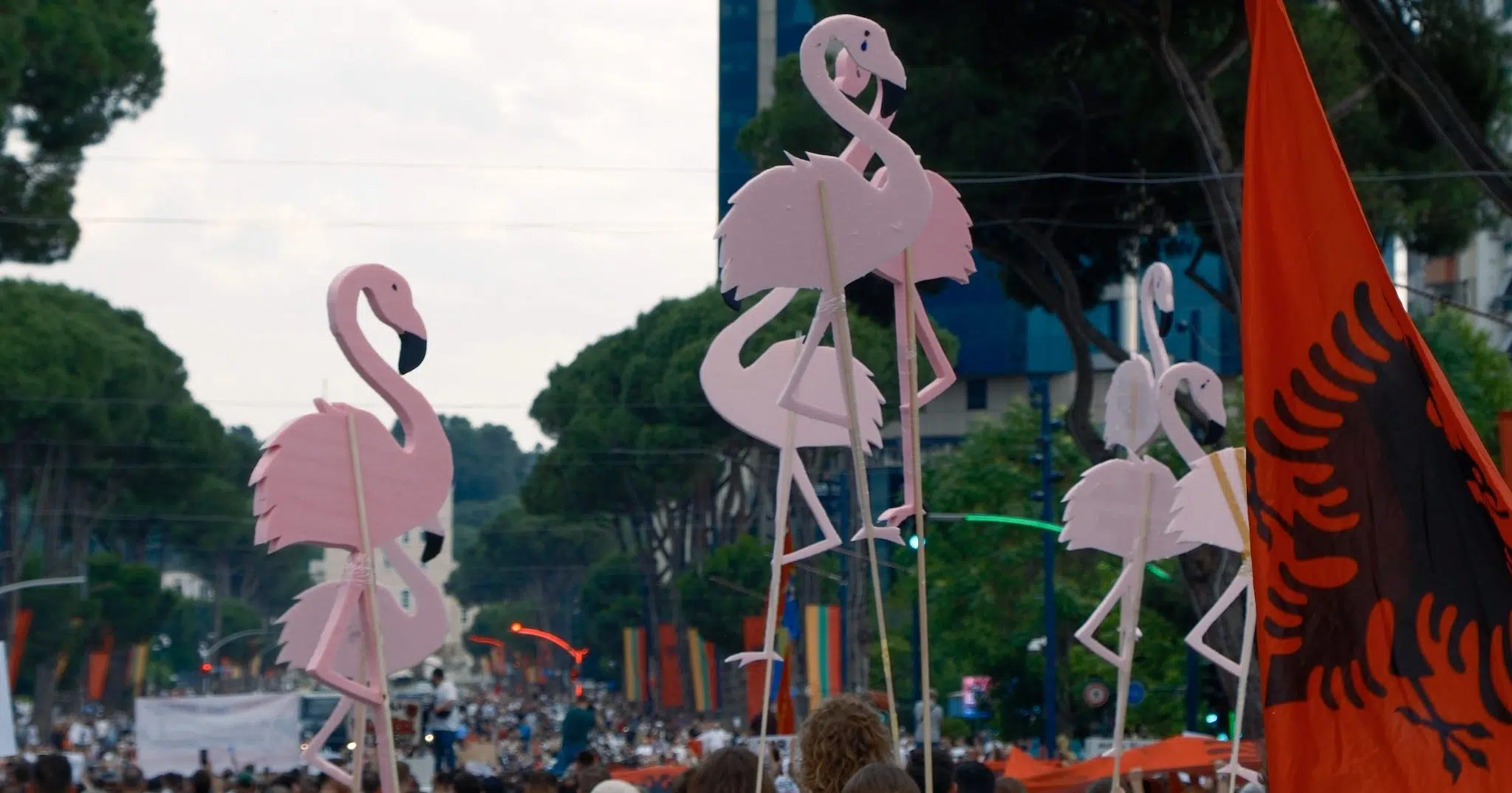
Thousands of citizens have converged on the streets of Tirana for several consecutive days, igniting a powerful movement dubbed the "Flamingo Revolution" by some media outlets. At the heart of their fervent protests lies the imminent threat to the Vjosa Narta Protected Landscape, a pristine and ecologically vital coastal ecosystem in the Mediterranean, now jeopardized by a massive luxury tourism development. This ambitious project, backed by a consortium of foreign investors including prominent American businessman Jared Kushner, has sparked widespread outrage, exposing deep-seated concerns about environmental degradation, governmental transparency, and the fundamental tenets of democratic governance in Albania.
The Unfolding Crisis in Vjosa Narta: A Mediterranean Gem Under Threat
The Vjosa Narta Protected Landscape, situated along Albania’s southwestern coastline, represents one of the Mediterranean’s last remaining intact coastal ecosystems. Spanning approximately 19,000 hectares, this mosaic of lagoons, salt marshes, sand dunes, and pristine beaches is an internationally recognized Ramsar site, signifying its wetlands of international importance. It is a critical biodiversity hotspot, serving as a vital migratory corridor and breeding ground for an astonishing array of species. The wetlands alone shelter hundreds of bird species, including significant populations of greater flamingos (Phoenicopterus roseus), whose vibrant presence has become an emblem of the ongoing protests. Beyond its avian treasures, the area is a crucial habitat for critically endangered Mediterranean monk seals (Monachus monachus), one of the world’s most threatened marine mammals, and boasts pristine nesting beaches for endangered Loggerhead sea turtles (Caretta caretta). Unlike much of the Mediterranean’s heavily developed coastline, Vjosa Narta has remained remarkably untouched, a testament to its protected status and historical isolation. Any significant alteration to this delicate balance risks triggering cascading, irreversible consequences for the intricate web of life that depends on it.
The proposed luxury tourism development envisions a sprawling complex of resorts, golf courses, and associated infrastructure. While exact details from the developers remain somewhat opaque, preliminary reports suggest a multi-hundred-million-euro investment aimed at transforming a largely untouched natural landscape into an exclusive tourist destination. Proponents of the project, including the Albanian government, often highlight the potential for economic growth, job creation, and increased foreign investment as key drivers. However, environmental organizations and local communities vehemently argue that these short-term economic gains would come at an incalculable long-term cost, irrevocably damaging a natural heritage that is irreplaceable.
A Chronology of Contention
The seeds of the current conflict were sown months, if not years, ago, as whispers and then concrete plans for the Vjosa Narta development began to emerge.

- Early 2020s: The Albanian government signals its intent to boost tourism, identifying key coastal areas for development, including zones near protected landscapes.
- Late 2023: Initial reports surface regarding a significant tourism investment in the Vlora region, specifically targeting areas adjacent to or within the Vjosa Narta Protected Landscape. Environmental NGOs, including PPNEA (Protection and Preservation of Natural Environment in Albania) and BirdLife Europe & Central Asia, begin to raise alarms about potential violations of national and international environmental protection laws.
- March 2024: Details of the proposed development, reportedly involving foreign investors, including entities linked to Jared Kushner, become public. This news amplifies concerns, drawing international attention.
- April 2024: Environmental organizations and local community groups formally challenge the project, citing lack of transparency, insufficient environmental impact assessments, and potential breaches of Albania’s own protected areas legislation and international conventions (such as Ramsar and Bern Convention).
- May 2024: Despite growing opposition, reports indicate the project is moving forward, with some initial permits or preliminary approvals allegedly granted by Albanian authorities. This perceived disregard for public and expert objections acts as a catalyst for organized protests.
- Early June 2024: The first large-scale demonstrations erupt in Tirana and Vlora, marking the beginning of the "Flamingo Revolution." Thousands take to the streets, demanding the immediate cessation of the project and greater government accountability. Protests intensify, gaining momentum over several days, drawing support from a broad spectrum of Albanian society.
Beyond Ecology: A Crisis of Governance and Democratic Accountability
While the immediate catalyst for the protests is the ecological threat to Vjosa Narta, the unrest in Tirana quickly transcended mere environmental activism. Activists and citizens articulate a deeper frustration: the perceived erosion of democratic governance and the right to participate in decisions that directly impact their lives, their landscapes, and the future they envision for their children.
Environmental conflicts are often superficially framed as binary disputes between conservation and economic development. This simplistic and often politically convenient narrative frequently portrays nature as an impediment to prosperity rather than its foundational pillar. The protestors in Albania, however, are challenging this false dichotomy, asserting that genuine prosperity must be built on sustainable practices and respect for natural resources.
What these conflicts truly illuminate are fundamental questions of democratic practice: Who holds the authority to determine how shared national resources are utilized? Whose interests are prioritized in grand development schemes? And, crucially, whose voices are genuinely heard and valued in the decision-making process? When the practical answer to these questions is consistently "not yours," citizens, driven by a shared sense of disenfranchisement, inevitably organize and mobilize.
The social contract upon which democracy rests is relatively straightforward: citizens grant authority to their government in exchange for responsible stewardship of public goods and common inheritance. Nature, with its invaluable ecosystems and biodiversity, is an intrinsic part of this common inheritance. When public assets are disposed of without transparency, when established environmental laws are repeatedly circumvented or violated, and when judicial bodies fail to provide effective oversight, this fundamental pact begins to fray. Protest, then, becomes not merely an act of defiance, but a necessary expression of a broken trust and a demand for its restoration.
Official Responses and Developer Perspectives
The Albanian government has largely maintained that the proposed development adheres to all national laws and regulations, emphasizing its potential for economic growth and job creation in a nation eager to expand its tourism sector. Officials have reiterated their commitment to sustainable development, though critics argue that the specifics of the Vjosa Narta project contradict this very principle. There have been statements from government spokespersons acknowledging the right to protest but also underscoring the need for "progress" and "modernization."

Representatives for the development consortium, including those linked to Jared Kushner, have, when approached, typically emphasized the project’s adherence to international standards and a commitment to "eco-friendly" practices, aiming to integrate luxury tourism with environmental responsibility. They often highlight the potential for high-end tourism to attract affluent visitors, generating revenue and creating a sophisticated new image for Albania on the global stage. However, detailed environmental mitigation plans and independent assessments that would validate such claims have not been made fully public or have been challenged by expert groups. The involvement of high-profile international figures like Jared Kushner has further intensified scrutiny, with activists questioning the due diligence processes and potential political influences behind such large-scale projects in sensitive ecological zones.
The "Flamingo Revolution" and Civil Society’s Resurgence
The "Flamingo Revolution" has become a powerful symbol of civil society’s renewed vigor in Albania. The protests are not merely against a single development but represent a broader pushback against a prevailing narrative across Europe that often casts environmental protections as mere obstacles to economic growth. Organizations defending these protections are frequently dismissed as anti-progress or obstructionist. The demonstrations in Tirana vigorously challenge this narrative, asserting that citizens will not quietly accept policies that undermine their natural heritage and democratic rights.
The mobilization has been characterized by its diverse participation, drawing in not only seasoned environmental activists but also students, families, and concerned citizens from various walks of life. The visual impact of flamingos, symbols of the threatened landscape, has resonated deeply, providing a clear and evocative rallying point. This grassroots movement underscores the growing public awareness of environmental issues and a heightened demand for accountability from their elected representatives.
Albania’s EU Aspirations Under Scrutiny
The events unfolding in Tirana carry significant implications for Albania’s long-standing ambition to join the European Union. As a candidate country, Albania is expected to align its legislative framework and administrative practices with the EU acquis communautaire, particularly in areas concerning the rule of law, democratic accountability, and effective institutions. These are not merely bureaucratic checkboxes but fundamental criteria that define the very nature of an EU member state.
The controversy surrounding the Vjosa Narta project raises legitimate and serious doubts about how genuinely these commitments are being embraced and implemented by the Albanian government. The perceived lack of transparency in decision-making, the alleged disregard for existing environmental laws, and the inadequate mechanisms for public participation directly challenge the core principles of good governance that the EU champions. Furthermore, the EU’s Birds and Habitats Directives, which underpin the Natura 2000 network of protected areas, set stringent standards for the protection of biodiversity. Any development that threatens a Ramsar site and a critical habitat for endangered species, especially if pushed through with questionable legal backing, would undoubtedly be viewed critically by Brussels. The credibility of Albania’s EU accession process hinges on its demonstrated capacity to uphold these democratic and environmental standards. Failure to do so could significantly impede its progress towards full membership, signaling to the EU that fundamental reforms are not being taken seriously.

Broader Regional and International Implications
The struggle in Vjosa Narta also resonates beyond Albania’s borders, setting a precedent for environmental battles across the Western Balkans and indeed, the wider Mediterranean. The region is rich in biodiversity but also faces intense development pressures, often driven by foreign investment seeking to capitalize on untouched coastlines and natural landscapes. The outcome of the "Flamingo Revolution" could embolden or discourage similar citizen movements fighting to protect their natural heritage elsewhere.
Internationally, conservation bodies and human rights organizations are closely monitoring the situation. The involvement of high-profile international investors brings an additional layer of global scrutiny, highlighting the responsibility of foreign capital to adhere to the highest ethical and environmental standards, particularly in ecologically sensitive areas of developing nations.
Conclusion: A Fight for the Future
The "Flamingo Revolution" in Tirana is far from an abstract conflict. It is a tangible battle for the future of a vital ecosystem and a powerful assertion of democratic rights. Right now, flamingos still wade in the shallows of Vjosa Narta, a Mediterranean monk seal might haul out onto its undisturbed beaches, and a Loggerhead turtle could find her nesting site intact. These realities persist because, for decades, this coastline has been protected, and more recently, because thousands of people in Tirana and beyond are bravely taking to the streets, insisting that it remains that way. Their protests are a poignant reminder that the health of our planet and the strength of our democracies are inextricably linked, and that the power of collective action can still shape the future of our shared world.
