
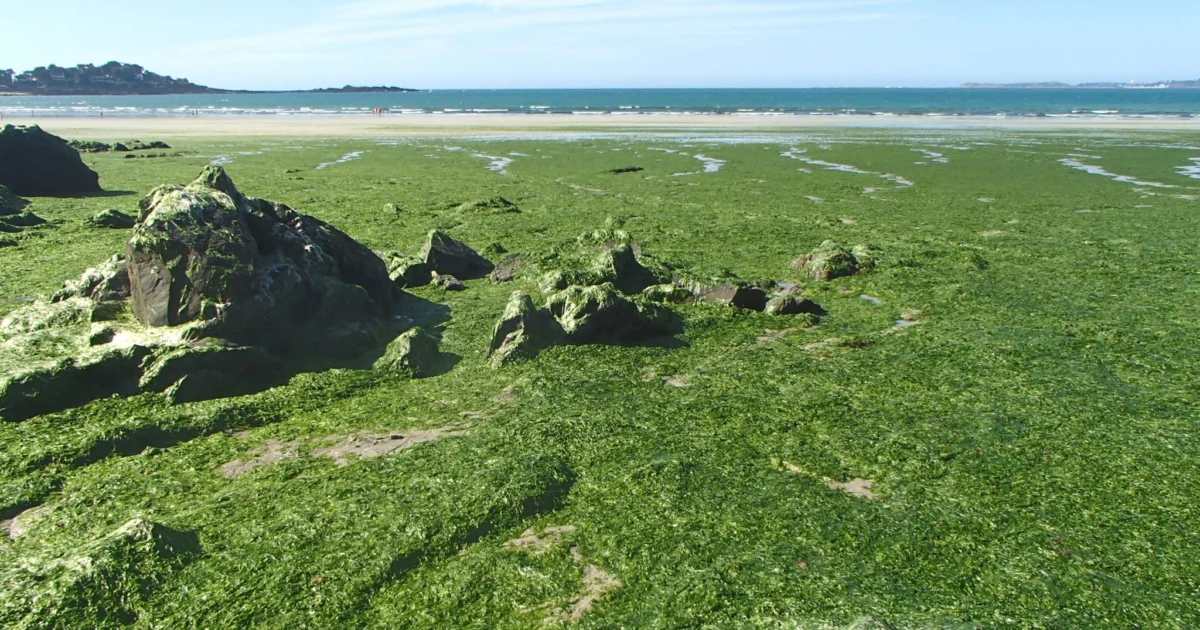
Along the picturesque coast of Brittany in France, a recurring environmental phenomenon transforms the serene summer seascape into a scene of ecological distress. Certain warm days witness the sea turning an unsettling bright green, as vast, thick mats of algae, particularly Ulva lactuca (sea lettuce), wash ashore. These accumulating blooms, often reaching several feet in depth, decompose under the sun, releasing hydrogen sulfide gas – a highly toxic substance known for its pungent, rotten-egg smell. This potent gas has been directly implicated in severe health incidents, including the deaths of animals, such as wild boars and domestic livestock, and, tragically, has been linked to human fatalities and serious illnesses, prompting public health warnings and beach closures. These alarming occurrences are not natural ecological cycles but are a direct consequence of anthropogenic activity, specifically the efflux of nutrient-rich runoff from intensive agricultural practices into rivers that eventually discharge into coastal waters. This localized yet potent crisis in Brittany serves as a stark, visible emblem of a much broader, systemic environmental challenge confronting Europe.
The Historical Trajectory of Intensive Agriculture and Its Environmental Toll
The post-World War II era in Europe saw a concerted drive towards maximizing food production, fueled by memories of wartime rationing and a desire for greater food security. This ambition was largely realized through the widespread adoption of intensive farming methods, heavily reliant on chemical inputs. The Common Agricultural Policy (CAP), established in 1962, initially focused on increasing productivity and ensuring a fair standard of living for farmers, inadvertently incentivizing practices that prioritized yield over environmental sustainability. Over the subsequent decades, European agriculture witnessed a dramatic shift towards monocultures, larger farm sizes, and the prolific use of synthetic chemical fertilisers, pesticides, and concentrated animal manure from ever-expanding livestock operations.
While these practices undeniably boosted agricultural output, contributing significantly to Europe’s food self-sufficiency and economic growth, they simultaneously placed immense and unsustainable pressure on natural resources. The very foundation of sustainable agriculture—healthy soils, clean water, and functioning ecosystems—began to erode under this relentless pressure. Excess nutrients, predominantly nitrogen and phosphorus from fertilisers and manure, are not fully absorbed by crops or retained by the soil. Instead, they leach into groundwater or are washed by rainfall into surface waters—rivers, lakes, and eventually coastal seas. This nutrient overload, known as eutrophication, fuels explosive algal growth, depletes oxygen in aquatic environments (hypoxia), and devastates aquatic biodiversity, creating "dead zones" where marine life cannot survive. Scientific studies estimate that up to 50% of applied nitrogen fertiliser can be lost to the environment through leaching and runoff, a staggering inefficiency with profound ecological consequences.
Water Quality Under Siege: A Threat to Public Health and Drinking Water
The infiltration of excess fertilisers and manure into groundwater poses a direct and insidious threat to human health and the availability of safe drinking water. Groundwater, which supplies a significant portion of Europe’s potable water, becomes contaminated when nitrate levels from agricultural runoff exceed health-based thresholds. The European Union’s Drinking Water Directive sets a maximum admissible concentration of 50 milligrams of nitrate per litre (mg/L) for tap water, a limit designed to protect against conditions like methemoglobinemia (blue baby syndrome) in infants and potential links to other health issues in adults.
In numerous regions across Europe, this critical threshold is routinely breached. Parts of Spain, particularly in intensive agricultural zones like Murcia, Catalonia, and Castilla-La Mancha, have seen hundreds of thousands of residents temporarily lose access to safe tap water due to elevated nitrate concentrations. Local authorities have been forced to issue "not fit for consumption" warnings, relying on bottled water or expensive municipal treatment plants to render water safe. For example, in Catalonia, a region with a high concentration of intensive pig farming, authorities have repeatedly highlighted that groundwater pollution from nitrates threatens drinking water supplies for entire communities. The financial burden of removing nitrates from drinking water is substantial, often running into millions of euros annually for affected municipalities, costs that are ultimately borne by taxpayers. A 2021 report by the European Environment Agency (EEA) indicated that nitrate concentrations in groundwater are above the EU drinking water standard in 14% of groundwater monitoring sites across Europe, with agricultural pressures being the primary driver. Similar challenges are documented in countries like Germany, France, Belgium, and the Netherlands, where intensive livestock farming and arable crop production dominate.
The Economic and Ecological Ripple Effects
The economic repercussions of agricultural pollution extend far beyond increased water treatment costs. Eutrophication severely impacts fisheries, as algal blooms and subsequent oxygen depletion reduce fish stocks and marine biodiversity, affecting livelihoods in coastal communities. Tourism, a vital economic sector for many European regions, suffers when beaches are closed due to toxic algae or offensive odours. The degradation of soil health, through acidification and nutrient imbalance, can reduce long-term agricultural productivity, creating a self-defeating cycle where the very practices intended to boost output ultimately undermine it. Moreover, the loss of biodiversity, from aquatic invertebrates to pollinating insects, weakens ecosystem resilience, making agriculture itself more vulnerable to pests and diseases. The estimated annual cost of nutrient pollution to the European economy, encompassing water treatment, biodiversity loss, and recreational impacts, runs into billions of euros.
A Chronology of EU Environmental Legislation and Enforcement Challenges

Recognizing the escalating environmental crisis, the European Union has, over several decades, developed a comprehensive framework of environmental legislation.
- 1991: The Nitrates Directive (91/676/EEC) was a pioneering piece of legislation, aiming to reduce water pollution caused or induced by nitrates from agricultural sources and to prevent further such pollution. It requires Member States to designate "Nitrate Vulnerable Zones" (NVZs) and to establish action programmes for these zones, including mandatory measures like limits on fertiliser application and periods when fertilisers cannot be applied.
- 1992: The Habitats Directive (92/43/EEC), alongside the 1979 Birds Directive (2009/147/EC), forms the cornerstone of Europe’s nature conservation policy. These directives aim to protect biodiversity by establishing a network of protected areas (Natura 2000) and safeguarding threatened species and habitats, many of which are directly impacted by agricultural pollution.
- 2000: The Water Framework Directive (WFD, 2000/60/EC) established a groundbreaking framework for the protection of all waters—rivers, lakes, transitional waters, coastal waters, and groundwater—aiming to achieve "good ecological and chemical status" for these waters by 2015, later extended to 2027. It mandates integrated river basin management plans and sets ambitious targets for water quality.
Despite this robust legal framework, agricultural pollution remains widespread across Europe. The primary reason for this persistent failure is often attributed to insufficient implementation and lax enforcement of existing rules at the national level. Member States have frequently struggled or been reluctant to fully apply the directives, facing pressure from agricultural lobbies and citing economic competitiveness concerns. Recent legal actions by the European Commission highlight this ongoing challenge. For instance, in 2022, the European Court of Justice (ECJ) ruled against Belgium for failing to adequately protect its waters from nitrate pollution, specifically citing persistent breaches of the Nitrates Directive in Flanders. Similarly, the Netherlands has faced intense scrutiny and court rulings regarding its nitrogen surplus from intensive livestock farming, which has severely impacted Natura 2000 sites and necessitated drastic measures, including farm buy-outs, to reduce nitrogen emissions. These cases underscore a systemic problem: governments are still failing to properly apply and enforce established environmental laws designed to protect critical natural resources.
Nature-Friendly Solutions: A Pathway to Sustainable Agriculture
The silver lining amidst this environmental crisis is that these challenges are largely avoidable. A wealth of sustainable farming methods, often grouped under the umbrellas of agroecology and organic agriculture, offer viable pathways for farmers to produce food while actively protecting nature, restoring healthy soils, and safeguarding water resources. These approaches move away from a linear, input-heavy model towards a more circular, ecosystem-centric system.
Examples of such practices include:
- Cover Cropping and Legume Integration: Planting legumes like clover, alfalfa, or beans between cash crops, or as cover crops, naturally enriches the soil with nitrogen through biological nitrogen fixation. This reduces or eliminates the need for synthetic nitrogen fertilisers, simultaneously improving soil structure, preventing erosion, and suppressing weeds.
- Diversified Crop Rotations: Moving beyond monocultures to diverse crop rotations breaks pest and disease cycles, enhances soil fertility, and reduces reliance on chemical pesticides.
- Precision Agriculture: Utilizing advanced technologies such as GPS, sensors, and drones to apply fertilisers, pesticides, and water precisely where and when needed, minimizing waste and runoff.
- Integrated Livestock Systems: Implementing livestock systems that integrate animals into crop production cycles, allowing manure to be recycled locally as a natural fertiliser, reducing dependence on synthetic inputs and minimizing off-farm nutrient leakage. This can involve rotational grazing, where animals fertilize pastures naturally.
- Buffer Strips and Riparian Zones: Establishing vegetated buffer strips along rivers, streams, and lakes acts as a natural filter, trapping sediments and absorbing excess nutrients before they can wash into water bodies. Restoring wetlands and creating artificial wetlands also serves as highly effective natural water purification systems, filtering pollutants and providing critical wildlife habitats.
- Conservation Tillage: Practices like no-till or reduced tillage minimize soil disturbance, preserving soil structure, enhancing organic matter content, and significantly reducing erosion and nutrient runoff.
These practices are not merely environmental measures; they are investments in the long-term resilience of agricultural systems, rural communities, and food security. They help restore crucial ecosystem services, protect biodiversity, mitigate climate change by sequestering carbon in soils, and ensure the continued ability to produce healthy food for future generations.
The Danger of Weakening Environmental Protection: A Step Backwards
Despite the clear evidence of environmental degradation and the availability of effective solutions, a concerning trend has emerged. Some EU countries, often influenced by powerful agricultural and industrial lobbies and their political allies, are actively pushing to weaken existing environmental rules. These proposals are frequently framed as efforts to "simplify regulation," "reduce administrative burdens" for businesses, or enhance "competitiveness." However, critics argue that these initiatives risk dismantling decades of environmental progress.
Weakening safeguards would likely entail reducing reporting and accountability requirements for agricultural practices, loosening limits on pollution, and making it harder for authorities to monitor compliance. Such measures would undermine the very directives designed to protect water quality, biodiversity, and climate goals, at a time when Europe is already struggling to meet these ambitious targets. The European Commission’s recent proposals to exempt small farms from certain environmental rules or to delay the implementation of environmental targets within the CAP have been met with fierce criticism from environmental organizations and scientists, who argue that such concessions will exacerbate pollution rather than solve farmers’ economic challenges.
The implications of weakening environmental protection are profound. It would put already fragile ecosystems at greater risk, compromise public health by threatening drinking water supplies, and undermine Europe’s long-term ability to produce food sustainably. Furthermore, it sends a contradictory signal, undermining the EU’s global leadership aspirations in environmental policy and climate action. What is urgently needed is not a rollback of protections, but rather a renewed commitment to better implementation and rigorous enforcement of existing laws. Concurrently, farmers must receive robust financial and technical support to facilitate their transition to more sustainable farming models. This includes incentivizing eco-schemes within the CAP, providing training, and ensuring fair prices for sustainably produced goods.
The survival of resilient rural communities, the integrity of our food systems, and the health of European citizens are inextricably linked to the health of its natural environment. Citizens across Europe are increasingly vocal, calling on EU leaders to defend, rather than weaken, environmental protections. Environmental organizations and civil society movements are actively campaigning, urging decision-makers to uphold Europe’s water, nature, and environmental laws for the benefit of current and future generations. The choice before policymakers is clear: to continue down a path of ecological degradation with short-term economic gains, or to embrace a future where food production harmonizes with environmental stewardship, securing a healthier, more sustainable Europe for all.
