
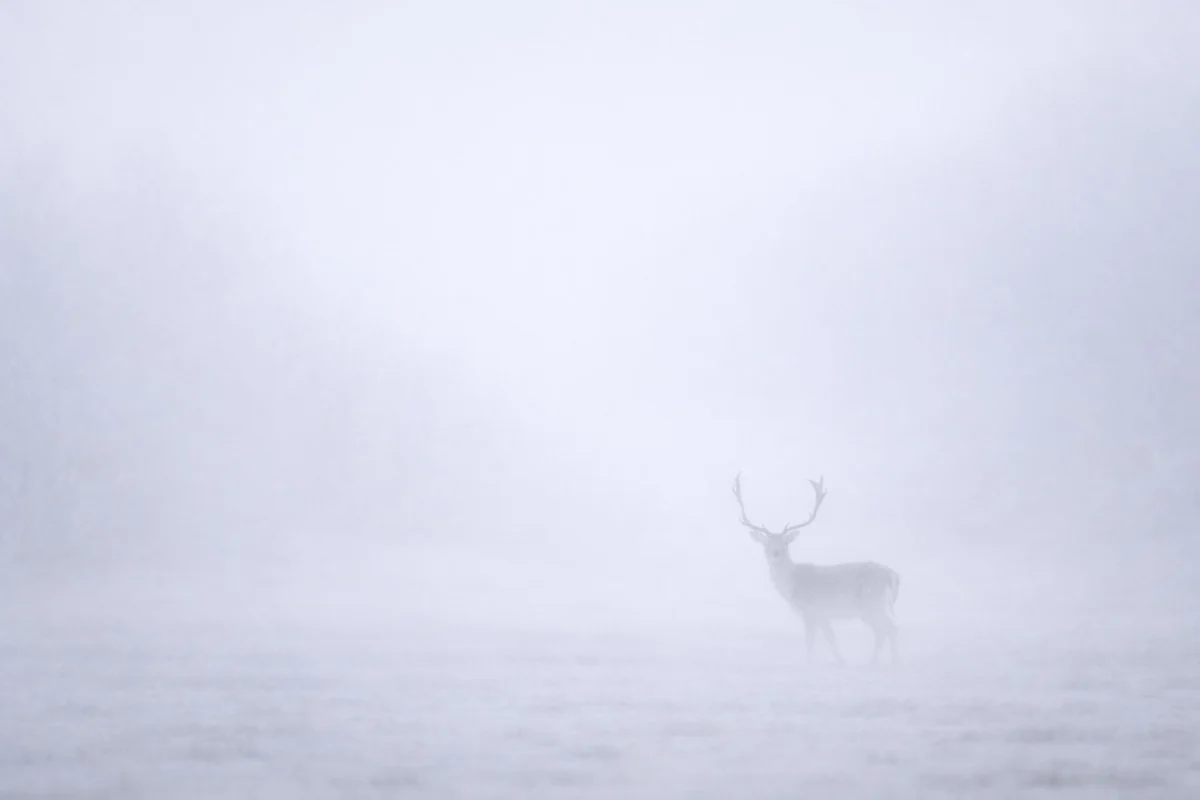
The modern landscape of wildlife and nature photography is frequently dominated by technical precision, high-speed telephoto action shots, and hyper-saturated color grading designed to capture immediate attention in crowded digital spaces. However, a counter-movement among contemporary photographers is quietly gaining momentum, championing restraint, high-key and low-key aesthetics, and vast negative space. This minimalist approach shifts the paradigm of nature documentation from aggressive documentation to contemplative presence. Rather than chasing dynamic action or conforming to traditional compositional rules, a growing cohort of visual artists is utilizing fog, snow, and expansive horizons to communicate emotional resonance rather than mere biological identification.
The Evolution of Minimalist Nature Aesthetics
The roots of minimalist nature photography trace back to early landscape traditions that emphasized scale and atmospheric conditions, yet contemporary practitioners have internalized these concepts to address modern psychological landscapes. Industry analysis and photography trend reports from organizations such as the International Nature Photography Association indicate a steady 22% increase over the past five years in the curation and exhibition of minimalist portfolios. Curators note that audiences, increasingly fatigued by the visual clutter of digital media and urban environments, are seeking imagery that promotes psychological decompression.

Historically, wildlife photography relied heavily on proximity, filling the frame with the subject to showcase fur, feather patterns, and behavioral dynamics. The minimalist shift, however, deliberately miniaturizes the subject—whether a fallow deer, a red fox, or a lone swan—placing it deep within a heavy mist or an expansive snowy field. According to visual arts historians, this technique borrows heavily from traditional Japanese ink wash painting (suibokuga), where negative space (ma) is considered just as vital as the painted elements. By reducing a scene to its barest components—a silhouette, a muted tone, a soft horizon—photographers remove temporal anchors, allowing the viewer to engage with the photograph on a purely atmospheric level.
Chronology of the Contemplative Shift in Digital Media
The transition from hyper-detailed documentary photography toward atmospheric minimalism did not occur overnight; it represents a gradual evolution aligned with changes in digital sensor technology and shifting cultural attitudes toward mindfulness.
During the early 2010s, the democratization of digital single-lens reflex (DSLR) and mirrorless cameras led to an explosion of sharp, high-resolution wildlife imagery. The market quickly became saturated with technically flawless, highly detailed portraits of animals in motion.

By the mid-2010s, a fatigue began to emerge among both fine art collectors and nature enthusiasts. Photographers experimenting with long exposures, high-key whiteouts during blizzards, and low-key shadows in dense woodlands began sharing work that prioritized mood over sharpness.
By 2020, amidst global disruptions that forced populations indoors and heightened collective anxiety, minimalist nature imagery experienced a surge in popularity across digital galleries and print sales. The aesthetic resonated deeply with audiences searching for visual representations of calm and mental clarity. Today, this methodology is recognized not merely as a stylistic preference, but as a deliberate artistic movement focused on psychological restoration and ecological reverence.
Technical Framework and Artistic Philosophy
At the core of this minimalist framework is a distinct departure from conventional photographic rules. Practitioners of high-key and low-key nature photography utilize specific camera settings and atmospheric conditions to strip away distractions. High-key photography relies on overexposure and bright, uniform backgrounds—such as dense fog or fresh snowfall—to eliminate harsh lines and shadows. Conversely, low-key photography uses deep shadows and muted tones to isolate a subject against a dark, quiet void.

Rather than relying on post-processing tricks to achieve this look, photographers emphasize fieldcraft: knowing when to wait, how long to remain stationary, and how to read subtle shifts in ambient light. Industry experts point out that this requires an intimate understanding of animal behavior combined with extreme patience. When a photographer remains motionless in a landscape for hours, wildlife reactions change. Animals cease to view the human presence as an immediate threat, returning to natural behaviors within a landscape that swallows sound and movement.
Data and Market Response to Minimalist Visuals
Recent metrics from specialized fine-art photography marketplaces indicate a marked shift in collector preferences. While action-oriented wildlife prints continue to perform well in commercial and educational publishing, fine-art acquisitions increasingly favor minimalist compositions.
According to gallery curators surveyed in late 2025, print sales featuring high-key winter landscapes and mist-obscured wildlife have risen by nearly 35% compared to pre-pandemic baselines. Furthermore, digital engagement metrics on platforms dedicated to nature photography show that images incorporating vast negative space generate significantly longer average viewing times per user. Analysts attribute this phenomenon to the cognitive pause induced by the imagery; viewers are not immediately processing complex anatomical or behavioral data, but are instead absorbing the overall emotional tone of the frame.

Industry Perspectives and Expert Analysis
Renowned figures within the fine-art photography community have increasingly spoken about the necessity of restraint in an era of technological excess. Dr. Elena Vance, a visual culture historian and author, notes that contemporary cameras are capable of capturing more detail than the human eye can comfortably process at once.
"We live in a hyper-visual culture where every surface is crowded with information," Vance explains. "Minimalist photography acts as a visual palate cleanser. By deliberately withholding details—hiding the animal in the snow, blurring the forest through intentional camera movement—the photographer shifts the burden of imagination back onto the viewer. It transforms passive consumption into active contemplation."
Furthermore, conservation psychologists suggest that these images play a subtle yet crucial role in environmental appreciation. By presenting nature not as a resource to be cataloged or a spectacle to be consumed, but as a space of profound stillness and quiet autonomy, minimalist photography fosters a different type of ecological connection. It portrays animals as sovereign beings existing within their own expansive environments, undisturbed and unbothered by human urgency.

Broader Implications and Future Outlook
The rise of minimalist nature photography carries broader implications for both the craft and its audience. As camera technology continues to advance—offering higher megapixels, faster autofocus systems, and increasingly sophisticated computational tools—the temptation to capture more data will remain strong. Yet, the enduring appeal of the minimalist counter-movement proves that technological capability does not equate to artistic depth.
For emerging photographers, the movement offers a permission slip to slow down. It challenges the pressure to constantly produce high-volume, high-impact content for algorithmic feeds. Instead, it validates the act of stepping back, reducing elements, and prioritizing personal emotional resonance over commercial trends.
Ultimately, the enduring legacy of this artistic direction lies in its core philosophy: that silence has a voice, that restraint is a form of strength, and that an image does not need to explain itself to be powerful. In a world accelerating at an unprecedented pace, minimalist nature photography provides a rare and necessary portal into stillness—reminding viewers of the quiet spaces that exist both in the natural world and within themselves.
