
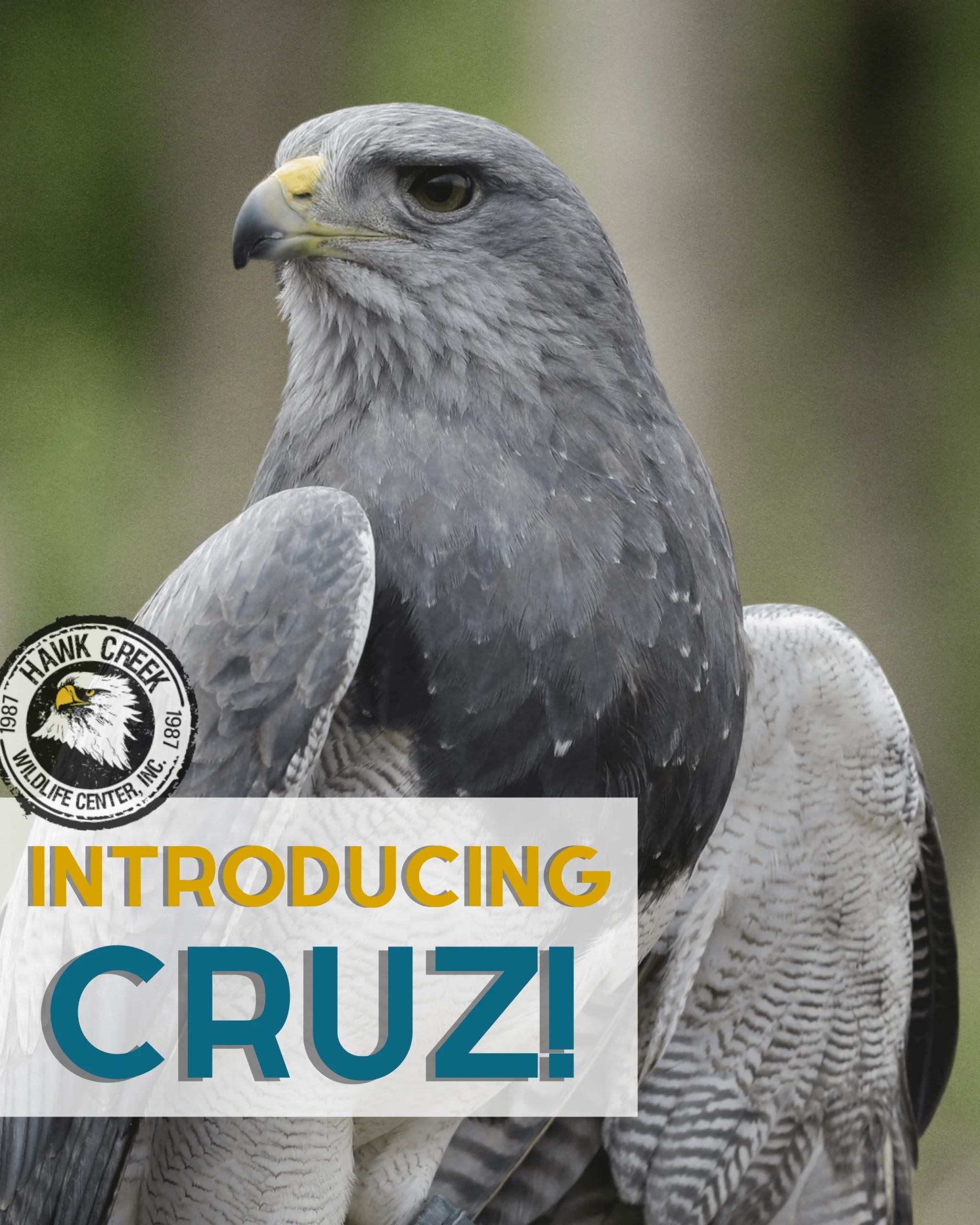
Hawk Creek Wildlife Center, a prominent facility dedicated to avian conservation and public education, has officially announced the arrival of its newest resident: a Black-chested Buzzard-eagle. Known taxonomically as Geranoaetus melanoleucus, the bird has been given the name "Cruz" by staff. This addition marks a significant milestone in the facility’s ongoing efforts to broaden public understanding of raptor biodiversity, particularly concerning species that are geographically distant from North American ecosystems. The Black-chested Buzzard-eagle, which also carries regional designations such as the Chilean Blue Eagle, Patagonian Eagle, and Gray Buzzard Eagle, represents a unique addition to Hawk Creek’s avian collection.
Taxonomic Profile and Natural History
The Black-chested Buzzard-eagle is a large raptor native to the mountainous and open regions of South America, with a distribution range extending from the Andes of Venezuela and Colombia down to the southern tips of Chile and Argentina. Despite its broad geographical reach, the species remains understudied in contemporary ornithological literature, particularly regarding its long-term population stability in fragmented landscapes.
Physically, the species exhibits a robust build, characterized by a wingspan that can reach up to 200 centimeters. Its plumage is predominantly slate-gray, with distinctive black-and-white patterns that provide camouflage against the rocky outcrops of its native high-altitude habitat. Ecologically, these birds occupy an apex predator role in their respective niches. Observations in the field indicate that they are highly efficient hunters, primarily targeting small-to-medium mammals such as the degu—a rodent native to the Chilean matorral—and the European hare, an invasive species that has significantly altered the trophic dynamics of South American grasslands.
By managing populations of small mammals, the Black-chested Buzzard-eagle provides critical ecosystem services. Their presence helps regulate rodent populations, which in turn influences local vegetation patterns and soil health. However, like many raptors, they face increasing pressure from habitat loss, power line electrocutions, and secondary poisoning from rodenticides used in agricultural sectors.
The Partnership: Hawk Creek and Sia
The arrival of Cruz is the direct result of a strategic partnership between Hawk Creek and Sia, an Oklahoma-based organization renowned for its dedication to global eagle conservation. This collaboration, which has been active for several years, focuses on the exchange of scientific knowledge, ethical animal management practices, and the fostering of public awareness regarding endangered or rarely observed raptors.
The synergy between these two institutions has previously facilitated the introduction of other rare species to the Hawk Creek program, including Jara, a Short-toed Snake Eagle, and Onyx, a Verreaux’s Eagle. These birds serve as "ambassador animals," allowing the public to engage with species that would otherwise be inaccessible for research or observation in the United States.
The procurement and transport of these birds are subject to rigorous regulatory oversight, adhering to both domestic wildlife laws and international conventions like CITES (the Convention on International Trade in Endangered Species of Wild Fauna and Flora). Such partnerships are essential for maintaining genetic diversity in captive populations while simultaneously ensuring that the birds receive the highest standard of veterinary care and behavioral enrichment.
Upcoming Educational Outreach: The Wild Earth Event
To celebrate the arrival of Cruz and to highlight the importance of international raptor conservation, Hawk Creek has scheduled a special presentation during its annual Wild Earth event, set to take place on May 13. The event will feature a keynote address by Waha Thuweeka, also known as William "Two-Raven" Voelker.
Voelker is a respected figure in the field of ethno-ornithology and leads the Comanche Ethno-Ornithological Initiative. His work seeks to bridge the gap between indigenous ecological knowledge and modern scientific inquiry. During the May 13 presentation, Voelker is expected to discuss the cultural significance of eagles in various societies and provide an analysis of the challenges facing raptor conservation in the 21st century.
The event serves as a platform for Hawk Creek to translate its specialized research into actionable public knowledge. By inviting expert speakers, the center aims to transform the observation of a single bird into a broader conversation about the global interconnectedness of wildlife health and environmental sustainability.
Chronology of Conservation Efforts
The history of this project spans several months of preparation and international coordination. The chronology of events leading to the introduction of Cruz includes:
- Q4 2023: Initial discussions between Hawk Creek and the Sia organization regarding the expansion of the ambassador bird program.
- January 2024: Completion of veterinary and quarantine assessments required for the transfer of the Black-chested Buzzard-eagle.
- March 2024: Finalization of transport logistics, ensuring the safety and welfare of the bird during transit from Oklahoma.
- April 2024: Successful acclimation of Cruz to the Hawk Creek habitat, overseen by specialized avian husbandry staff.
- May 13, 2024: Scheduled public debut and educational seminar at the Wild Earth event.
Analysis of Implications for Conservation
The inclusion of non-native raptors in American educational facilities is not without its complexities. Critics often question the necessity of moving birds across continents, citing the potential for stress and the lack of contribution to wild population recovery. However, institutions like Hawk Creek argue that the educational value—creating an emotional and intellectual connection between the public and global wildlife—far outweighs the logistical challenges.
From an analytical standpoint, the presence of these birds provides researchers with rare opportunities to collect data on metabolic rates, flight mechanics, and behavioral responses in a controlled setting. This data is often difficult, if not impossible, to collect in the wild, where the birds are elusive and inhabit rugged terrain. Furthermore, the partnership model employed by Hawk Creek and Sia provides a blueprint for how smaller regional facilities can contribute to global conservation goals. By funding and participating in international programs, these centers ensure that resources are directed toward habitat protection and anti-poaching initiatives in the countries of origin.
The Black-chested Buzzard-eagle, while not currently classified as a critically endangered species, is nonetheless sensitive to the rapid environmental shifts occurring in the Andes. As human development continues to expand into high-altitude grasslands, the risk of habitat fragmentation increases. The "ambassador" role played by Cruz is intended to sensitize the American public to these distant environmental issues, thereby fostering a more global perspective on conservation policy.
The Role of Ethno-Ornithology
The involvement of Waha Thuweeka, or William "Two-Raven" Voelker, underscores a growing trend in conservation: the integration of traditional ecological knowledge. Modern wildlife management has increasingly recognized that indigenous perspectives on predator-prey relationships and land management offer insights that are often overlooked by strictly quantitative Western scientific models.
By examining the relationship between the Black-chested Buzzard-eagle and the cultures that have coexisted with it for centuries, conservationists can develop more holistic strategies. These strategies move beyond simple population counts to address the socio-economic and cultural factors that dictate the success or failure of a conservation program. For the community members attending the Wild Earth event, the lecture will likely emphasize that protecting species like the Black-chested Buzzard-eagle is not merely a biological necessity, but a cultural responsibility.
Looking Ahead
As Hawk Creek continues to refine its public outreach initiatives, the addition of Cruz is expected to bolster attendance and engagement at its facilities. The center maintains that while the bird is a marvel to behold, his true purpose lies in his ability to inspire future generations of ornithologists, conservationists, and wildlife advocates.
The partnership with Sia is expected to continue for the foreseeable future, with plans to potentially introduce additional species to the facility’s roster in the coming years. For now, the focus remains on the successful integration of the Black-chested Buzzard-eagle into the daily educational rotation, ensuring that every interaction between the public and the bird serves as a lesson in the delicate balance of the natural world.
Through rigorous scientific protocols, collaborative institutional efforts, and a commitment to public education, Hawk Creek is positioning itself as a vital node in the international conservation network. As the May 13 event approaches, the staff at the center remain optimistic that the story of Cruz will serve as a catalyst for deeper public engagement with the plight of the world’s raptors, ensuring that these majestic creatures continue to soar—not just in the skies of South America, but in the collective conscience of a globally informed public.
