
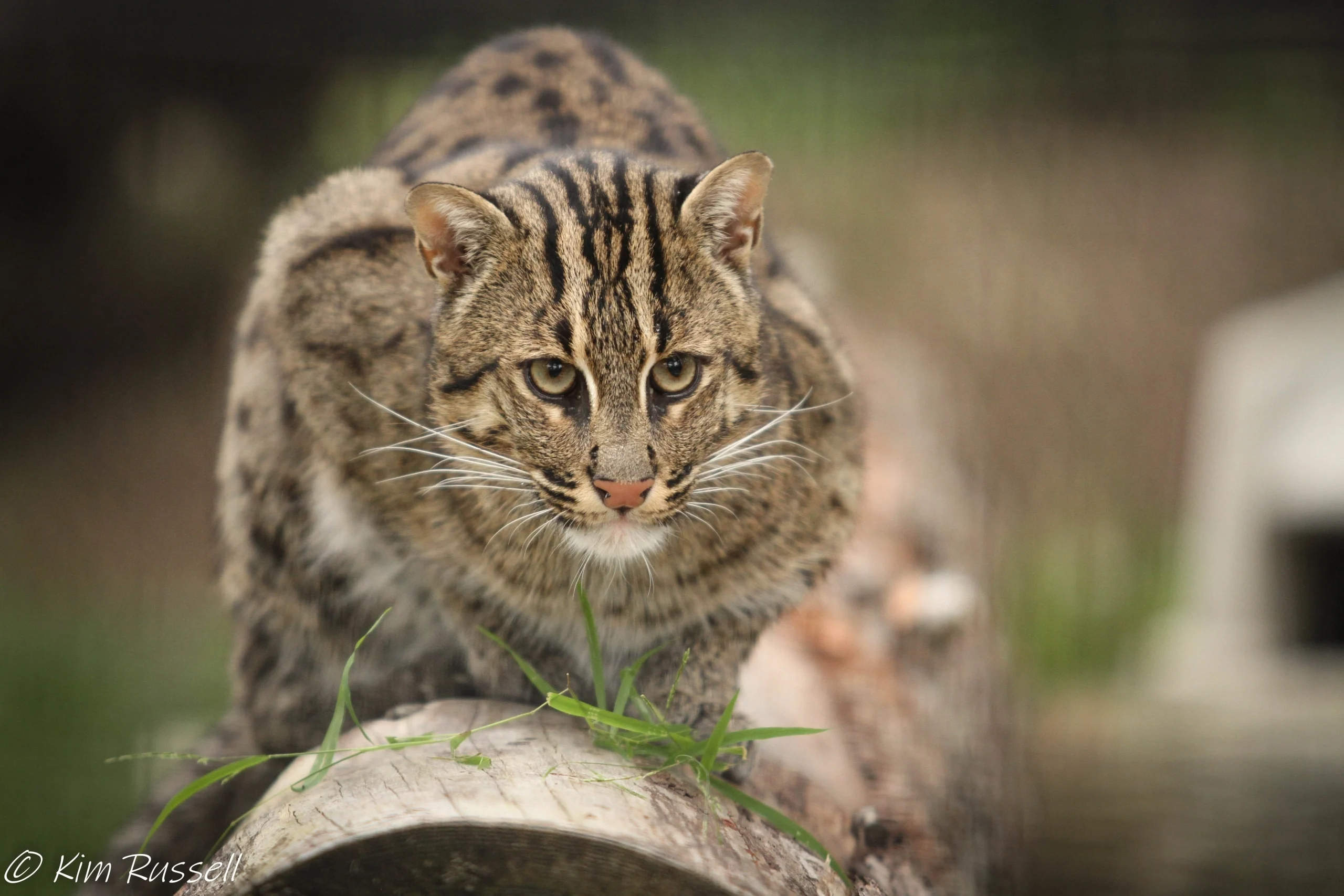
Every year on March 3, the international community observes World Wildlife Day, a date designated by the United Nations to celebrate the world’s wild fauna and flora while raising awareness about the multifaceted challenges facing biodiversity. This year’s theme, "Partnerships for Wildlife Conservation," highlights the necessity of collaborative efforts between non-governmental organizations, scientific institutions, and the public to prevent the extinction of vulnerable species. Central to this mission is the role of ambassador animals, such as River, a six-year-old fishing cat (Prionailurus viverrinus) residing at the Hawk Creek Wildlife Center, who serves as a vital bridge between human populations and the plight of her elusive wild counterparts.
Understanding the Fishing Cat: A Vulnerable Predator
The fishing cat is a medium-sized wild feline native to South and Southeast Asia. Unlike most members of the Felidae family, which are typically associated with terrestrial habitats, the fishing cat is uniquely adapted to wetlands. With partially webbed toes and a semi-aquatic lifestyle, they are expert hunters of fish, crustaceans, and amphibians.
Despite their specialized evolutionary adaptations, the species is currently classified as "Vulnerable" on the IUCN Red List of Threatened Species. Their populations are in a state of steady decline, primarily driven by the rapid degradation and fragmentation of wetland ecosystems. As human infrastructure projects, agricultural expansion, and industrial runoff encroach upon these habitats, the fishing cat’s range has shrunk significantly. Experts estimate that the global population is decreasing, yet the species remains largely unknown to the general public, a phenomenon known as "conservation invisibility." This lack of awareness often leads to a deficiency in the public funding and political will required to implement effective protective policies.
The Role of Ambassador Animals in Modern Science
Ambassador animals like River are not merely displays for public education; they serve as critical subjects for behavioral research that is often impossible to conduct in the wild. Because fishing cats are notoriously elusive and nocturnal, field biologists struggle to observe their natural behaviors, such as their specific hunting techniques or movement patterns, without disturbing their fragile environments.
The importance of this captive research was underscored recently when the founder of the Fishing Cat Conservancy traveled to the Hawk Creek Wildlife Center to conduct a formal study of River. By documenting her physical movements and the specific way she utilizes her paws to extract prey from water, researchers have gained insights that inform conservation strategies in the field. These observations allow scientists to better understand the ecological requirements of the species, which in turn helps in designing effective "corridors" and nature preserves that mirror the natural hunting environments required for these cats to thrive.
Chronology of Conservation Efforts
The movement to protect the fishing cat has gained momentum over the last two decades.
- 2008: The fishing cat was officially upgraded to "Vulnerable" status on the IUCN Red List, signaling an urgent need for international intervention.
- 2010s: Increased attention was directed toward the wetlands of Southeast Asia, where illegal poaching and habitat conversion reached a critical inflection point.
- 2015-2020: The Fishing Cat Conservancy intensified its efforts to map the feline’s territory, discovering that many cats were living outside of protected areas, often on private agricultural land.
- 2023: The focus of World Wildlife Day shifted to the importance of partnerships, marking a turning point where private landowners were invited to participate in land-management agreements to preserve fishing cat habitats.
This timeline illustrates a shift from purely reactive conservation—where protected areas were the only focus—to a proactive, partnership-based approach that emphasizes human-wildlife coexistence.
Supporting Data and Environmental Context
The urgency surrounding the protection of the fishing cat is supported by broader environmental statistics. According to the Ramsar Convention on Wetlands, the world has lost approximately 35% of its wetlands since 1970. This loss is three times faster than the loss of forests. Because the fishing cat is an apex predator within its specific wetland niche, its presence serves as a bio-indicator of ecosystem health. Where fishing cats vanish, it is often a sign that the entire water system is undergoing toxic contamination or severe physical alteration.
The partnership model promoted by the Fishing Cat Conservancy is specifically designed to address these systemic issues. By working with local landowners in regions like West Bengal and Southeast Asia, the organization helps implement "wildlife-friendly" farming practices. This includes reducing the use of pesticides that accumulate in the fish the cats eat and preventing the draining of irrigation ponds that the cats utilize as hunting grounds.
Official Responses and Institutional Collaboration
Representatives from Hawk Creek Wildlife Center have noted that the success of these partnerships relies heavily on the public’s ability to connect with individual animals. "River acts as an envoy," stated a spokesperson for the facility. "When people see her, they no longer view the fishing cat as an abstract concept or a statistic on a list. They see a living, breathing creature that depends on our ability to manage our natural resources responsibly."
The Fishing Cat Conservancy has echoed this sentiment, emphasizing that scientific research is only as effective as the public support behind it. Their collaborative model—which bridges the gap between the controlled, data-rich environment of a wildlife center and the wild, unpredictable environment of natural habitats—is increasingly being viewed as a "gold standard" for small-cat conservation.
Broader Impact and Global Implications
The implication of this work extends far beyond the survival of a single species. Protecting the habitats of the fishing cat creates a "protected umbrella" for thousands of other species that share the same ecosystem, including migratory birds, aquatic insects, and various plant species. When a wetland is preserved for a fishing cat, the ecosystem continues to provide vital services to humans as well, such as water purification, flood mitigation, and carbon sequestration.
Furthermore, the model of the "ambassador" is changing. No longer are zoos and wildlife centers viewed merely as educational venues; they are now considered research outposts. The data collected from River, combined with satellite tracking data from the wild, allows for the creation of predictive models that can identify which wetland regions are most likely to sustain a population in the next decade.
Looking Toward the Future
As World Wildlife Day serves as a reminder of the fragility of the natural world, the ongoing efforts at institutions like Hawk Creek demonstrate that progress is possible through dedicated partnership. The integration of public awareness campaigns with rigorous, peer-reviewed science is the most effective path forward for species at risk of extinction.
For those looking to support these initiatives, the focus remains on long-term sustainability. Donations and public engagement do not merely fund the day-to-day care of animals like River; they provide the financial backbone for the Fishing Cat Conservancy to acquire land, lobby for environmental protections, and provide resources to the local communities that serve as the front line of conservation.
As the global community reflects on the theme of "Partnerships for Wildlife Conservation," the story of the fishing cat serves as a poignant reminder that while the challenges are vast, the collective capacity for human intervention is greater. Through the intersection of scientific inquiry, community engagement, and the silent advocacy of animals like River, the goal of preventing the decline of the fishing cat remains a tangible, achievable objective. Information regarding these ongoing conservation projects and opportunities for partnership can be found through official channels such as fishcat.org, providing a clear path for the public to contribute to a more sustainable future for one of the world’s most unique and elusive predators.
