
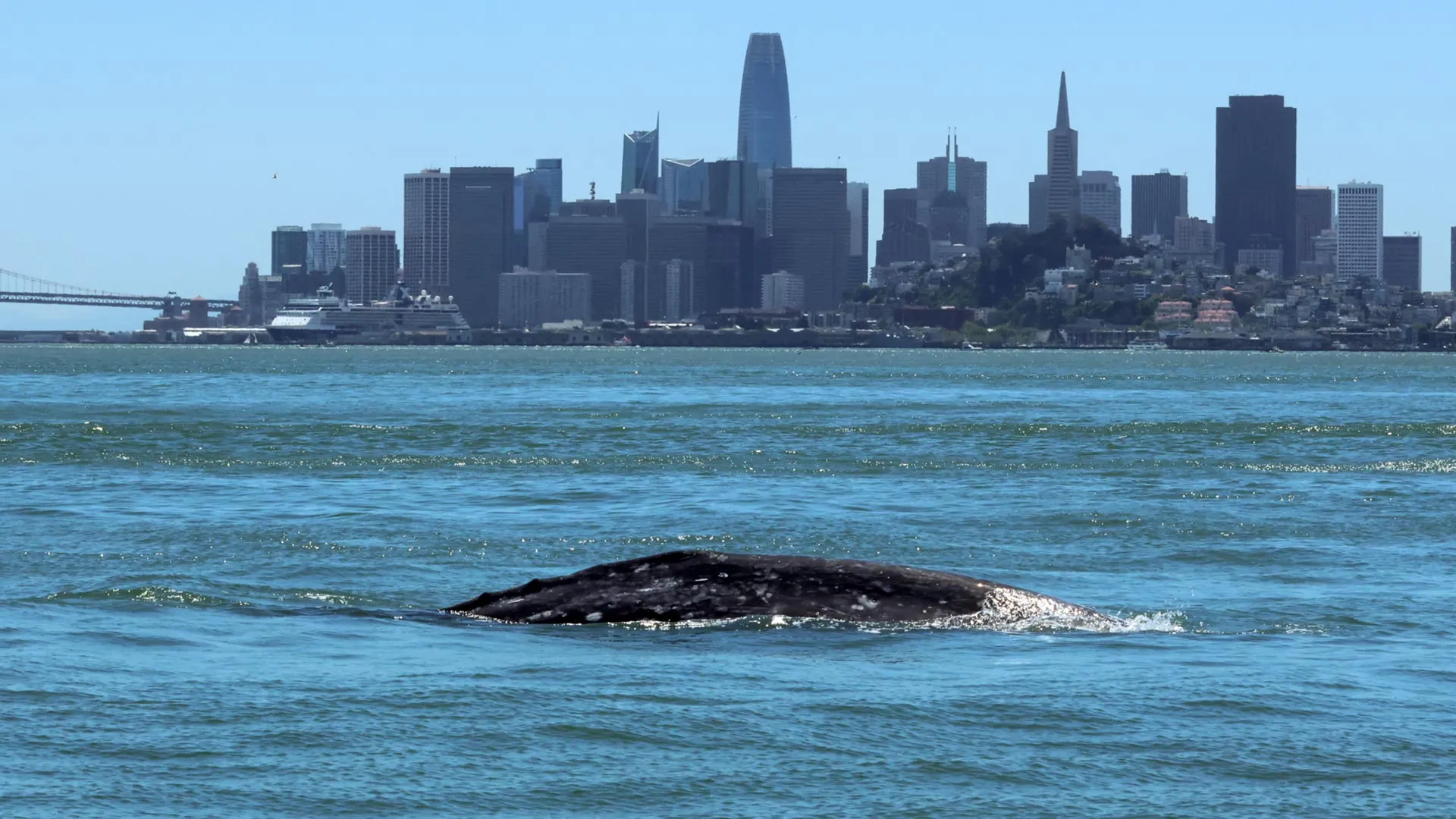
Gray whales, renowned for their epic annual migration between the food-rich Arctic waters and the warm, sheltered lagoons of Baja Mexico, are exhibiting alarming and unprecedented behaviors driven by a rapidly changing climate. This iconic journey, one of the longest of any mammal, is undergoing significant disruption, forcing some whales to seek sustenance in unfamiliar and dangerous territories. A recent comprehensive study, published in Frontiers in Marine Science, sheds critical light on a concerning trend: an increasing number of gray whales are entering San Francisco Bay, a heavily trafficked urban waterway, where a disproportionately high percentage are meeting untimely deaths, predominantly from boat strikes. The research underscores a direct link between oceanic shifts, altered feeding patterns, and a surge in whale mortality within this vital Californian estuary.
A Species Adrift: The Gray Whale’s Shifting Fortunes
Historically, the eastern North Pacific gray whale population has demonstrated remarkable resilience, recovering from near-extinction in the 19th and early 20th centuries. Their traditional migratory route spans approximately 10,000 to 12,000 miles round trip, a testament to their evolutionary adaptations. During this arduous journey, whales typically forgo feeding, relying instead on the substantial energy reserves accumulated during their summer gorging in the Arctic. Their diet primarily consists of amphipods and other small crustaceans filtered from the seafloor. However, the delicate balance of their Arctic feeding grounds is now profoundly threatened by global warming.
Since 2016, the National Oceanic and Atmospheric Administration (NOAA) has observed a dramatic decline in the eastern North Pacific gray whale population, estimating a reduction of more than half. This precipitous drop led NOAA to declare an Unusual Mortality Event (UME) for the species in 2019, which remains active. Scientists attribute this decline largely to widespread nutritional stress, a direct consequence of warming ocean temperatures impacting the availability and distribution of their primary prey in the Arctic. The diminishing sea ice, altered currents, and changes in ocean stratification are all contributing factors to the disruption of the Arctic ecosystem, forcing whales to expend more energy to find less food. Compounding this dire situation, sightings of gray whale calves have become increasingly rare in recent years, signaling potential reproductive challenges and a worrying outlook for future generations.
San Francisco Bay: A Lure and a Trap
San Francisco Bay was not traditionally considered part of the gray whale’s regular migration or feeding grounds. It represented an ecological anomaly for a species typically traversing open ocean or coastal waters with less human impact. Yet, this began to change notably in 2018, when researchers and the public alike started observing gray whales entering the Bay with unusual frequency. This new pattern coincided tragically with a significant rise in local whale deaths, prompting scientists to launch an intensive investigation to understand the phenomenon of these "Bay Grays." The core questions revolved around whether these were transient, desperate individuals or if a new, albeit perilous, behavioral pattern was emerging.
The Bay’s unique geography and environmental conditions present a formidable challenge for marine megafauna. As Josephine Slaathaug of Sonoma State University, lead author of the Frontiers in Marine Science article, explained, "Gray whales have a low profile to the water when they surface, and this makes them difficult to see in conditions like fog which are common to San Francisco Bay." This inherent characteristic, combined with the Bay’s status as a highly trafficked waterway, creates a perfect storm for potential collisions. The Golden Gate Strait, in particular, acts as a critical bottleneck, funneling both immense commercial and recreational vessel traffic, alongside any whales attempting to enter or exit the Bay. This choke point significantly increases the probability of encounters, especially given the whales’ compromised state. The Port of San Francisco, a major international shipping hub, handles millions of tons of cargo annually, with thousands of vessel movements ranging from massive container ships to ferries and recreational boats, all navigating these confined waters.
Unraveling the Mystery of the "Bay Grays"
To gain a clearer understanding of these unprecedented incursions and their deadly consequences, researchers embarked on a multi-year study. Their methodology involved constructing a comprehensive catalog of individual whales sighted in the Bay. This catalog was meticulously built using opportunistic sightings and photographs generously contributed by the public between 2018 and 2023, effectively leveraging citizen science. Complementing these informal observations, more structured surveys were conducted from 2023 to 2025, providing a more systematic data collection approach.
Individual whales were identified based on their unique markings – distinct patterns of barnacles, whale lice, and scars on their skin and flukes. These natural "fingerprints" allowed researchers to track individual movements and determine revisitation rates. The photographic records were then cross-referenced with necropsy data from stranded whales found within the region. Acknowledging the inherent limitations, researchers noted that these unique markings can unfortunately fade or be obscured after death, meaning some potential matches between live sightings and deceased individuals might have been missed. Despite these challenges, the study represents a groundbreaking effort to monitor and understand this novel behavior in real-time.
Grim Statistics: High Mortality Rates Revealed
The findings from this exhaustive study painted a stark and troubling picture. Over the entire study period, a total of 114 individual gray whales were documented entering San Francisco Bay. A key revelation was the low rate of revisitation: only four of these individuals were observed in more than one year. This suggests that for the vast majority, the Bay is likely a desperate, one-time foray rather than a newly established, regular feeding ground. Scientists hypothesize that the Bay functions as an "emergency feeding stop" for whales in extremely poor physical condition, seeking any available sustenance to survive. This theory is supported by observations of unusually thin individuals foraging in other non-traditional habitats along the coast, indicating a broader struggle for survival across the population.
The mortality statistics are particularly grim. Between 2018 and 2025, a staggering 70 gray whales were found dead in the broader San Francisco Bay region. Of these, 30 were definitively confirmed to have died from vessel strikes, underscoring the lethal threat posed by maritime traffic. For the remaining whales where a cause of death could be determined, a significant number showed clear signs of severe malnutrition, reinforcing the hypothesis of widespread food scarcity. Researchers successfully matched 21 of the 45 identifiable dead whales to individuals previously documented in their live sighting catalog. This direct correlation provided compelling evidence of the dangers faced by the "Bay Grays."
Bekah Lane of the Center for Coastal Studies, a co-author of the study, emphasized the severity of the situation: "At least 18% of the individuals identified in San Francisco Bay later died in the area." She further added, "Our broader analysis of local strandings both inside and outside San Francisco Bay found that over 40% of these whales died of trauma from vessels." These figures highlight an alarming mortality rate, suggesting that for many whales seeking refuge in the Bay, it ultimately becomes a death trap.
The Interplay of Starvation and Ship Strikes
The study’s findings present a complex interplay between starvation and vessel strikes. While a significant portion of deaths were attributed directly to collisions, many deceased whales also showed signs of severe emaciation. This leads to a critical question: are weakened, starving whales inherently more vulnerable to ship strikes? It is plausible that whales suffering from nutritional stress are less agile, slower to react, or simply lack the energy to effectively avoid oncoming vessels. Their compromised physical state might diminish their ability to navigate the complex and noisy environment of a busy shipping channel.
Furthermore, the act of foraging itself within the Bay likely increases their exposure risk. Unlike their traditional deep-water feeding, whales in the Bay might be feeding closer to the surface or in areas with higher vessel traffic density. Determining the precise primary cause of death—whether it’s direct trauma from a strike, or whether the strike was a secondary consequence of a weakened state—remains a challenge for marine mammal pathologists. This intricate relationship underscores the multifaceted nature of the threats facing these whales, driven by the overarching pressure of climate change.
Urgent Calls for Protective Measures
In light of these urgent findings, scientists are emphasizing the critical need for more in-depth research to fully comprehend the nuances of why and how whales are utilizing San Francisco Bay. The situation appears to be escalating, with 2025 alone seeing 36 individual whales entering the area, sometimes in groups exceeding ten individuals. This increasing presence necessitates more detailed tracking technologies, such as satellite tagging, and additional necropsies to definitively ascertain whether the low number of returning whales is primarily due to high mortality rates, and whether these deaths are predominantly caused by starvation, vessel strikes, or a synergistic combination of both factors. Understanding these dynamics is paramount for developing effective conservation strategies.
The scientific community, along with conservation organizations, is advocating for a range of preventive measures to mitigate the immediate risks. These include comprehensive educational programs for commercial vessel operators, aiming to raise awareness about whale presence and safe navigation practices. Adjusting ferry routes, particularly during peak whale seasons or in known feeding hotspots, could also significantly reduce collision risks. Furthermore, the implementation of speed restrictions in high-risk areas, such as the Golden Gate Strait and specific zones within the Bay, has emerged as a key recommendation.
Bekah Lane underscored the direct impact of vessel traffic: "In San Francisco Bay, the biggest threat to these whales is vessel traffic." She added, "Continued monitoring will help illuminate their distribution patterns and behaviors while within the Bay, which can impact risk. Route changes and speed restrictions have been found to significantly reduce vessel strike mortality to large whales, and an assessment of risk can help identify the most effective strategies to protect these animals." Precedents exist for such measures; for example, mandatory and voluntary speed restrictions in other heavily trafficked coastal areas, like those implemented for North Atlantic right whales, have demonstrated tangible success in reducing vessel strike incidents. Port authorities and maritime industry stakeholders are increasingly being called upon to collaborate with scientists and regulators to devise practical and effective solutions that balance safe passage with marine wildlife protection.
Beyond the Bay: Broader Implications for a Changing Ocean
While this study provides an invaluable snapshot of gray whale behavior in San Francisco Bay, researchers caution that there are still inherent gaps in the day-to-day understanding of individual whale movements and nuanced behaviors. Nevertheless, the findings offer a powerful illustration of how a charismatic megafauna species is directly responding to, and suffering from, rapidly changing environmental conditions on a global scale.
The gray whale serves as a vital sentinel species, an early warning system for the broader health of our oceans. Their struggle highlights the profound and far-reaching impacts of climate change, not only on polar ecosystems but also on migratory patterns and the intricate balance of marine life worldwide. The challenges faced by these whales in San Francisco Bay are indicative of larger ecological shifts, demanding innovative approaches to marine spatial planning and adaptive management strategies.
As Josephine Slaathaug concluded, "This study is our best analysis of the data we collected, but it’s important to consider that we do not have the full picture of each whale’s movements on a daily timescale." She emphasized, "These results are an important piece of the larger puzzle of what is going on in the overall population as they attempt to adapt to climate change in real time." The fate of the "Bay Grays" is a stark reminder of the urgent need for concerted global action to address climate change and for robust local conservation efforts to protect vulnerable populations attempting to navigate an increasingly uncertain future. The race against time to understand and mitigate these threats is critical, not just for the gray whale, but for the health of our planet’s oceans.
