
Rachel Bigsby, a prominent voice in contemporary nature photography, challenges conventional notions of wildlife imagery, advocating for an approach she terms "natural artistry." Her philosophy transcends mere documentation, aiming instead to capture the profound essence and emotional resonance of the natural world, particularly through her intimate studies of seabirds. For Bigsby, the act of photography is an art of witnessing, a meticulous process of learning nature’s intricate "grammar" through patience and presence, translating it into an experience palpable to those who were not there. This distinctive perspective positions her work not just as visual records, but as narratives etched in light, movement, and the very fabric of the environment.
The core of Bigsby’s vision lies in the belief that true artistry in nature photography is not an imposition by the photographer but an inherent quality awaiting discovery. She describes a critical moment before pressing the shutter when the world seems to pause, allowing a deep connection to the subject. This instant, where a seabird tilts into the wind and light shifts across its feathers, transforms the scene from a simple photographic opportunity into a "sentence being written in a language older than any of us." This profound engagement with the subject’s spirit, rather than its mere physical form, is what Bigsby continually seeks.
Her concept of "natural artistry" finds expression in the fluid grace of a seabird mastering the wind, the subtle interplay of light and feather, the anticipatory stillness before a dive, or the vibrant chaos of a densely packed colony. It encompasses not just aesthetic beauty but the deeper story – the "essence" of a species conveyed through a careful orchestration of light, movement, texture, color, behavior, environment, and perspective. The guiding principle for Bigsby is clear: she aims to photograph what it feels like to be near seabirds, rather than merely depicting them as static objects. This emphasis on subjective experience and emotional truth marks a significant departure from traditional wildlife photography’s focus on clinical precision.

A Deep-Rooted Connection to the Wild: Bigsby’s Journey
Rachel Bigsby’s profound relationship with the natural world began long before she ever picked up a camera. Her late grandfather, a dedicated naturalist and fisherman, instilled in her a fundamental understanding of nature, teaching her not just to observe, but to "truly see" and to approach the environment with reverence. This early education bypassed factual rote learning, instead fostering an attentive and appreciative bond with the wild.
At the tender age of six, Bigsby joined the Scout Association, an affiliation that, unbeknownst to her at the time, would irrevocably shape her life’s trajectory. Weekends became immersive experiences on rugged trails, navigating with weathered maps, fostering an intimacy with the outdoors where the landscape transitioned from mere "scenery" to a profound companion. Nature served as her primary classroom, and she, its eager and dedicated student.
Photography entered her life more subtly. A childhood friend introduced her to the medium, prompting initial experiments with an iPod camera. These early explorations focused on minute details: the way morning light illuminated dewdrops, or how a dandelion’s silhouette mimicked a drawing. While her friend’s interest waned, Bigsby’s deepened, marking the nascent stages of her artistic path.
A pivotal moment occurred when she witnessed a Northern Fulmar gliding effortlessly along cliffs near her home. Its wings, held rigid and assured, demonstrated an unparalleled oceanic mastery, defying gravity with an almost structural elegance. This encounter sparked an intense curiosity, leading Bigsby to research the Fulmar, discovering its kinship with the albatross, a bird of legend and her childhood dreams. This revelation, she states, didn’t merely interest her; it "claimed" her, cementing seabirds as her central muse.

From this point, seabirds ceased to be a mere photographic subject and became her entire world. Bigsby diligently saved for her first DSLR camera, which opened up wider horizons: new species, diverse colonies, and an array of new questions. As her images gained public recognition, opportunities emerged, and she quickly learned that her path would be unconventional. She volunteered extensively, exchanging labor – from cleaning compost toilets on remote islands and scything bracken in summer heat to repairing ancient, weather-beaten doors – for invaluable access to seabird habitats. By day, she worked; by dusk, the colonies reclaimed their own rhythm, and Bigsby found her place among them, observing, listening, and learning. This immersive period, characterized by deep understanding of seabird behaviors, biology, and ecology rather than just photography, forms the bedrock of her work’s credibility.
Challenging the Conventional: Beyond Technical Perfection
Bigsby critically examines the prevailing discourse in wildlife photography, which often prioritizes technical perfection: razor-sharp focus, pristine backgrounds, and adherence to textbook compositional rules. She argues that this relentless pursuit of flawlessness can lead to images that, while competent, are ultimately forgettable – pictures that show what a bird looks like, but fail to convey its intrinsic being.
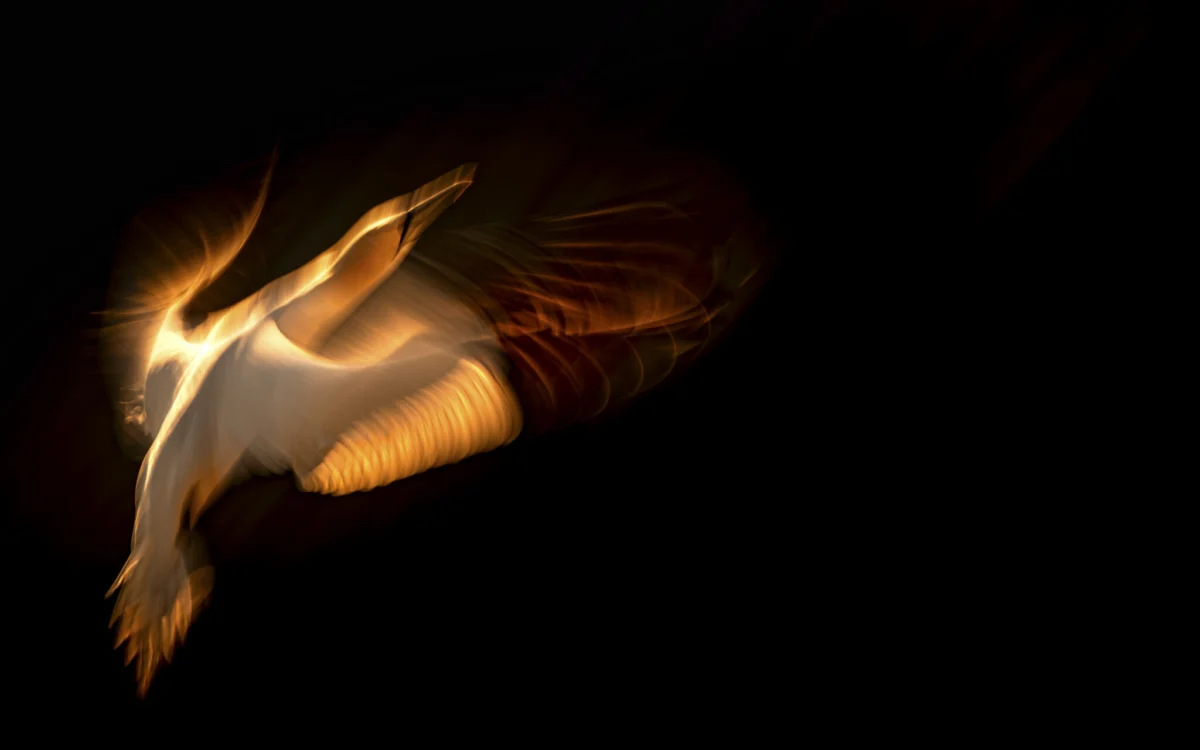
A transformative experience for Bigsby involved a photograph she captured that defied these conventional standards. The image, depicting an Atlantic Puffin in flight, was characterized by soft focus, a slow shutter speed, and a cluttered background. Yet, it possessed a captivating golden light that pierced through the puffin’s delicate wings, rendering its movement as a blur – a "whisper of motion" dissolving into the atmosphere. This image, she reflects, resonated deeply precisely because it didn’t conform to a checklist of technical perfection; it evoked a profound feeling.
This experience solidified her understanding that wildlife photography extends beyond mere documentation; it is fundamentally about storytelling, emotion, and artistry. The wild, Bigsby asserts, is inherently untamed and unpredictable. Seabirds do not perform for the camera; their lives are governed by elemental forces – weather, tide, hunger, fear, devotion, and instinct. Their world is a chaotic, fluid, and vibrant reality. To present their lives through sterile, "perfect" images, she argues, would be disingenuous.

Bigsby recounts a period where she initially sought ideal conditions: calm air, soft light, clear sight-lines. A week-long volunteering stint on an island, however, presented nothing but persistent rain, fog, and mist. Initially heartbroken by what she perceived as "bad weather," she eventually realized that her frustration stemmed from trying to impose an artificial idea of perfection onto nature. For the birds, these were not adverse conditions; they were simply "life." This realization prompted a shift: instead of resisting, she began to collaborate with the environment. The fog became a blank page, the whiteness a canvas, inadvertently leading her to explore high-key imagery, which later became a hallmark of her visual style. This experience profoundly altered her perception of light, teaching her that the most meaningful images often arise when one stops demanding specific conditions and instead observes and responds honestly to what is already present.
The Elements of Natural Artistry: Light, Shape, Texture, Environment
At its core, "natural artistry" for Bigsby is about perceiving beyond the obvious. It involves recognizing the innate patterns, textures, forms, and subtle geometries that imbue nature with a masterpiece-like quality. These elements, she emphasizes, are not invented by the photographer but have existed for millennia, and the photographer’s role is to notice and translate their energy into a compelling still frame.
Bigsby actively seeks artistry in elements often overlooked as "the subject" itself:
- The rippling surface of the sea, sculpted by the wind.
- The rugged, time-worn contours of a cliff face.
- The delicate barbs of a feather, catching light at a precise angle.
- The expansive negative space of the sky, imparting a sense of weightlessness to a solitary bird.
- The sheer density of a colony, where repetition transforms into pattern, and pattern evolves into intricate design.
By moving beyond the rigid expectation of a clean portrait, Bigsby encourages a more abstract and expressive engagement with nature. This approach shifts the focus from "hunting for a good subject" to "listening for composition" – an intuitive understanding of shape, line, rhythm, contrast, and restraint. She posits that often, the most powerful images are the simplest, embracing minimalism to allow a single bird against a vast sky or a solitary gesture within emptiness to convey profound emotion: freedom, loneliness, resilience, or endurance. Allowing the frame to "breathe" deepens the narrative rather than forcing it.

This philosophy leads Bigsby to diverge sharply from the notion that a wildlife image must be perfect to be powerful. For her, "imperfection is artistry." A seabird battered by wind, its feathers ruffled into wild disarray, communicates a more profound narrative than a static, perfectly groomed counterpart. A blur of motion can convey more truth about the dynamic act of flight than a perfectly frozen wing. Mist and rain are not obstacles to be overcome but essential atmospheric elements, integral to the emotional reality of a seabird’s existence.
Light, for Bigsby, is not a technical parameter but the "emotional spine" of an image. While a subject’s presence is constant, light fundamentally shapes how it is perceived, felt, and remembered. She recalls a morning in Shetland where the seabird colony lay in darkness, save for the highest peaks of rock glowing with the first light. A single Gannet then ascended from shadow into this illumination, its white wings stark against the dark cliff, appearing like a deliberate brushstroke. This moment, she explains, taught her what no manual could: light is not just about clarity, but about drama, about "mood made visible."
Her use of color similarly prioritizes emotional tone over mere vibrancy. For instance, Northern Fulmars possess subtle, stormy hues of slate-grey, which are best complemented by chalk-white cliffs or dark grey rock, allowing their inherent mood to resonate, rather than being overwhelmed by a bright blue backdrop. When color becomes a distraction, she intentionally opts for monochrome, viewing black and white not as a shortcut to seriousness, but as a deliberate choice to direct attention to the fundamental "bones of the image": shape, light, and texture.
Texture, in Bigsby’s work, makes a photograph tangible, allowing the viewer to almost "feel salt in the air." Shape lends intentionality, transforming wildlife into design through curves, arcs, symmetry, and contrast. Critically, environment is never merely a background; it is a fundamental aspect of character. A bird without context is "just an animal"; a bird honestly situated in its world becomes a story, conveying scale, struggle, intimacy, resilience, and fragility. This environmental context, she acknowledges, can also carry difficult truths—beauty intertwined with grief, life alongside loss. Bigsby believes photography can ethically convey this complexity by remaining truthful, respectful, and intentional, without exploitation.

Patience, Presence, and the Language of Birds
Bigsby defines patience not as passive waiting, but as an informed anticipation, "knowing what you are waiting for." Her extensive understanding of seabird behavior is akin to learning a new language, where recognizing patterns and cues transforms the wild from a random spectacle into a readable narrative. This enables her to anticipate actions rather than merely reacting, shifting photography from luck to intentionality.
She has dedicated countless hours to observing seemingly ordinary seabird activities: preening, shifting, calling, settling, and rising. Yet, it is in the smallest changes—a tightening posture, a lifting glance, a repeated gesture—that she discerns the signals of impending action. This deep observational practice fosters a profound shift in the photographer-subject relationship, moving from "taking" to "listening."
Through this sustained listening, Bigsby is often rewarded with moments that feel like gifts: intimate reunion rituals, courtship exchanges, synchronized movements between bonded birds, or sudden instances of tenderness amidst colony chaos. These are more than mere behaviors; they are powerful stories of devotion, endurance, and survival, unfolding on the precipitous cliff edges where the wind never truly rests. This intrinsic drama and resilience are why seabirds remain her enduring muse, embodying freedom and strength, sculpted by time and tide, and inspiring a sense of liberation in their presence.
An Invitation to Authentic Expression
While acknowledging the undeniable importance of technical proficiency, Bigsby firmly asserts that camera settings are merely "scaffolding." They can produce an image, but they cannot imbue it with soul. The enduring quality of a photograph, she argues, stems not from a dial setting, but from the photographer’s unique vision: their way of seeing, feeling, and connecting.

She challenges the prevalent dogma of rules in photography, noting that the images that truly endure and resonate are rarely those that meticulously followed every convention. Instead, they are the ones imbued with honesty, those that evoke genuine emotion. Bigsby hopes her work grants others "permission" to create photographs that are personally meaningful, even if they deviate from established expectations.
In an era saturated with formulaic imagery, Bigsby believes the world needs photographs born of the heart – images that educate through their inherent beauty and honor the wild by truthfully depicting its reality. Her concluding advice to aspiring photographers is to approach their craft gently, observe closely, wait longer than instinct suggests, embrace challenging weather as a compositional element, and photograph the world not just as it appears, but as it profoundly feels. She reminds us that "no one else sees like you do," underscoring the invaluable power of individual perspective in capturing the untamed spirit of nature.
