

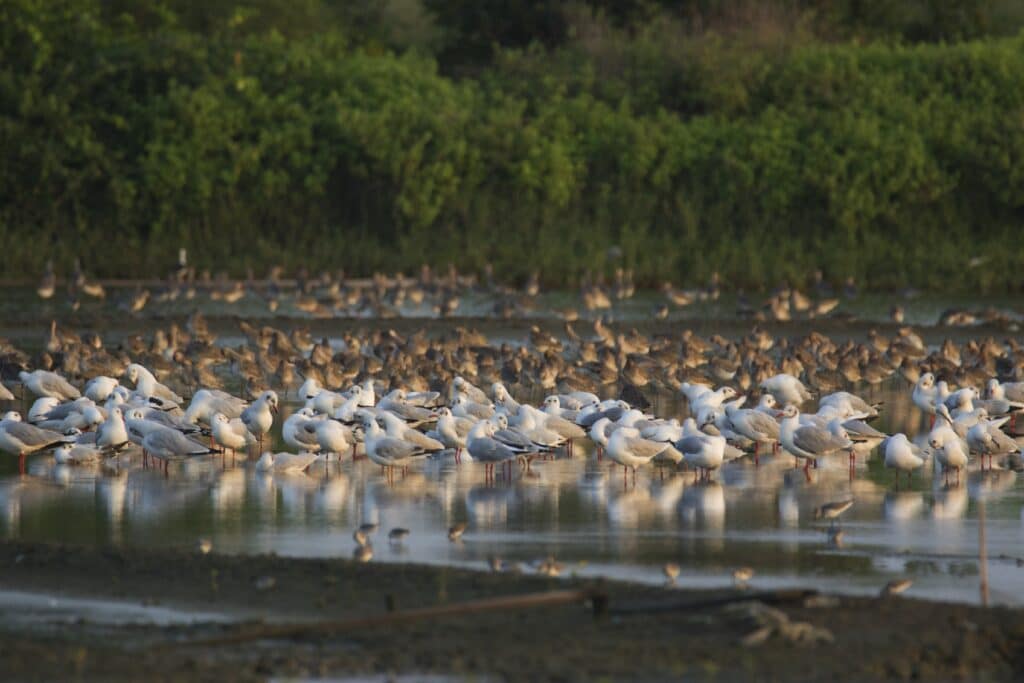
Against the clear blue backdrop of the Gulf of Thailand, hundreds of birds suddenly take flight, their small white and grey wings creating a pixelated wall that skims the surface of the water. These shorebirds are all here for the same reason: to feed on the plentiful organisms living on the coastal mudflat. This vibrant ecological tapestry, however, is now under imminent threat from proposed industrial development.
Pak Thale: A Vital Node on the East Asian-Australasian Flyway
Every winter, these shorebirds descend upon the wetlands at Pak Thale Nature Reserve in Southern Thailand, having travelled from their summer homes as far north as the Arctic Circle. Pak Thale is not merely a scenic stopover; it is a vital wintering and refueling site on the East Asian-Australasian Flyway (EAAF), one of the world’s most critical and extensive bird migration routes. Spanning 22 countries and covering over 13,000 kilometers, the EAAF connects breeding grounds in Arctic Russia and Alaska with non-breeding areas in Southeast Asia and Australasia. It is a lifeline for over 250 species of migratory waterbirds, with an estimated 50 million individuals relying on its network of wetlands, mudflats, and coastal habitats. The integrity of this flyway hinges on the health of each stopover site, making places like Pak Thale indispensable for the survival of countless species.
The unique intertidal mudflats of Pak Thale offer an unparalleled abundance of invertebrates, crucial for birds to replenish energy reserves depleted by their arduous journeys. For many species, the availability of such rich feeding grounds at predictable locations is the difference between survival and starvation. Without adequate food and rest, migratory birds cannot complete their epic annual migrations, leading to population declines that cascade across the flyway.
A Sanctuary Forged by Conservation and Community
Recognizing Pak Thale’s profound importance, particularly for some of Asia’s rarest avian species, the Bird Conservation Society of Thailand (BCST), a BirdLife Partner, took decisive action in 2019. In a significant move to secure this critical habitat, BCST purchased 8 hectares of land along the coast to establish a dedicated wildlife sanctuary. This proactive measure underscored the growing urgency to protect vital stopover sites in the face of rampant coastal development across the region.
Since its establishment, the Pak Thale Nature Reserve has become a globally renowned hotspot for birdwatchers and researchers. Its relatively small and accessible size allows for exceptional views of highly sought-after species, making it a unique destination in Southeast Asia. Among the illustrious visitors are the Critically Endangered Spoon-billed Sandpiper (Calidris pygmaea), a species with fewer than 500 mature individuals left in the wild, instantly recognizable by its spatulate bill. Other critically important species regularly observed include the Endangered Far Eastern Curlew (Numenius madagascariensis), the Great Knot (Calidris tenuirostris), and the Spotted Greenshank (Tringa guttifer). For many birdwatchers, Pak Thale offers a rare opportunity to observe all these imperiled species within a single day, a testament to its ecological richness and conservation value.
Beyond its ecological significance, Pak Thale has also become a model for sustainable community development. BCST has actively fostered ecotourism, transforming it into a valuable income stream for local residents. The society has invested in training community members to become expert bird guides, empowering them with new skills and creating direct economic benefits from conservation. Furthermore, BCST engaged with local salt farmers, helping them to develop and market "biodiversity-friendly salt." This initiative not only provides a profitable and sustainable avenue for their produce but also incentivizes farming practices that are compatible with the ecological needs of the reserve, demonstrating a harmonious coexistence between human livelihoods and nature.
The Looming Threat: Industrial Development on the Horizon

This carefully cultivated balance of nature and community is now gravely imperiled. News of a proposed oil refinery and power plant, slated for construction mere kilometers from the Pak Thale Nature Reserve, has sent shockwaves through the conservation community and among local residents. The prospect of heavy industry in such close proximity to a globally significant wetland presents an existential threat to both the birds and the livelihoods that depend on them.
The details surrounding the proposed development indicate a substantial industrial complex, designed to meet the region’s energy demands and fuel economic growth. While proponents of such projects often emphasize job creation and energy security, the location of this particular development raises serious questions about its environmental and social viability. The proximity to a Ramsar-designated site (or a site with similar international recognition, given its EAAF importance) and a community-led conservation initiative underscores a potential conflict between national development goals and international conservation commitments.
Environmental and Economic Catastrophe: The Dual Impact
The potential environmental ramifications of an oil refinery and power plant near Pak Thale are extensive and catastrophic. An oil refinery, by its very nature, is a major source of air and water pollution. Atmospheric emissions would likely include sulfur dioxide, nitrogen oxides, volatile organic compounds, and particulate matter. These pollutants can degrade air quality, causing respiratory issues in humans and animals, and creating smog that obscures visibility, which could disorient migratory birds. Acid rain, a consequence of sulfur and nitrogen oxide emissions, could acidify the wetland, altering its pH balance and impacting the delicate food web upon which the shorebirds depend.
Water pollution poses an equally dire threat. Runoff from the refinery, containing heavy metals, hydrocarbons, and other toxic chemicals, could contaminate the coastal mudflats and the Gulf of Thailand. Even minor spills or accidental discharges could have devastating effects on marine organisms, which form the base of the food chain for the shorebirds. The ingestion of contaminated prey can lead to illness, reproductive failure, and mortality in birds. Furthermore, chronic low-level pollution can reduce the abundance and diversity of organisms, diminishing the food supply and rendering the habitat unsuitable for foraging.
The proposed power plant introduces its own set of hazards. Beyond air and water pollution associated with energy generation (depending on the fuel source, likely fossil fuels), the infrastructure itself poses a direct threat. Low-flying birds, particularly during migration or in adverse weather conditions, are highly susceptible to collisions with live electrical wires and transmission towers. Such collisions are a significant cause of mortality for migratory birds globally, and their impact would be particularly severe for already endangered species. Thermal pollution from the discharge of heated water into the Gulf could also alter local marine ecosystems, further disrupting the delicate balance.
The economic implications for the local community are equally grim. The vibrant ecotourism industry, carefully built over years by BCST and local residents, would undoubtedly collapse. Birdwatchers, seeking pristine natural environments and healthy bird populations, would be deterred by the presence of heavy industry and pollution. The loss of ecotourism would mean the loss of income for trained guides, local guesthouses, restaurants, and other businesses that benefit from the influx of visitors. Similarly, the market for "biodiversity-friendly salt" would likely vanish, as the very premise of its sustainability and environmental consciousness would be undermined. Without the birds, there is no longer ecotourism, no market for specialized salt, and no sustainable future for the community that has invested so much in its natural heritage.
The Broader Flyway Crisis: A Cumulative Impact
The potential loss of Pak Thale is not an isolated incident; it represents a critical blow within a larger, ongoing crisis along the East Asian-Australasian Flyway. Across the flyway, coastal wetlands are rapidly disappearing due to relentless urban expansion, industrial development, and aquaculture. These crucial rest stops and feeding grounds are becoming increasingly fragmented and less frequent. For migratory birds, losing a site like Pak Thale is not as simple as finding another place to rest. Migratory journeys are energetically demanding, requiring precise timing and readily available resources at predictable locations. Each lost stopover site increases the distance between refueling points, demanding more effort and energy from the birds, often beyond their physiological limits.
For critically endangered species like the Spoon-billed Sandpiper, whose global population is precariously low, the loss of a single vital site like Pak Thale could spell an irreversible decline towards extinction. Every individual bird is critical, and every suitable habitat is a sanctuary. The cumulative effect of habitat loss across the EAAF is pushing these species to the brink, making the protection of every remaining site paramount. International conservation efforts, such as the EAAF Partnership, work tirelessly to identify and protect these sites, but local development pressures often override these broader ecological considerations.
Community Mobilization and Conservation Response
Upon learning of the proposed development, the Bird Conservation Society of Thailand swiftly mobilized. Understanding the gravity of the situation, BCST launched a robust campaign to raise awareness and rally support against the project. This included engaging directly with local community members, who are the most immediate stakeholders. Niyom Thongmeun, Pak Thale Manager for BCST, has been at the forefront of this effort, conveying the message of impending doom for both the local economy and the natural environment. Signs carried by community members, like Niyom’s, explicitly state: "This affects ecotourism and the bird habitat," directly linking the proposed industrialization to the tangible losses facing their lives and the ecosystem.
BCST has initiated a public petition, urging individuals, both within Thailand and internationally, to voice their opposition to the project. This petition serves as a critical mechanism for demonstrating widespread concern and influencing decision-makers. The campaign highlights the established value of Pak Thale as a natural asset, its role in global biodiversity, and the successful model of sustainable development it represents. It also seeks to counter arguments that prioritize short-term economic gains over long-term environmental sustainability and community well-being.
Balancing Act: Development vs. Conservation
The conflict at Pak Thale is emblematic of a broader challenge faced by many developing nations: how to balance the undeniable need for economic growth and energy security with the imperative of environmental conservation. Thailand, like many countries in Southeast Asia, is experiencing rapid industrialization and urbanization, leading to increasing energy demands. Large-scale infrastructure projects like oil refineries and power plants are often seen as essential components of national development strategies.
However, the location of such projects is crucial. Siting heavy industry in close proximity to ecologically sensitive areas carries significant risks that can far outweigh the perceived economic benefits. The long-term costs of environmental degradation, biodiversity loss, and the destruction of sustainable livelihoods often prove to be far greater than the initial economic gains. A thorough and transparent Environmental Impact Assessment (EIA) process is critical, one that genuinely considers cumulative impacts, alternative sites, and the full range of socio-economic and ecological consequences. Such an assessment should not only evaluate the direct impacts but also the indirect and induced impacts on the entire regional ecosystem and the communities dependent on it.
International Significance and Call to Action
The fate of Pak Thale resonates far beyond Thailand’s borders. As a vital link in the East Asian-Australasian Flyway, its protection is a matter of international concern. The migratory birds that grace its shores are shared heritage, traversing multiple nations and relying on the collective stewardship of each country along their route. The international community, through organizations like BirdLife International and the EAAF Partnership, has a vested interest in ensuring that such critical sites are preserved.
The message from Niyom Thongmeun, Pak Thale Manager for BCST, encapsulates the urgency of the situation: "We cannot guarantee when the final migration of migratory birds will occur, because both humans and birds are facing the same fate. Let’s work together to stop the fossil fuel industry." His words underscore the interconnectedness of human well-being and environmental health, linking the immediate threat to Pak Thale with the broader global challenge of climate change and the transition away from fossil fuels.
The decision regarding the proposed oil refinery and power plant at Pak Thale will be a critical test of Thailand’s commitment to sustainable development and its role as a steward of global biodiversity. It will determine whether a thriving, community-led conservation success story can withstand the pressures of industrial expansion, or if a vital link in the chain of life for migratory birds will be irrevocably broken. The call to action is clear: help ensure that this unique haven for migratory birds remains protected. Sign the petition here to share your voice and stand with the community and conservationists working tirelessly to safeguard Pak Thale for future generations of both birds and people. Together, a strong collective voice can ensure that Pak Thale remains a sanctuary, a testament to the power of nature, and a beacon of hope along the East Asian-Australasian Flyway.
