
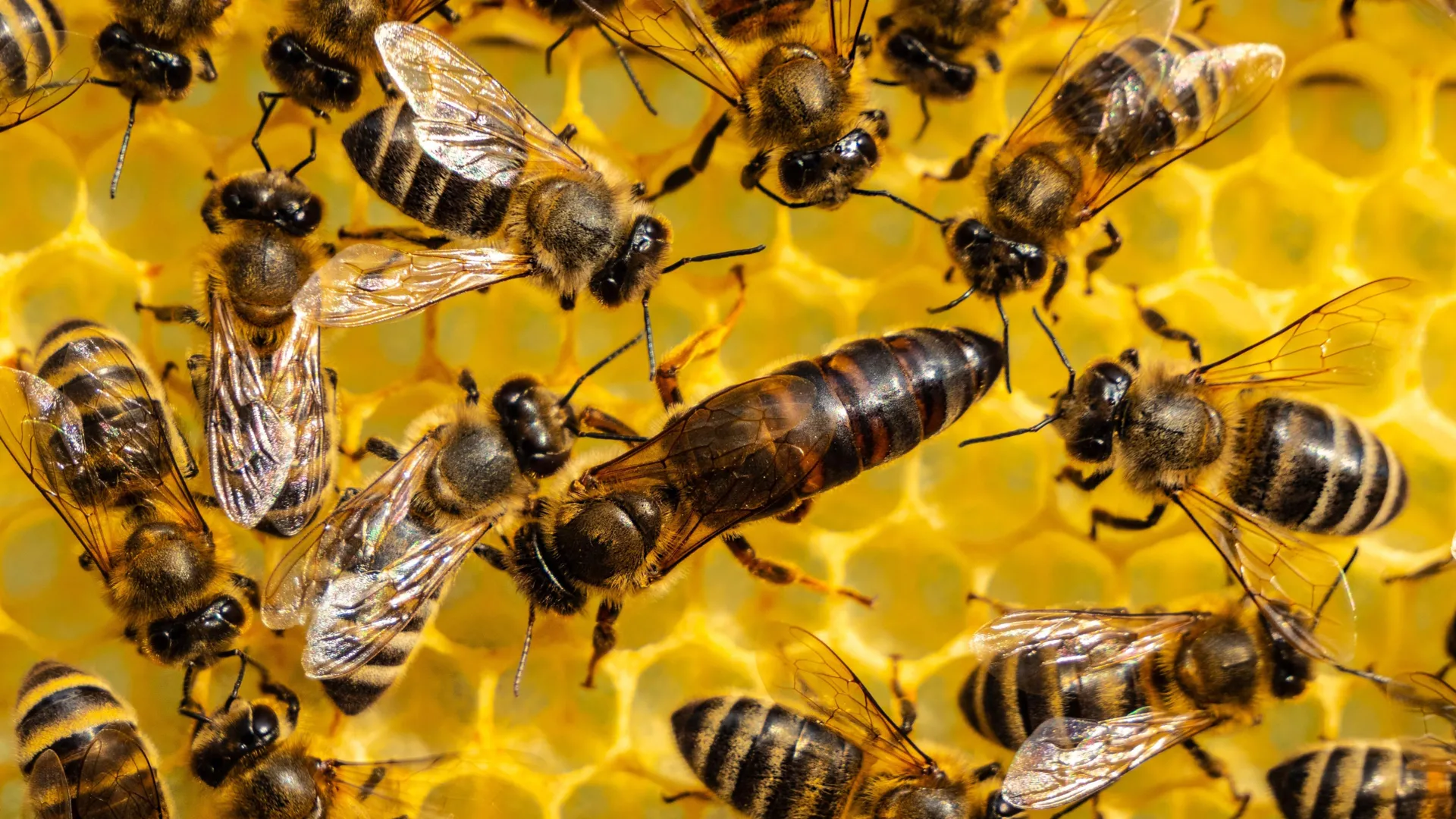
In the complex and highly organized society of a honeybee colony, survival depends on a meticulous division of labor. For generations, entomologists and beekeepers understood that worker bees served as the primary biological shield against environmental hazards. These diligent foragers filter out harmful pathogens, heavy metals, and synthetic agricultural chemicals before these toxins can penetrate the inner sanctum of the hive and reach the sovereign queen. However, groundbreaking new research has revealed that this protective barrier is not impenetrable. When worker bees become overwhelmed by prolonged chemical exposure, honeybee queens deploy a desperate, last-resort biological mechanism of their own: they offload accumulated toxic substances directly into their developing eggs.
Published in the journal Current Biology, this revealing study was spearheaded by researchers at the University of California, Davis, in close collaboration with the Lawrence Livermore National Laboratory (LLNL) and the U.S. Department of Agriculture’s Agricultural Research Service (USDA-ARS). The findings provide the scientific community with its very first empirical documentation of how far a honeybee queen will go to purge her own bodily tissues of chemical contaminants, shedding critical new light on the insidious, cumulative threats facing global pollinator populations.
The Mechanics of Maternal Offloading
At the heart of the discovery is a physiological process that researchers have termed "maternal offloading." As agricultural chemicals, urban pesticides, and industrial pollutants accumulate in the environment, they inevitably find their way into the nectar and pollen gathered by foraging honeybees. While worker bees act as an initial line of defense by metabolizing or sequestering a significant portion of these toxins, continuous exposure over time tests the limits of their biological filtering capacity.
When these defenses begin to buckle, trace amounts of pesticides bypass the worker bees and enter the hemolymph and tissues of the queen. To prevent acute toxicity and preserve her own immediate survival, the queen routes these xenobiotic compounds away from her vital organs—such as her neural tissue and flight muscles—and deposits them straight into her ovaries. Consequently, the toxins become embedded inside the yolks of her eggs.
"In order to protect herself, the queen bee offloads these chemicals into her eggs to get rid of them," explained Sascha Nicklisch, the senior author of the study and an associate professor in the Department of Environmental Toxicology at UC Davis. "No one has shown this in honeybees before."
This revelation fundamentally alters how toxicologists view the lifecycle of a managed or wild honeybee colony. Rather than simply acting as a secure nursery for the next generation, the brood comb may inadvertently become a toxic sink, receiving chemical residues passed down directly from the maternal matriarch.
Replicating the Hive: The Nanocolony Experiment
To investigate the intricate pathways of chemical accumulation and distribution within a hive, the research team had to devise a controlled, experimental environment that mirrored real-world conditions without risking full-scale apiaries. Led by Angela Encerrado-Manriquez, a recent Ph.D. graduate from UC Davis and the paper’s lead author, the scientists constructed specialized miniature test systems known as "nanocolonies."
Each nanocolony consisted of a compact conical plastic container equipped with a netted bottom to ensure proper ventilation. Housed inside each unit was a single honeybee queen accompanied by a cohort of 60 worker bees. This setup allowed the researchers to closely monitor the interactions between the workers, the queen, and the provisioned resources.
Over the course of the study, the nanocolonies were fed controlled rations of pollen, water, and sucrose syrup contaminated with methyl parathion—an organophosphate insecticide commonly deployed in agricultural settings. To track the exact movement of the chemicals through the tiny hive ecosystems, the researchers utilized a low-level radioactive carbon marker attached to the pesticide molecules. This radioactive tagging enabled the team to trace the chemical’s journey with pinpoint precision, even at minuscule concentrations that would typically evade standard laboratory detection methods.
The chronologic tracking revealed a distinct shift in the colony’s filtering efficacy over a ten-day period. On the very first day of the experiment, the worker bees demonstrated remarkable efficiency, successfully filtering out and sequestering approximately 95 percent of the ingested pesticide, diverting it safely away from the queen and into the surrounding wax honeycomb.
However, as the days progressed, the burden of continuous exposure began to take its toll. By day 10, the worker bees’ filtration efficiency dropped to 86 percent. This diminishing capacity meant that increasingly larger quantities of the chemical were slipping past the workers and accumulating within the bodies of the queens, triggering the maternal offloading response.
Advanced Technology Unlocks Trace-Level Tracking
A significant technological hurdle in modern environmental toxicology is the ability to detect and quantify chemical residues at sub-lethal, environmentally relevant concentrations. Traditional analytical instruments often require high threshold levels to register a positive result, missing the slow, creeping accumulation of toxins that occur in natural settings.
To overcome this obstacle, the UC Davis team partnered with scientists at the Lawrence Livermore National Laboratory, leveraging their world-class nuclear and analytical infrastructure. LLNL researchers utilized Accelerator Mass Spectrometry (AMS)—specifically biological accelerator spectrometry, or BioAMS—to measure the radioactive isotopes with extraordinary sensitivity.
"With BioAMS, we can trace very low levels of a pesticide," noted Bruce Buchholz, an LLNL scientist and co-author of the study. "The pesticide concentrations we used were not lethal and were environmentally relevant to that seen in nature."
This partnership bridged the gap between macro-level entomology and micro-level molecular tracking. By combining the USDA’s deep expertise in honeybee biology with LLNL’s ultra-sensitive physical measurement tools, the research team was able to map the exact distribution of chemicals across every tier of the colony: the queen’s ovaries, her internal organs, the worker bees, the developing eggs, and the wax comb.
Broader Implications for Agriculture and Food Security
The implications of these findings extend far beyond academic curiosity. Honeybees are foundational pillars of both natural ecosystems and commercial agriculture. It is widely estimated that honeybees and other pollinators are responsible for pollinating roughly one-third of all agricultural crops consumed by humans globally, including high-value fruits, vegetables, nuts, and forage crops for livestock.
The health of a honeybee colony is inextricably tied to the reproductive output of its queen. A healthy, productive queen is capable of laying between 1,500 and 2,000 eggs every day, supplying the massive workforce required to maintain hive temperature, forage for resources, and care for developing larvae.
However, the discovery of maternal offloading introduces a troubling ecological paradox. While the mechanism successfully preserves the life of the queen in the short term, it potentially compromises the viability of the very offspring required to sustain the colony.
"When pesticides accumulate to the extent that the queen bee has eggs that are so loaded they may no longer develop properly, there could be a tipping point," Nicklisch warned. "There may be a slow creeping effect of chemical accumulation that will contribute to delayed colony collapse."
This delayed collapse phenomenon may help explain a long-standing mystery in apiculture: why some colonies seemingly wither and die months after a heavy pesticide exposure event, even when visible acute mortality among worker bees was relatively low. If successive generations of worker larvae are continuously exposed to maternal toxins during their embryonic development, hatching rates may decline, developmental deformities may rise, and the overall workforce may experience cognitive or physiological impairments that hinder foraging success.
Furthermore, the study challenges current risk-assessment models used by environmental regulators and integrated pest management (IPM) planners. Historically, pesticide toxicity tests have focused predominantly on acute worker mortality—measuring how many foraging bees die within 48 to 96 hours of exposure. This narrow focus overlooks the chronic, sub-lethal accumulation of chemicals inside the hive architecture and the reproductive toll taken on the queen over her multi-year lifespan.
Expert Reactions and the Path Forward
The publication of the study has drawn widespread attention from agricultural extension specialists, apiary researchers, and commercial beekeeping associations, all of whom grapple with escalating colony losses year after year.
Industry analysts point out that modern agricultural landscapes often expose honeybees to a complex cocktail of multiple agrochemicals simultaneously, including systemic insecticides like neonicotinoids, fungicides, and acaricides used to combat parasitic varroa mites. While the UC Davis study focused specifically on methyl parathion as a model compound, researchers emphasize that the underlying physiological stress of maternal offloading likely applies to a broad spectrum of persistent environmental contaminants.
"The queen is the only member of the hive who can lay eggs that become the next generation of workers," Nicklisch reiterated, underscoring her irreplaceable role in colony survival. "She keeps the colony alive, so understanding how pesticides can affect queen bees and also her offspring is important."
Despite these concerning insights, the researchers caution that many critical questions remain unanswered. Future studies must determine the precise threshold at which maternally offloaded toxins begin to impair embryonic development or larval viability. Scientists also need to investigate whether different classes of chemicals—such as lipophilic versus water-soluble compounds—are offloaded at varying rates, and whether queens possess any capacity to detoxify these substances before depositing them into their eggs.
Additionally, researchers hope to explore whether older queens, which have accumulated a higher lifetime chemical burden, exhibit diminished reproductive success compared to younger queens in chemically intensive agricultural zones.
The collaborative research initiative was made possible through financial and logistical backing from several key institutions. Support was provided by the USDA’s National Institute of Food and Agriculture and its Non-Assistance Cooperative Agreement program, alongside the PAm-Costco USA Scholarship program and the University of California National Laboratory Fees Research Program. Work conducted at the Lawrence Livermore National Laboratory was performed under the auspices of the U.S. Department of Energy. In addition to Nicklisch, Encerrado-Manriquez, and Buchholz, the research team included Julia Fine and Eliza Litsey with the USDA-ARS, as well as David Baliu-Rodriguez and Sean Leonard at LLNL.
As agricultural demands continue to intensify and chemical pressures on insect populations mount, understanding the hidden physiological costs borne by queen bees represents a vital step forward. By uncovering the microscopic battlegrounds within the hive, scientists hope to pave the way for more effective conservation strategies, improved pesticide regulatory frameworks, and ultimately, healthier apiaries capable of sustaining global food production for decades to come.
