
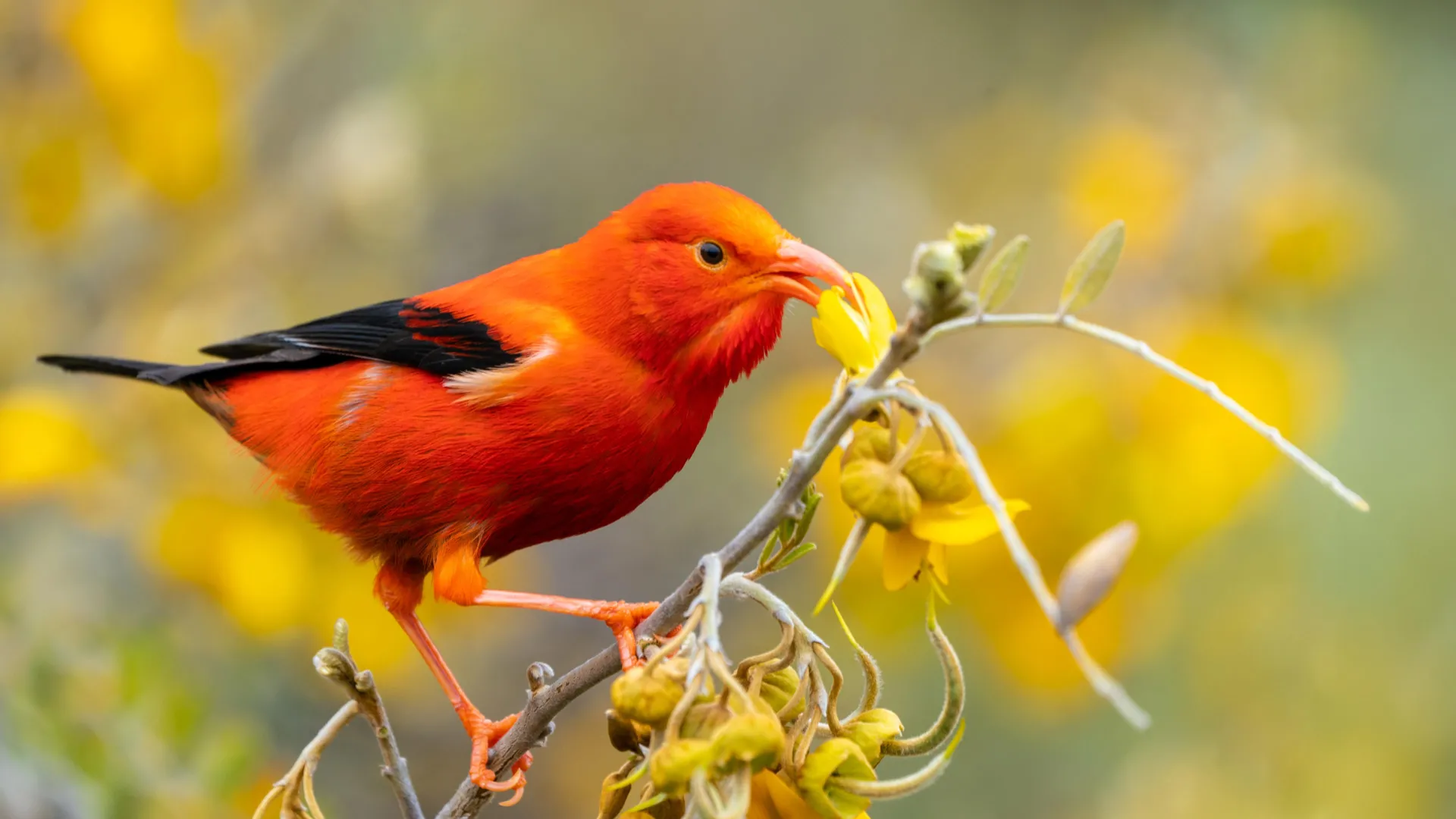
A groundbreaking new study led by researcher Christa M. Seidl, conducted as part of her Ph.D. at the University of California, Santa Cruz, and affiliated with the University of Hawaiʻi at Mānoa, has unveiled a critical and pervasive threat to the archipelago’s unique avian biodiversity. The comprehensive research indicates that nearly every forest bird species in Hawaiʻi possesses the capability to transmit avian malaria, a widespread ability that provides a stark explanation for the disease’s ubiquitous presence across mosquito-infested habitats throughout the islands. This alarming finding, published on February 10 in the prestigious journal Nature Communications, underscores the profound challenges facing Hawaiian bird conservation and highlights the urgent necessity of advanced mosquito control measures.
Unprecedented Scope of Avian Malaria Spread
The study’s extensive fieldwork and laboratory analysis revealed avian malaria at 63 of 64 locations sampled across the Hawaiian Islands, including sites with vastly different compositions of bird species. This near-universal detection rate paints a grim picture of the disease’s entrenchment within the delicate Hawaiian ecosystem. The illness, caused by the generalist parasite Plasmodium relictum, has long been recognized as a primary driver behind the precipitous declines and outright extinctions of native Hawaiian honeycreepers, a group of endemic passerine birds renowned for their diverse forms and ecological roles.
"Avian malaria has taken a devastating toll on Hawaiʻi’s native forest birds, and this study shows why the disease has been so difficult to contain," stated Christa M. Seidl, who now serves as the mosquito research and control coordinator for the Maui Forest Bird Recovery Project. Her remarks emphasize the silent, widespread nature of the threat. "When so many bird species can quietly sustain transmission, it narrows the options for protecting native birds and makes mosquito control not just helpful, but essential." The implication is clear: traditional conservation strategies focused solely on habitat protection are insufficient in the face of such a pervasive pathogen.
The Silent Killer: Plasmodium relictum and its Impact
Avian malaria, while distinct from human malaria, shares a similar parasitic mechanism, attacking the red blood cells of infected birds. This assault can lead to severe anemia, compromised organ function, drastically reduced survival rates, and in many susceptible species, outright mortality. The consequences for Hawaiʻi’s iconic avian inhabitants have been nothing short of catastrophic. Research has shown that the ‘I’iwi (also known as the scarlet honeycreeper, Drepanis coccinea), a vibrant and culturally significant species, faces a staggering mortality rate of approximately 90 percent if infected with Plasmodium relictum. Another poignant example is the ‘Akikiki (Oreomystis bairdi), a honeycreeper endemic to Kauaʻi, which has recently been declared extinct in the wild, largely due to the relentless pressure of avian malaria combined with other threats.
Unlike many infectious diseases that rely on a limited number of "super-spreaders" to maintain transmission, avian malaria in Hawaiʻi operates differently. The research unequivocally demonstrates that a broad spectrum of forest birds, encompassing both native and introduced species, are at least moderately capable of infecting southern house mosquitoes (Culex quinquefasciatus), the primary vector for the disease in the islands. Even birds carrying minuscule amounts of the parasite were found to be capable of transmitting it to mosquitoes. This critical finding means that virtually any bird community, regardless of its specific species composition, can perpetuate ongoing transmission, effectively transforming the entire landscape into a reservoir for the pathogen.
Seidl elaborated on this vector-parasite relationship, noting, "We often understandably think first of the birds when we think of avian malaria, but the parasite needs mosquitoes to reproduce and our work highlights just how good it has gotten at infecting them through many different birds." This insight shifts the focus from merely treating infected birds to a more comprehensive understanding of the parasite’s lifecycle and its reliance on a diverse avian host pool.
A Chronology of Decline: Avian Malaria’s Hawaiian Journey
The story of avian malaria in Hawaiʻi is deeply intertwined with the history of human colonization and the introduction of non-native species. Prior to the late 1800s, Hawaiʻi’s native birds lived in an ecosystem largely free from avian malaria and its mosquito vectors. The islands’ geographic isolation had fostered a unique evolutionary trajectory, leaving native species without natural defenses against novel pathogens.
The fateful turning point arrived with the introduction of the southern house mosquito (Culex quinquefasciatus) in 1826. This invasive species, likely arriving in freshwater casks aboard whaling ships, found ideal breeding conditions in Hawaiʻi’s warm, wet climate. For several decades, the mosquito’s impact remained localized, primarily in coastal areas. However, it was the subsequent introduction of non-native birds, beginning in the late 19th and early 20th centuries, that completed the tragic triad. Many of these introduced bird species, such as the Japanese White-eye (Zosterops japonicus) and Northern Cardinal (Cardinalis cardinalis), carried Plasmodium relictum but exhibited a higher degree of natural resistance, becoming chronic carriers.
By the mid-20th century, the combination of a highly effective vector and a readily available parasite, alongside highly susceptible native hosts, began to decimate native bird populations, particularly the honeycreepers. The disease quickly spread from low-elevation areas, where mosquitoes thrived, into mid-elevation forests. For a time, higher-elevation forests, typically above 1,500 meters (approximately 5,000 feet), remained a "refugia" due to cooler temperatures that inhibited mosquito survival and parasite development. However, as the new study highlights, even these last bastions of native bird survival are now under threat.
Chronic Infections: The Engine of Ongoing Transmission
To unravel the complexities of avian malaria transmission, researchers meticulously examined blood samples from over 4,000 birds across the four main islands of Kauaʻi, Oʻahu, Maui, and Hawaiʻi Island. These extensive field data were then complemented by rigorous laboratory experiments designed to quantify the readiness with which mosquitoes became infected after feeding on avian hosts. The findings from this dual approach were illuminating: both native and introduced bird species exhibited similar levels of infectiousness, unequivocally demonstrating that both groups contribute significantly to the ongoing spread of Plasmodium relictum.
A particularly crucial discovery was the phenomenon of chronic infections. The study revealed that birds can harbor the parasite for extended periods, sometimes for months or even years. During these prolonged phases, birds may display only mild symptoms or appear outwardly healthy, yet they remain fully capable of transmitting the parasite to feeding mosquitoes. The researchers’ estimates suggest that this long-lasting, low-to-moderate infectious stage is responsible for the vast majority of avian malaria transmission observed across the state. This "stealth" transmission mechanism makes containment exceptionally difficult, as the disease is constantly circulating even when outward signs of severe illness are not prevalent.
Climate Change: Shrinking Safe Havens and Intensifying the Crisis
The pervasive ability of Plasmodium relictum to infect a wide array of bird species is the primary reason for its widespread distribution across the Hawaiian archipelago. The study’s findings grimly suggest that very few mosquito-infested habitats are truly free from the risk of transmission. Compounding this already dire situation is the accelerating impact of climate change. Rising global temperatures are directly contributing to the expansion of mosquito populations and avian malaria into higher elevation areas that historically served as critical refuges for vulnerable native birds.
As temperatures warm, the thermal barrier that once protected these high-altitude ecosystems is eroding. Mosquitoes can now survive and reproduce at elevations previously too cold, and the parasite’s development within the mosquito vector is accelerated. This upward march of the disease is pushing native birds, already clinging to existence in shrinking habitats, further towards the brink. Species like the Kiwikiu (Pseudonestor xanthophrys) on Maui and the ‘Akepa (Loxops coccineus) on Hawaiʻi Island are now facing malaria threats in their last remaining strongholds.
Dr. Lisa “Cali” Crampton, Project Coordinator for the Maui Forest Bird Recovery Project, who was not directly involved in the study but is deeply immersed in conservation efforts, commented on the broader implications. “This study confirms our worst fears: there are no easy answers, and the window for action is closing rapidly. Every square meter of forest that mosquitoes invade translates to a loss of native bird life. We are in a race against time.” Her statement highlights the urgency that permeates the conservation community.
The Path Forward: Advanced Mosquito Control and Collaborative Action
The stark realities presented by this study underscore the critical need for innovative and aggressive conservation interventions. Traditional methods of habitat restoration, while valuable, cannot address the core problem of a widespread and highly transmissible disease vector. The focus must now shift decisively towards effective mosquito control.
Christa Seidl and the Maui Forest Bird Recovery Project are integral members of "Birds, Not Mosquitoes," a formidable coalition comprising academic institutions, state and federal agencies, non-profit organizations, and industry partners. This collaborative initiative is dedicated to advancing and implementing cutting-edge mosquito control strategies to safeguard Hawaiʻi’s unique avian heritage.
The coalition is actively exploring and developing methods such as Incompatible Insect Technique (IIT) using Wolbachia bacteria. This technique involves releasing male mosquitoes carrying a specific strain of Wolbachia that renders them incompatible with wild female mosquitoes, preventing the production of viable offspring. Such targeted, self-sustaining methods are seen as the most promising avenues for reducing mosquito populations in remote forest areas without resorting to broad-spectrum insecticides that could harm other beneficial insects or the environment.
Dr. Sam ‘Ohukani’ōhi’a Gon III, Senior Scientist and Cultural Advisor at The Nature Conservancy of Hawaiʻi, emphasized the cultural significance of these efforts. "The ‘āina, our land, is intrinsically linked to our native birds. Their songs, their presence, are vital to the health of our forests and our cultural identity. This study is a call to arms for all who cherish Hawaiʻi’s natural and cultural heritage to support proactive mosquito management."
The Maui Forest Bird Recovery Project, operating under the aegis of the Pacific Cooperative Studies Unit in the College of Natural Sciences at the University of Hawaiʻi at Mānoa, exemplifies the dedicated scientific and conservation work being undertaken. All birds involved in this extensive study were captured and handled by highly trained ornithologists, adhering strictly to state and federal permits, ensuring ethical treatment and minimal impact on the study subjects.
The implications of this research extend beyond Hawaiʻi, serving as a cautionary tale for other island ecosystems and biodiversity hotspots globally that face similar threats from invasive species and climate change. The study provides irrefutable evidence that without decisive and sustained action to control the primary vector, the unique and irreplaceable birds of Hawaiʻi face an increasingly uncertain future, with the very real possibility of further extinctions. The scientific community, conservation organizations, and governmental bodies are now tasked with translating these critical findings into effective, large-scale interventions before the last melodies of the honeycreepers fall silent forever.
