
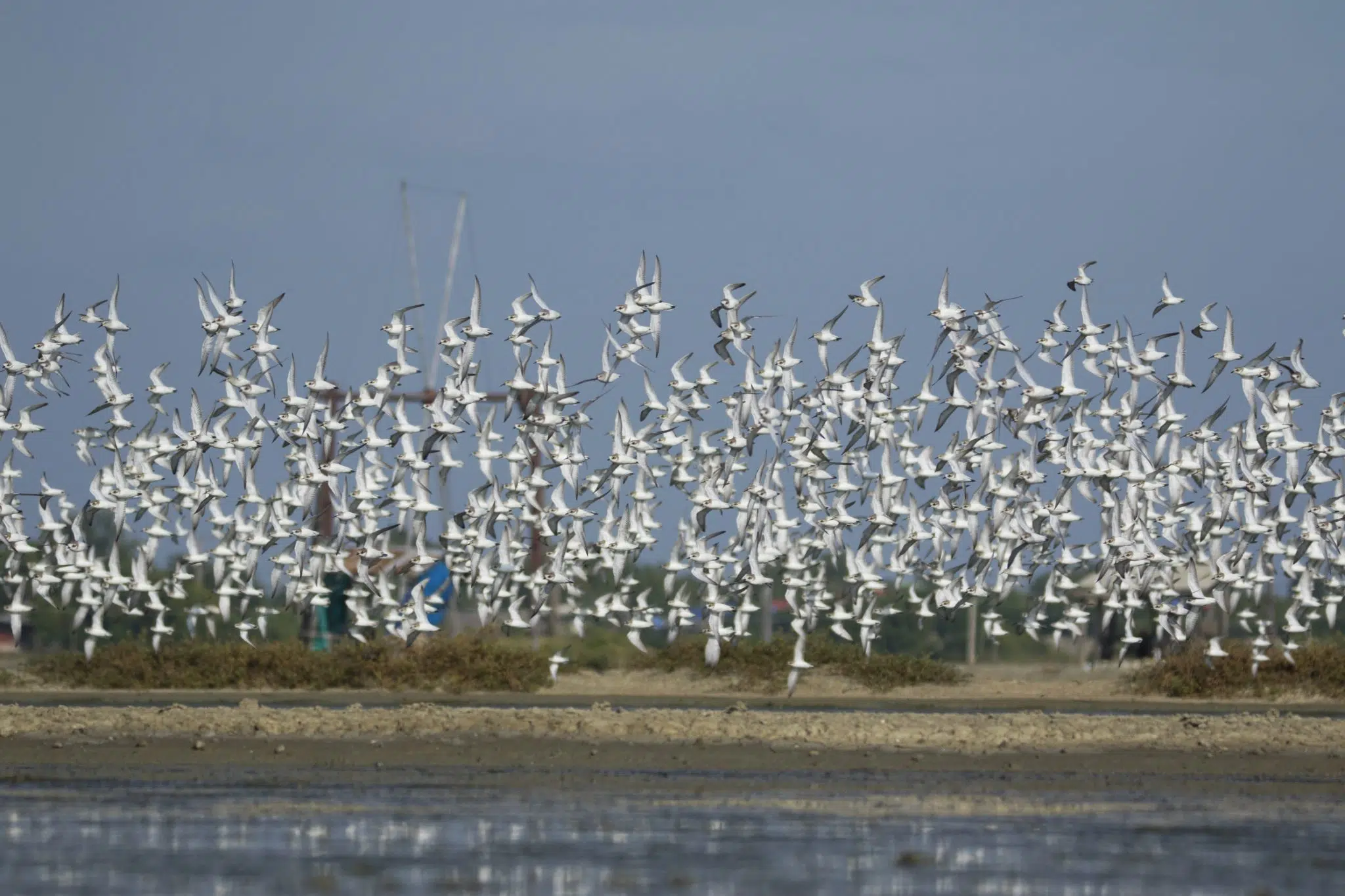
Against the clear blue backdrop of the Gulf of Thailand, hundreds of birds suddenly take flight, their small white and grey wings creating a pixelated wall that skims the surface of the water. These shorebirds are all here for the same reason: to feed on the plentiful organisms living on the coastal mudflat. But this vital ecosystem, a critical stopover for some of the world’s most endangered migratory birds and a cornerstone of local livelihoods, is now under severe threat from a proposed oil refinery and power plant development. The Bird Conservation Society of Thailand (BCST) and local communities are mobilizing to protect Pak Thale Nature Reserve, a site recognized globally for its immense biodiversity and strategic importance along the East Asian-Australasian Flyway.
Pak Thale: A Lifeline on the East Asian-Australasian Flyway
Every winter, these shorebirds descend upon the wetlands at Pak Thale Nature Reserve in Southern Thailand, having travelled thousands of kilometres from their summer homes as far north as the Arctic Circle. This arduous journey, traversing diverse landscapes and climates, is facilitated by a network of critical stopover and wintering sites collectively known as the East Asian-Australasian Flyway (EAAF). Spanning 22 countries from Alaska and Siberia down to Australia and New Zealand, the EAAF is one of the world’s four major land migration routes for birds, hosting over 50 million migratory waterbirds from 250 different populations, including 37 globally threatened species. Pak Thale’s unique position along Thailand’s coastline provides a crucial refuelling and resting point for these long-distance travellers, offering rich mudflats teeming with invertebrates essential for their survival.
The significance of Pak Thale has not gone unnoticed by conservationists. In 2019, recognizing its irreplaceable value, the Bird Conservation Society of Thailand (BCST), Thailand’s BirdLife Partner, took a decisive step. They purchased 8 hectares of land along the coast to establish a dedicated wildlife sanctuary. This proactive measure aimed to secure a permanent haven for migratory species against the backdrop of increasing habitat loss across the region. Since its establishment, the reserve has become a beacon for avian diversity, hosting some of Asia’s rarest birds and, consequently, attracting a growing number of international birdwatchers hoping to catch a glimpse of these elusive species.
A Biodiversity Hotspot and Ecotourism Success Story
The relatively small size and accessible nature of Pak Thale Nature Reserve allow birdwatchers unparalleled views of species that are critically imperiled elsewhere. Among its most celebrated residents is the Critically Endangered Spoon-billed Sandpiper (Calidris pygmaea), a tiny shorebird whose global population is estimated to be fewer than 500 mature individuals. Losing even a handful of these birds due to habitat degradation could have catastrophic consequences for the species’ survival. Other endangered visitors include the Far Eastern Curlew (Numenius madagascariensis), the Great Knot (Calidris tenuirostris), and the Spotted Greenshank (Tringa guttifer). It is possibly the only place in Southeast Asia where birdwatchers can easily observe all these species in a single day, a testament to the site’s ecological richness.
This exceptional biodiversity has fostered a thriving ecotourism industry, transforming the local economy. Ecotourism has become a valuable income stream for the community, providing employment opportunities and fostering a sense of ownership and pride in their natural heritage. BCST has been instrumental in this development, not only by establishing the reserve but also by actively engaging with and empowering the local populace. They have trained community members to become expert guides for the reserve, sharing their intimate knowledge of the birds and the local environment with visitors.

Beyond direct tourism, BCST has also championed sustainable alternative livelihoods. They collaborated with local salt farmers, helping them develop and market "biodiversity-friendly salt." This initiative promotes traditional, less intensive salt farming practices that are compatible with the ecological needs of the mudflats, providing a profitable and sustainable avenue for farmers while reinforcing the connection between local production and environmental health. These integrated conservation and development strategies have made Pak Thale a model for sustainable rural development in the region.
The Looming Threat: Industrial Development at Pak Thale’s Doorstep
The success story of Pak Thale now hangs precariously in the balance. News of a proposed oil refinery and power plant, slated for construction mere kilometres from the heart of the nature reserve, has sent shockwaves through the conservation community and among local residents. For BCST, who have invested years in protecting this vital ecosystem and empowering its community, the prospect of such industrial development in close proximity represents a devastating blow.
The potential environmental impacts of an oil refinery and power plant are multifaceted and severe. An oil refinery, by its very nature, is a major source of air and water pollution. Atmospheric emissions, including sulphur dioxide (SO2), nitrogen oxides (NOx), volatile organic compounds (VOCs), and particulate matter, could drastically reduce air quality. These pollutants are known to cause respiratory issues in humans and animals, acidify rainfall, and harm vegetation. For birds, chronic exposure to such pollutants can impair their health, navigation, and reproductive success, potentially driving away the roughly 270 bird species that call Pak Thale home during various seasons.
Water pollution poses an equally dire threat. Accidental oil spills, even minor ones, can be catastrophic for coastal ecosystems, coating birds’ feathers, poisoning marine life, and destroying the invertebrate populations that form the base of the shorebird food chain. Furthermore, the discharge of treated or untreated wastewater from industrial operations, along with potential thermal pollution from power plant cooling systems, can alter water chemistry and temperature, disrupting the delicate ecological balance of the mudflats and estuaries. Heavy metals and other toxic chemicals, common by-products of industrial processes, could accumulate in the food chain, posing long-term health risks to both birds and humans who rely on local seafood.
Beyond pollution, the power plant introduces its own set of hazards. The construction and operation of transmission lines and other infrastructure associated with power generation can lead to habitat fragmentation and direct mortality. Low-flying migratory birds, particularly during periods of poor visibility or nocturnal migration, are highly susceptible to colliding with live electrical wires, a common cause of bird fatalities globally. Such incidents could significantly impact bird populations, especially those already teetering on the brink of extinction.
The economic consequences for the local community are equally stark. Without the vibrant bird populations, the very foundation of Pak Thale’s ecotourism industry would collapse. The trained local guides, guesthouses, restaurants, and other businesses that have flourished around the reserve would face severe financial hardship. Similarly, the market for "biodiversity-friendly salt," which relies on the pristine environmental image of Pak Thale, would likely vanish, undoing years of sustainable development efforts. The community’s health could also be jeopardized by industrial emissions, creating a double burden of environmental degradation and economic despair.
The Broader Implications for Migratory Bird Conservation
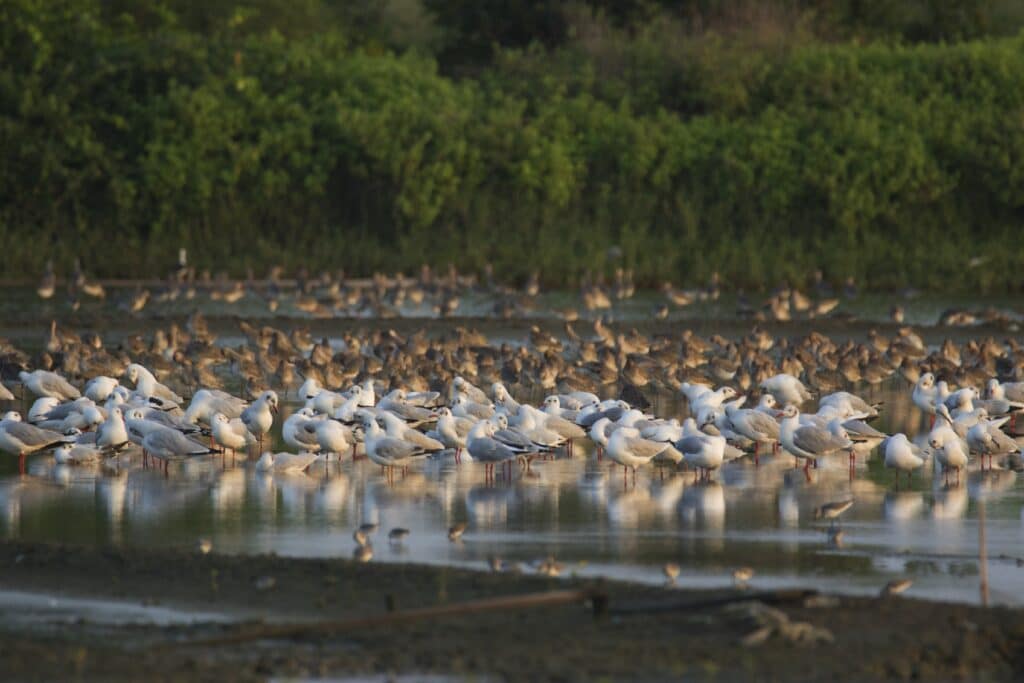
The loss of a site like Pak Thale is not a localized issue; it resonates across the entire East Asian-Australasian Flyway and beyond. For migratory birds, finding an alternative resting site is not as simple as relocating. Migration is an energy-intensive endeavour, requiring adequate food and rest at strategic intervals. Each stopover site is part of a finely tuned network, and the loss of one link can severely disrupt the entire chain. Birds forced to travel further or settle in suboptimal habitats expend more energy, face increased predation risks, and may arrive at their breeding or wintering grounds in poor condition, impacting their reproductive success and survival rates.
Tragically, the situation at Pak Thale is emblematic of a broader, alarming trend. Across the entire EAAF, coastal wetlands are rapidly disappearing due to relentless urban, industrial, and agricultural development. These vital "rest stops" are becoming less frequent and more degraded, intensifying pressure on already vulnerable populations. For species like the Spoon-billed Sandpiper, with fewer than 500 adults left in the wild, the loss of a critical site like Pak Thale would not just be a "significant dent" but could potentially push the species irreversibly closer to extinction. Each lost mudflat, each polluted estuary, represents a step closer to the silence of the skies.
A Call for Urgent Action and Sustainable Pathways
The fight to save Pak Thale is a testament to the global conservation dilemma: how to balance economic development with the preservation of irreplaceable natural heritage. The proposed industrial projects highlight the urgent need for comprehensive environmental impact assessments (EIAs) that genuinely consider the long-term ecological and socio-economic consequences, rather than simply focusing on short-term economic gains. It also underscores the importance of strategic spatial planning that identifies and protects critical biodiversity areas from incompatible development.
BCST and the local community are not standing idly by. They are actively engaged in advocacy, raising awareness, and seeking support from national and international stakeholders. The petition launched by BCST represents a critical tool for public engagement, allowing individuals worldwide to voice their concern and opposition to the proposed development. This collective voice is crucial in influencing policymakers and corporate decisions.
Niyom Thongmeun, Pak Thale Manager for BCST, articulated the gravity of the situation with poignant clarity: "We cannot guarantee when the final migration of migratory birds will occur, because both humans and birds are facing the same fate. Let’s work together to stop the fossil fuel industry." His statement underscores the interconnectedness of human well-being and environmental health, emphasizing that the fate of the birds is inextricably linked to the fate of the community and, indeed, to the global climate crisis driven by fossil fuels.
The struggle at Pak Thale is more than just a local battle; it is a microcosm of the global challenge to protect biodiversity in the face of escalating industrial expansion. The decision made regarding Pak Thale will send a powerful message about Thailand’s commitment to its international environmental obligations and its vision for a sustainable future. Ensuring that Pak Thale remains a haven for migratory birds is not just an act of conservation; it is an investment in ecological resilience, local livelihoods, and the shared natural heritage of our planet. The opportunity remains for a path that prioritizes sustainable development, safeguards critical ecosystems, and respects the intricate web of life that sustains us all.
