
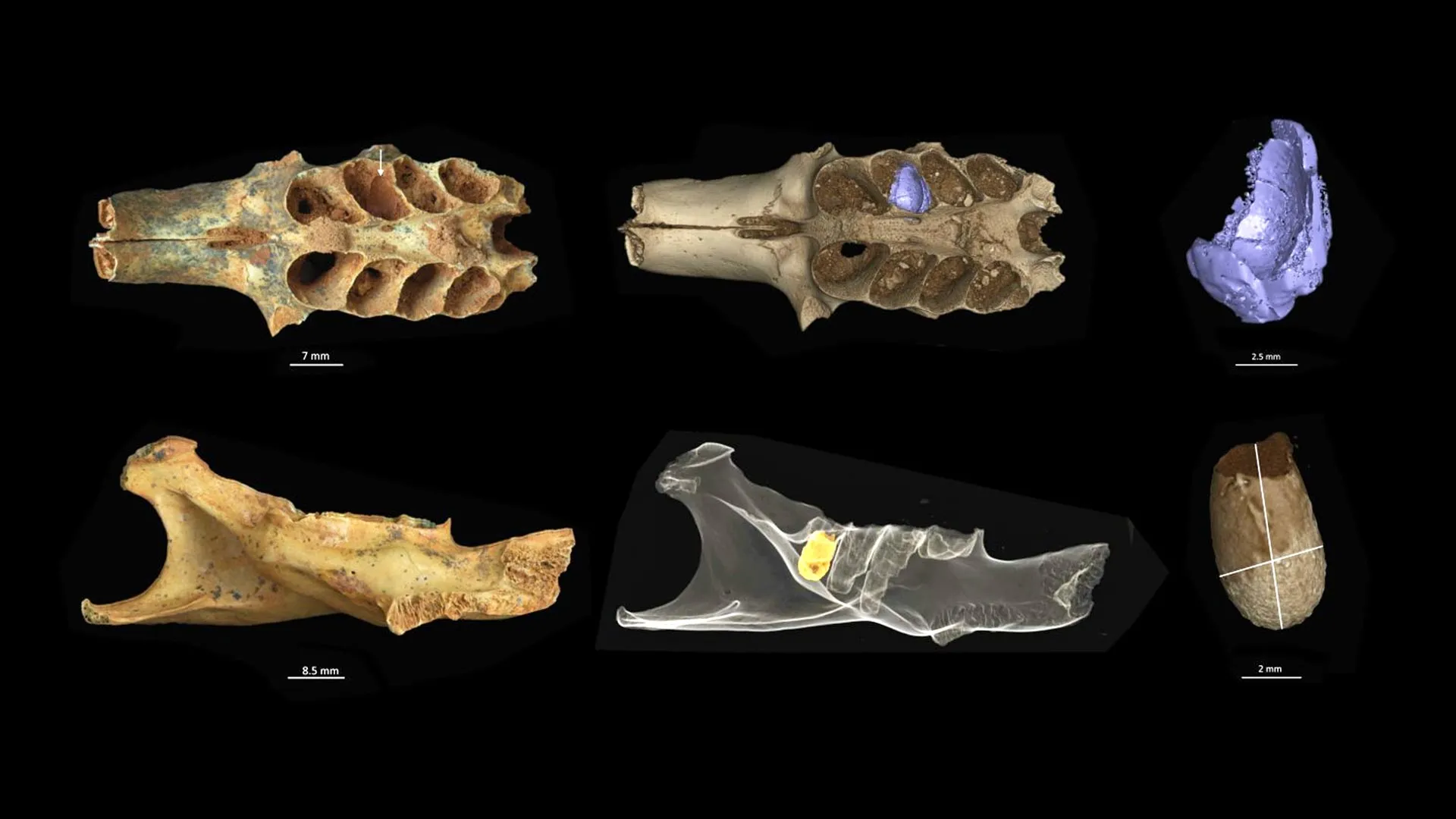
A giant barn owl, a hutia, and a burrowing bee entered a cave. Only two of them left, but the third left an indelible mark on scientific understanding, creating a fossil record unprecedented in its detail and implications for ancient insect behavior and paleoecology. This enigmatic scenario, far from being a mere riddle, encapsulates a remarkable paleontological discovery on the Caribbean island of Hispaniola, where scientists have unearthed fossilized bee nests meticulously constructed within the skeletal remains of long-extinct animals. This groundbreaking find, detailed in the Proceedings of the Royal Society B, provides a rare glimpse into the intricate relationships between predator, prey, and an opportunistic insect, all preserved in stone for millennia.
The unusual chain of events likely unfolded thousands of years ago, long before human colonization of the Americas. The colossal Hispaniolan giant barn owl (likely Tyto pollens, a formidable avian predator with a wingspan potentially reaching over 10 feet) was a dominant force in the island’s ancient ecosystem. It would have patrolled the nocturnal skies, its keen senses attuned to the movements of ground-dwelling prey. On one such hunt, it captured a hutia, a large rodent endemic to the Caribbean, and carried it back to its roost within a limestone cave. Here, the owl fed its hungry owlets, leaving the dismembered remains of the unfortunate rodent scattered across the cave floor. Over time, these organic remnants would become part of the accumulating debris, gradually buried under layers of fine, clay-rich silt. Much later, perhaps centuries or even millennia after the owl’s last meal, a different kind of inhabitant arrived: a burrowing bee, searching for a suitable place to construct its nest.
A Geological Time Capsule: The Cueva de Mono
The setting for this extraordinary discovery is the Cueva de Mono, or "Monkey Cave," nestled in the southern Dominican Republic. This cave, like many across Hispaniola, is a product of the island’s extensive karst topography—a landscape characterized by soluble bedrock, typically limestone, which is eroded by groundwater to form caves, sinkholes, and underground rivers. The sharp, often unforgiving limestone terrain of karst regions frequently lacks stable, deep soil layers. Instead, any accumulated topsoil is often washed into subterranean conduits, settling in the protected environments of caves. These unique geological conditions played a crucial role in both the preservation of the fossils and the unusual nesting behavior of the ancient bees.
Cueva de Mono served as a long-term feeding and roosting site for giant barn owls over countless generations. This consistent activity led to an immense accumulation of fossilized bones, primarily from hutias but also other small to medium-sized vertebrates. Such sites are invaluable to paleontologists, acting as natural archives that record the faunal composition and ecological dynamics of past environments. The sheer volume of remains found here—thousands of fossils, predominantly from a single species of hutia—underscores the cave’s significance as a paleontological treasure trove, offering an unparalleled window into the diet of apex predators and the prey populations they sustained.
Ingenuity in Miniature: How Bees Utilized Fossil Remains
The burrowing bee, facing the challenge of constructing a nest in a soil-poor environment, exhibited a remarkable degree of adaptive ingenuity. As it began to dig into the fine, clay-rich silt that had settled in the darker, more stable parts of the cave, it encountered the remains of the hutia. Specifically, it found the hutia’s jawbones, where the teeth had long since fallen out, leaving behind empty sockets known as alveoli. These hollow spaces, once cradling the rodent’s molars and incisors, proved to be an almost perfect fit for the bee’s nesting requirements. Their size and pre-formed structure offered a ready-made cavity, saving the bee the arduous task of excavating a new tunnel from scratch in the challenging cave substrate.
This opportunistic behavior was not an isolated incident. Over time, more bees followed, recognizing and exploiting these natural cavities within the fossilized bones as ideal nesting sites. The smooth, internal surfaces of the alveoli, once lined with soft tissue, provided a stable and protected environment for the bee’s brood. This repeated use by successive generations of bees led to the preservation of numerous such nests, creating an ichnofossil record—a trace fossil that records the activity of an organism rather than its body itself—that has captivated the scientific community.
The Serendipitous Discovery: A Story of Meticulous Observation
The discovery of these ancient bee nests might easily have been overlooked, a testament to the meticulous attention to detail practiced by lead excavator Lazaro Viñola Lopez. At the time, Viñola Lopez was a doctoral student at the Florida Museum of Natural History, deeply immersed in his research on this particular species of hutia, which was rarely found in such abundance elsewhere on Hispaniola.
"Usually, when collecting fossils, you get all the sediment out of the alveoli while cleaning the specimen," Viñola Lopez explained, highlighting a standard paleontological practice. However, his profound interest in the hutia fossils from Cueva de Mono led him to deviate from routine. Rather than immediately cleaning the thousands of specimens he uncovered, he inspected them closely. It was during this painstaking examination that a particular cavity caught his eye. Its inner surface was unusually smooth, distinctly different from the rough, porous texture of the surrounding bone. This subtle anomaly sparked his curiosity.
Viñola Lopez recalled a similar observation from an earlier excavation. "I’d seen something similar in Montana when I was collecting dinosaur fossils in 2014," he recounted. In that instance, he and his colleagues had found fossilized wasp cocoons mixed in with dinosaur material. Naturally, his initial assumption was that the same explanation applied to the Hispaniolan cave. He thought, "it would be nice to write a short paper reporting the occurrence of these wasp nests in the mandibles."
He shared his preliminary idea with fellow doctoral student Mitchell Riegler, also at the Florida Museum of Natural History. Riegler, initially focused on his own research, was not immediately swayed. "I was like, Lazaro, that’s a niche project, and I have a lot of other things to do," he admitted. The idea, though intriguing, was temporarily shelved. However, a friendly challenge from a former advisor to write a scientific paper within a week reignited the project. "He and I played this game back and forth in which we tried to write a paper in a week," Riegler described, illustrating the collaborative, yet sometimes competitive, spirit of scientific inquiry.
From Wasps to Bees: A Crucial Scientific Correction
As the research progressed, the team initially believed they were documenting wasp nests. They delved into existing literature on ichnofossils, scrutinizing descriptions and characteristics of various insect traces. It was during this rigorous review that a critical detail emerged, one that didn’t align with their initial hypothesis. Wasp nests, particularly those of burrowing species, typically have rough, textured walls, often constructed from chewed plant material mixed with saliva or mud. The structures they observed within the hutia fossils, however, were notably smooth.
This discrepancy led them to reconsider. Further investigation into insect ichnofossils revealed a key distinction: burrowing bees, unlike most wasps, frequently line their nests with a waxy, waterproof secretion. This secretion creates a polished, smooth interior, perfectly matching the appearance of the cavities they had found. This crucial detail led to a profound realization: they had not been studying wasps, but bees. This correction immediately elevated the significance of their discovery.
A Rare and Unprecedented Behavioral Insight
The reclassification from wasp to bee nests transformed the discovery from an interesting observation into a paleontological landmark. There is only one other known case globally of burrowing bees nesting inside a cave environment, and crucially, none where bees have been documented using pre-existing fossil structures without significantly altering them. Previous reports have described bees drilling into human bones for nesting purposes, but the Hispaniolan bees simply occupied natural, pre-formed cavities, showcasing an extraordinary level of opportunistic adaptation.
Recognizing the immense importance of their findings, the researchers prudently slowed down their process, expanding the scope and depth of their study. They consulted with leading experts in modern bee behavior and entomology, thoroughly reviewing extensive scientific literature to ensure the accuracy and completeness of their analysis. Viñola Lopez even made a return trip to Cueva de Mono, meticulously re-examining the cave’s geological layers and fossil deposits to gather further contextual information.
A Race Against Time: The Rescue Mission
The research took on an unexpected urgency when the Cueva de Mono faced a significant threat. Developers attempted to acquire the land with the intention of converting the ancient cave into a septic tank, a plan that would have utterly destroyed the invaluable fossil record. This alarming prospect spurred the research team into immediate action.
"We had to go on a rescue mission and get as many fossils out as possible, and we got a lot of them," Viñola Lopez recounted, emphasizing the critical need for rapid intervention. This concerted effort, driven by a deep understanding of the cave’s scientific significance, undoubtedly saved countless specimens from irreversible destruction, ensuring that future generations of scientists would still have access to this unique paleontological archive.
Beyond Hutia Jaws: Diverse Nesting Sites
The final study provided a comprehensive and detailed account of the cave’s complex history and the truly unusual nesting behavior of these ancient bees. The nests, it turned out, were not exclusively confined to hutia jawbones. The bees demonstrated a broader adaptability, utilizing various fossilized structures.
In one remarkable instance, a nest was discovered inside the pulp cavity of a sloth tooth. Tree sloths, once a diverse group in the Caribbean, were among the megafauna that disappeared from the islands following the arrival of humans. Another nest was found within a hutia vertebra, specifically in the space that once housed the animal’s spinal cord. These diverse locations further underscore the bees’ opportunistic strategy and the widespread availability of suitable cavities within the cave’s fossil-rich sediments.
Advanced imaging techniques, specifically CT scans, provided unprecedented insights into the internal architecture of these fossilized nests. The scans revealed that some cavities contained multiple layers of nests, demonstrating that certain bees, instead of excavating new tunnels, would reuse existing ones if they were empty. In a particularly striking example, researchers observed six distinct nests stacked within a single alveolus, arranged one inside another with an uncanny resemblance to Russian nesting dolls. This discovery not only highlights the bees’ resourcefulness but also suggests a long-term, possibly multi-generational, occupation of these prime nesting sites.
The Ecological Rationale: Why the Cave Became Home
The study also offers a compelling explanation for this highly unusual nesting behavior. The surrounding landscape, as previously noted, is characterized by its sharp, edgy karst limestone terrain, which is inherently poor in stable, deep soil.
"The area we were collecting in is karst, so it’s made of sharp, edgy limestone, and it’s lost all of its natural soils," Riegler explained, drawing from personal experience. "I actually fell on it at one point, so I can tell you all about it." This challenging environment would have presented significant hurdles for typical burrowing bees, which rely on soft, stable soil to dig their subterranean nests.
Any soil that does accumulate on the surface of such a landscape is often quickly washed into the intricate network of caves below, where it settles into protected pockets. These accumulated deposits within the Cueva de Mono, rich with fine clay-silt, likely provided some of the only viable nesting conditions for burrowing bees in the region. The pre-existing cavities within the abundant fossilized bones simply offered an unparalleled advantage, transforming an ecological constraint into an evolutionary opportunity.
Broader Implications and Future Discoveries
This extraordinary discovery has significant implications for several scientific disciplines. For paleontology, it expands our understanding of ichnofossils and the taphonomic processes that preserve such delicate traces of ancient life. It provides a unique lens through which to reconstruct past ecosystems, revealing not just the presence of animals but also their behaviors and interactions across trophic levels. For entomology, it offers unprecedented insights into the adaptability of ancient insects, pushing the boundaries of what we thought possible for their nesting strategies. It highlights the importance of environmental pressures in shaping evolutionary adaptations, demonstrating how a lack of suitable soil could drive a species to exploit an entirely novel resource—fossilized bones.
The work also underscores the immense value of meticulous excavation and the interdisciplinary approach to scientific research, combining expertise in paleontology, entomology, and geology. The Cueva de Mono, with its rich history spanning tens of thousands of years, is far from exhausted. The researchers are continuing to study other fossils recovered from the cave, with additional findings expected in future publications.
The intricate narrative preserved within Cueva de Mono—the giant owl’s hunt, the hutia’s demise, and the industrious bee’s ingenious adaptation—reveals a remarkable example of how life can adapt in unexpected ways. In this ancient Caribbean cave, the remains of past meals became a critical resource and shelter for a completely different kind of inhabitant, leaving behind a profound record of resilience and ingenuity that continues to tell stories from a long-lost world. This ongoing research promises to further illuminate the complex and fascinating tapestry of life that once thrived in the ancient Caribbean.
