
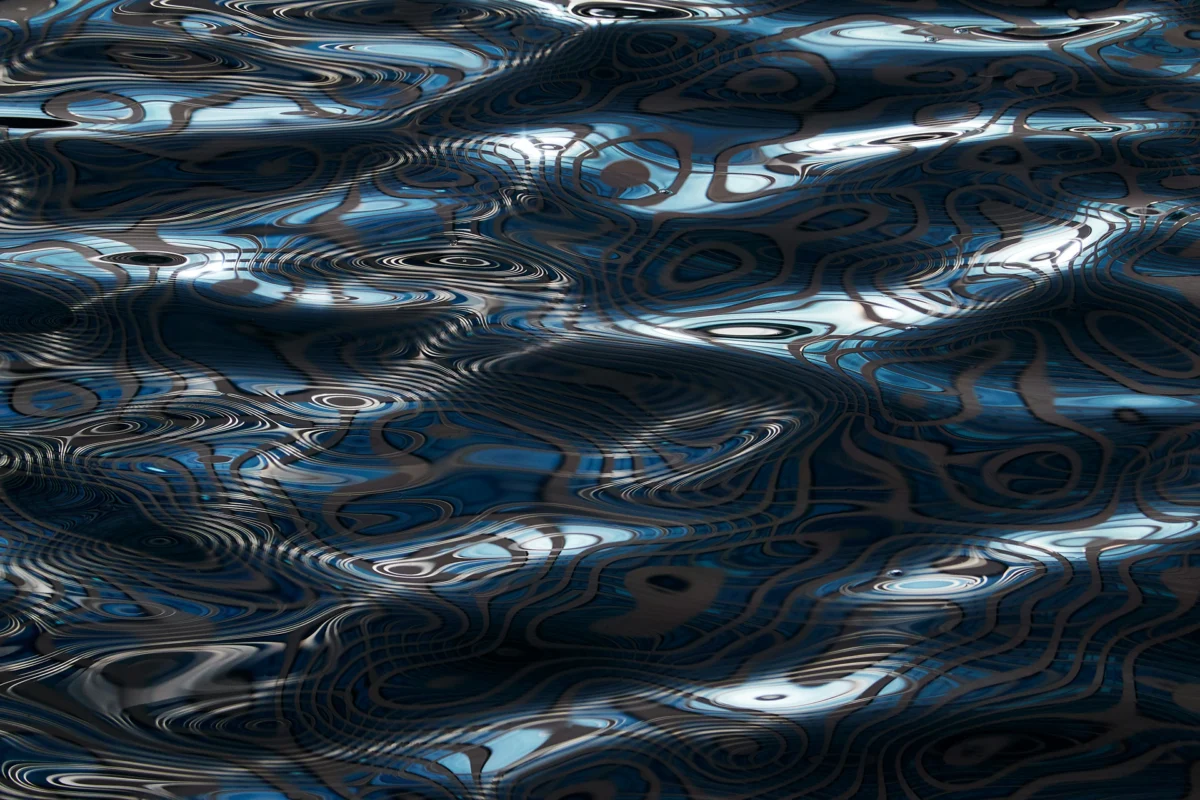
The contemporary photography landscape is frequently saturated with digital manipulation, composite imagery, and an endless pursuit of exotic, remote locations. Yet, the foundational ethos of serious photographic art often relies on a much simpler, more rigorous philosophy: acute observation, persistent discipline, and an intimate relationship with a familiar subject. For over a decade, photographer and author Peter Henry (a pseudonym for the voice behind the series) has challenged modern digital expectations with his acclaimed project, Fleeting Reflections. Composed entirely through in-camera techniques without the aid of digital shape-altering software, the project transforms the commercial glass and steel of London’s Canary Wharf docks into fluid, abstract masterpieces reminiscent of expressionist paintings or musical waveforms.
The resulting work—compiled into two published volumes, featured in prominent London exhibitions, and discussed extensively within fine-art photography circles—offers a profound counter-narrative to the prevailing industry myth that profound nature and abstract photography requires vast travel budgets and pristine wilderness. Instead, Henry’s body of work underscores the power of three fundamental pillars: accessibility, repeatability, and patience.

The Genesis of Fleeting Reflections: A Decade-Long Study in Place
The origins of Fleeting Reflections date back more than ten years, rooted in the urban waters surrounding the skyscrapers of Canary Wharf, London’s bustling secondary financial district. Traditionally viewed as a rigid monument to corporate enterprise, concrete, and modern architecture, Henry chose to recontextualize the district not as a collection of static structures, but as a dynamic matrix of natural light sources.
When sunlight, ambient artificial glow, and passing twilight interact with towering glass and steel facades, they cast vivid ribbons, lines, and blocks of color onto the surface of the adjacent docks. Wind, tidal shifts, and passing river traffic continually sculpt these reflected elements into fractured, organic geometries. Rather than capturing the built environment directly, Henry directs his lens downward, recording the interaction of light, water, and physics.
The project progressed organically through a methodical, multi-year timeline. Following years of quiet documentation, refinement, and intense self-editing, the body of work matured sufficiently to attract independent publishers. In 2017, the collection was officially published as a comprehensive monograph titled Fleeting Reflections by Triplekite Publishing. This milestone was quickly followed by public exhibitions at the Greenwich Gallery in 2017 and the Anise Gallery in London in 2019. Building upon the critical success of the initial release, a second volume, Fleeting Reflections II, was published in 2023, cementing the project’s place in contemporary abstract and fine-art photography.

Pillar One: Accessibility and the Myth of Remote Landscapes
A core argument underpinning the Fleeting Reflections series is the deliberate rejection of travel necessity in fine-art creation. Within mainstream nature and landscape photography, an unspoken hierarchy often prioritizes remote, dramatic, and difficult-to-reach geographies—from Arctic fjords to high-altitude mountain ranges.
Henry challenges this premise by demonstrating that profound visual discoveries can be made within a confined, highly accessible geographic footprint. His entire expansive archive is drawn largely from a single square mile of urban water. Because the location is easily accessible, requiring no extended transit, specialized permits, or rigorous pre-dawn wilderness hikes, it permits a frequency of visits that distant locations simply cannot match.
From an analytical perspective, this logistical ease fundamentally alters the creative process. Creators bound to distant, bucket-list locations often experience compressed timelines, forcing them to capture a scene under whatever climatic conditions happen to coincide with their brief window of visitation. In contrast, an accessible subject enables a photographer to study a single environment across dozens of iterations—visiting during brief forty-minute windows, inclement weather, unconventional lighting conditions, and seemingly "unfavorable" atmospheric states. Rain transforms the water surface into a texture resembling hammered metal, while flat, overcast light yields muted, pastel-like color gradients. This persistent physical presence fosters a deep, subconscious familiarity, allowing the creator to bypass superficial documentation and access more nuanced, sophisticated compositional discoveries.

Pillar Two: Repeatability and the Endless Variations of a Single Frame
The second foundational pillar of the project is repeatability—the deliberate selection of a subject that continuously evolves, surprising the artist and offering fresh possibilities with every encounter.
To the casual observer, photographing the same urban dock repeatedly might appear redundant. However, dynamic water systems ensure that absolute stasis is impossible. A calm morning produces long, glassy stretches of mirrored color, whereas a sharp, gusty afternoon fractures those same architectural reflections into jagged, serrated lines evoking the iconic waveform graphics of post-punk album art. Furthermore, fleeting anthropogenic and natural variables—such as diesel films creating brief, iridescent interference patterns or wakes from commercial riverboats smearing structural lines into hand-drawn gestures—ensure that no two frames are identical.
This high degree of environmental mutability enables the artist to photograph the "same" scene thousands of times while maintaining absolute creative freshness. Rather than engaging in traditional architectural photography, the methodology shifts toward capturing behavioral patterns of light and fluid dynamics.

Technically, capturing these ephemeral moments requires precise in-camera execution. High-speed burst rates are utilized to freeze micro-seconds of surface tension before the water structure collapses, while in-camera multiple-exposure modes allow the photographer to layer distinct gestures across a single frame. These techniques do not artificially generate forms; rather, they amplify and record the rapid kinetic transformations already occurring in the physical environment. Without a repeatable subject, a project risks devolving into a collection of isolated postcards; with it, a cohesive, deeply investigated body of work emerges.
Pillar Three: Patience and the Rigor of Editorial Discipline
The third and most demanding pillar of the Fleeting Reflections methodology is patience—an attribute frequently underestimated in an era dominated by instant digital gratification and rapid social media consumption.
Patience manifests across multiple phases of the creative workflow. In the field, it requires physical endurance. Henry notes that he frequently spends up to four consecutive hours stationed at a single vantage point, executing as many as 3,000 frames of what appears to be an unchanging scene. This sustained observation is mandatory to identify the precise micro-second where color harmony, rhythmic structure, and visual tension converge.

This rigorous discipline extends directly into the post-production and editing phase. Upon returning to the studio, thousands of nearly identical raw files are subjected to a brutal editorial sift. The keep rate for such specialized abstraction is intentionally low. Utilizing raw processing software such as Capture One, adjustments are strictly confined to global parameters—levels, clarity, sharpness, and global contrast.
The ethical boundary maintained throughout the editing process is absolute: no digital manipulation, warping, or synthetic shape creation is performed in software like Adobe Photoshop. The underlying philosophy asserts that the photographer acts not as a graphic designer fabricating a fantasy, but as a witness revealing hidden truths inherent in the natural and built environment. For Henry, the integrity of the statement "this happened" remains paramount to the artistic value of the image.
Industry Implications and Broader Lessons for Contemporary Creators
The enduring success of the Fleeting Reflections project carries significant implications for the broader photographic community. As camera technology advances and global travel becomes increasingly accessible—yet environmentally and financially burdensome—creators face mounting pressure to produce ever more exotic content.

Henry’s work serves as a compelling reminder that originality is rarely a byproduct of geographic distance; rather, it is the direct consequence of sustained attention, deep local knowledge, and technical mastery over familiar surroundings. By advocating for proximity, iterative study, and uncompromising editorial honesty, the project encourages emerging photographers to look closely at their immediate surroundings—whether an urban canal, a local harbor wall, or suburban wetlands.
Ultimately, while viewers encountering Fleeting Reflections are initially drawn to its striking visual palette of vibrant colors and complex geometries, what they are ultimately witnessing is the physical manifestation of time and sustained focus. In an image-saturated world that prioritizes speed and novelty, the project stands as a testament to the enduring power of slow, deliberate artistic inquiry.
