
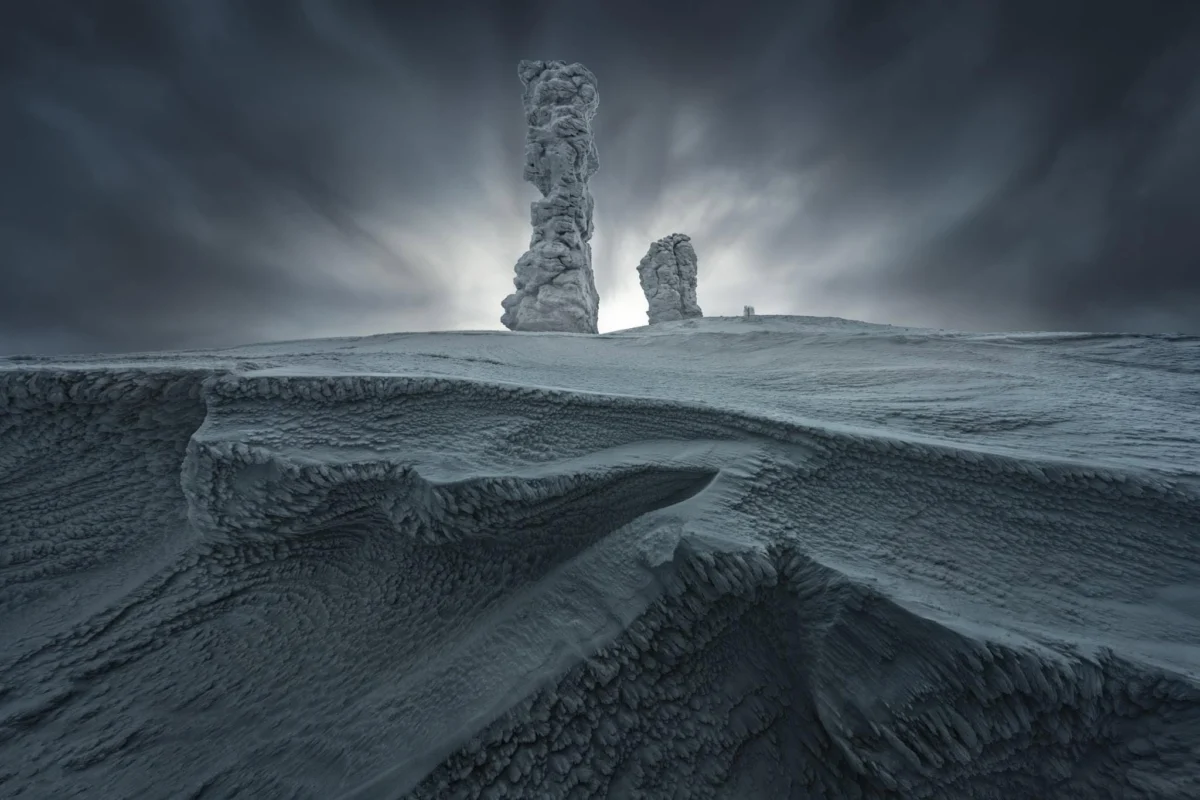
Deep within the unforgiving expanse of the Komi Republic in Russia lies one of the planet’s most remote and enigmatic geological wonders: the Manpupuner rock formations. Also known as the Dyatlov Seven Strong Men, these towering sandstone pillars rise mysteriously from the flat plateau of the Ural Mountains, standing between 30 and 42 meters tall. For centuries, these weathered monoliths remained largely unseen by the outside world, revered only by the indigenous Mansi people. In February 2022, an Italian photographer and traveler embarked on an arduous, multi-stage expedition to document this isolated landscape, yielding a rare fine-art portfolio from a region virtually untouched by commercial landscape photography.

The resulting collection offers a profound glimpse into a subarctic wilderness where nature operates without human interference. By blending a background in classical oil painting and hyperrealistic illustration with modern digital photography, the artist sought to capture the ethereal, almost otherworldly atmosphere of the northern taiga. The expedition not only tested the boundaries of outdoor documentary photography but also highlighted the logistical complexities of accessing Russia’s most protected and isolated natural monuments.
The Expedition: A Journey Beyond the End of the Road
The expedition to Manpupuner is defined by distance, harsh weather, and logistical friction. Traveling from Italy in February 2022, the photographer’s journey began with a flight to Moscow, followed by a domestic connection to Syktyvkar, the capital city of the Komi Republic. From there, the transit shifted to a grueling 500-kilometer automobile journey eastward toward Troitsko-Pechorsk, terminating in Ust-Unya—a minuscule settlement that marks the absolute frontier of drivable infrastructure.

Beyond Ust-Unya, conventional roads cease to exist. Reaching the Pechoro-Ilych Nature Reserve, where the Manpupuner plateau is situated, typically requires specialized transport such as snowmobiles, helicopter charters, or arduous multi-day cross-country skiing and snowshoeing expeditions, depending on the season and strict ecological permits. The winter timing introduced extreme meteorological challenges, including sub-zero temperatures, unpredictable windstorms, and severely limited daylight hours.
Geographically, the Manpupuner plateau sits high in the subpolar Urals. The Seven Strong Men are the remnants of ancient mountain ranges that, over some 200 million years, have been eroded by wind, frost, and rain—a geological process known as differential weathering. Softer rock surrounding the vertical quartz-sericite schist pillars wore away entirely, leaving behind these stark, anthropomorphic monoliths that command panoramic views of endless taiga forest and frozen tundra.

Artistic Evolution: From Oil Painting to Digital Minimalism
To fully understand the visual language of the Manpupuner portfolio, one must examine the photographer’s non-linear artistic background. Beginning with traditional oil painting at the age of seven, the artist later transitioned into an eight-year immersion in hyperrealistic drawing during adolescence. This rigorous foundation instilled a deep, instinctive comprehension of luminance, structural contrast, and shadow mechanics long before a digital camera was ever picked up.
Influence from Japanese visual culture—particularly the atmospheric, hand-painted worlds of Studio Ghibli and director Hayao Miyazaki—further shaped the photographer’s aesthetic framework. Rather than aiming for flat, clinical documentation, the artistic goal evolved toward creating a hybrid between objective geographical record and imaginative storytelling.

A pivotal turning point occurred during travels where a peer challenged the photographer to move beyond a monochromatic focus on light and delve heavily into color theory. Hours of subsequent study involving color frequencies, saturation matrices, and luminance masks allowed the artist to fine-tune digital raw files with surgical precision. When photographing high-altitude snow landscapes—where camera sensors routinely misinterpret brilliant white as washed-out magenta or harsh purple—this rigorous technical mastery became essential. The post-production phase focused on neutralizing false sensor tones, dialing in desaturated blues, and introducing subtle green undertones to accurately mirror the pristine color fidelity perceived by the human eye.
Weather Dynamics and Field Methodology on the Plateau
Arriving at the plateau presented immediate environmental hurdles. The first day was defined by a severe windstorm that blanketed the region in a milky, diffused light completely devoid of traditional shadows or hard contrasts. Rather than halting work, the photographer leveraged the atmospheric conditions. The gale-force winds had coated every branch of the surrounding taiga in intricate sculptures of frost and rime ice, turning micro-details of the forest into readymade natural installations.

During this storm, an unexpected human element entered the frame: a local forest ranger approached the most isolated monolith to quietly engage in prayer. This spontaneous moment captured the spiritual weight historically attributed to the site by indigenous populations, reinforcing the notion that certain landscapes evoke a reverence that defies technical capture.
By the second morning, the meteorological conditions shifted dramatically. A high-altitude dawn broke across the horizon, washing the plateau in intense, unearthly hues of burning orange and deep crimson. Recognizing the limitations of standard wide-angle landscape compositions, the photographer utilized a drone to capture vertical perspectives. This aerial viewpoint revealed the true geographical isolation of the seven giants—tiny, weathered sentinels marooned in an infinite sea of snow-covered wilderness. Over the course of just forty-eight hours, the expedition experienced a microcosm of subarctic extremes: brilliant sunshine, blinding snowstorms, dense fog, flat light, and explosive alpine glows.

Implications for Nature Photography and Wilderness Conservation
The documentation of Manpupuner carries broader implications for both the global fine-art photography community and environmental conservation efforts. Because the Pechoro-Ilych Nature Reserve is heavily regulated to protect its fragile subarctic ecosystem, unauthorized tourism is strictly prohibited, and commercial expeditions require extensive permits and logistical coordination with Russian environmental authorities. As a result, professional, high-end artistic portfolios from the site remain exceedingly rare, with the vast majority of existing imagery consisting of amateur smartphone captures or passing tourist snapshots.
From a photographic perspective, the project underscores a growing movement away from hyper-planned, overly manicured landscape photography toward improvisational fieldcraft. By refusing to rely heavily on pre-visualized reference images from the internet, the photographer preserved an unconditioned, authentic gaze—allowing the raw topography of the Urals to dictate the artistic direction in real time.

Furthermore, the project highlights the ongoing debate surrounding digital post-production in nature photography. While heavy digital manipulation is often criticized for distorting reality, the workflow utilized at Manpupuner demonstrates how advanced techniques—such as luminosity masking and targeted color harmonization—can be employed ethically. Rather than fabricating elements that did not exist, the post-production served as a digital darkroom tool to restore the emotional resonance and true visual fidelity of the human experience on the plateau.
As climate patterns shift and remote wilderness areas face mounting pressures from global tourism and industrial encroachment, photographic documentation of inaccessible sanctuaries like Manpupuner plays a vital role. These visual archives not only celebrate the geological resilience of the earth but also underscore the profound fragility of pristine natural habitats existing far beyond the end of the road.
