
Artistic nature photography continues to evolve beyond pure documentation into the realm of conceptual storytelling, challenging photographers to manipulate environmental elements in real-time rather than relying entirely on post-production software. This report examines the creative methodologies of contemporary artistic photographers who utilize specialized in-camera techniques—such as manual white balance shifts, vintage optics, physical polarization filters, and multi-exposure layering—to reinterpret everyday subjects across diverse geographic landscapes. By transforming ordinary moments into surreal visual metaphors, these practitioners are redefining the boundaries between traditional landscape capture and fine-art composition.

The Evolution of In-Camera Artistic Manipulation
In contemporary fine-art photography, the digital sensor and optical attachments serve as a primary canvas. Rather than utilizing digital manipulation software to construct composites or alter color profiles after capture, modern artistic photographers increasingly rely on hardware-level interventions. Techniques such as shifting Kelvin color temperatures, employing vintage specialty lenses with unique optical aberrations, and executing double exposures directly within the camera body allow creators to bypass post-processing.

Industry analysts note a growing movement among nature photographers seeking authenticity through mechanical craftsmanship. By committing artistic visions directly to the memory card via precise exposure layering and specialized optical filters, photographers achieve a tangible connection to the environment. This methodology requires rigorous technical precision, as in-camera adjustments leave little room for error compared to non-destructive digital editing workflows.
Case Study Analysis: Five Compositions of Ordinary Nature

A recently published portfolio highlights five distinct projects that demonstrate the application of these advanced in-camera techniques across varied global ecosystems, ranging from the sub-arctic shores of Norway to the subtropical rainforests of Argentina.
Sunrise at Skagsanden: Ephemeral Water Dynamics

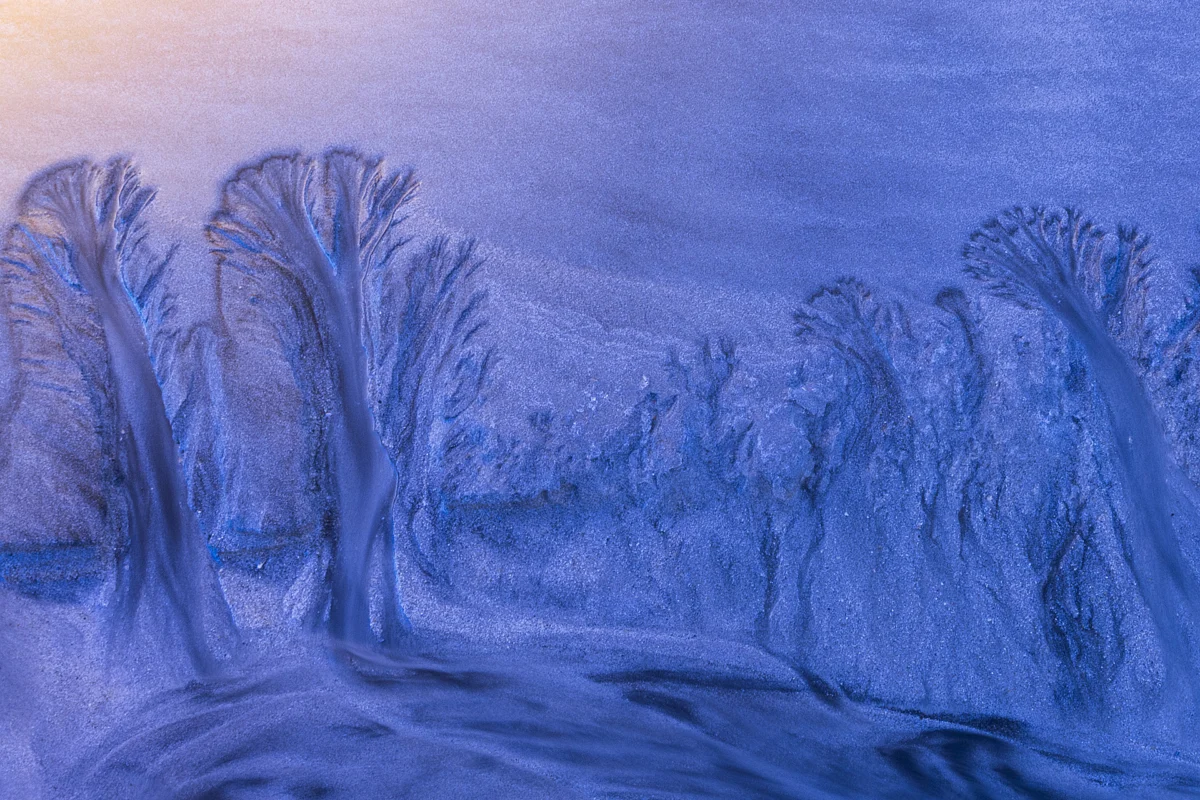
The first subject analysis centers on the coastal sands of Skagsanden beach in northern Norway, a location renowned for dynamic tidal movements. Captured as part of the photo essay Ephemeral, the Language of Water, the composition focuses on receding water carving transient shapes into the shoreline.
Technical execution required a wide-angle 16mm lens mounted on a tripod to ensure structural sharpness, paired with a slow shutter speed of 0.8 seconds to render the moving water with a silky texture contrasting against the coarse sand. To establish a cold, ethereal mood, the photographer intentionally adjusted the camera’s white balance to 3,500 Kelvin, introducing a strong bluish cast. Furthermore, a Singh-Ray Gold-N-Blue polarizing filter was utilized to suppress direct sunlight glare reflecting off the sand while infusing the upper frame with golden tones, thereby generating crucial tonal contrast within an otherwise frigid palette.

Black Alders and Plant Design Symmetries
Moving to the southern hemisphere, an overcast afternoon along the coast of Viedma in Rio Negro, Argentina, provided the backdrop for a study in botanical symmetry titled Plant Designs. Focusing on black alders (Alnus glutinosa) and their distinctive cone-like fruits, the photographer sought to isolate natural geometry against a bright water background.

Utilizing a telephoto lens mounted on a tripod, the artist employed an advanced in-camera double-exposure mode focused on shadow accumulation. By capturing a primary exposure and subsequently rotating the camera 180 degrees via the lens mounting ring before a secondary exposure, the shadows and fruit clusters were mirrored. A high white-balance setting of 8,000 Kelvin further accentuated warm chromatic tones, transforming a mundane riverbank detail into an abstract, rhythmic composition.
Whirlwind of Ferns in the Misiones Jungle

Deep within the subtropical Misiones jungle in Puerto Iguazu, Argentina, a rainy afternoon presented a challenge common to forest photography: chaotic and distracting backgrounds that detract from primary botanical subjects.
To isolate damp ferns glistening under a fine drizzle, the photographer implemented an additive double-exposure technique. The background bokeh was artificially generated using a vintage Helios 44-2 lens, focusing on sunlight filtering through dense canopy foliage to produce soft edge glints without central highlights. A subsequent exposure centered the ferns within the frame. The resulting in-camera blend dissolved the cluttered forest debris, allowing the delicate foliage to emerge with heightened presence and soft luminescence.

The Great Escape: Avian Dynamics at El Cóndor
Documenting wildlife behavior within a fine-art framework, the project Escape and Evasion explores the massive colony of burrowing parrots (Cyanoliseus patagonus) residing along the 50-meter-high cliffs of El Cóndor beach resort in Argentina. The location supports approximately 74,000 nesting birds, creating a constant sensory environment of movement and sound.

To convey a sense of narrative urgency, the photographer combined two distinct temporal elements using an in-camera double exposure. The first exposure utilized a 400mm telephoto lens on a tripod to record the violent impact of ocean waves crashing onto the beach. The second exposure captured backlit parrots in flight against a partly cloudy sky, shot freehand at maximum aperture for a rapid shutter speed. The camera’s internal processing merged the turbulent sea and fleeing birds into a single ochre-tinted frame, established by a warm 8,000 Kelvin white balance setting.
The Moth in Its Galaxy: Transforming the Domestic

The final case study illustrates how fine art can be extracted from domestic environments. Arriving at a cabin near the Paraná River in Puerto Iguazu, Argentina, the photographer observed a small moth resting on a dust-covered glass balcony door.
Envisioning a cosmic scene, the artist enlisted familial assistance to backlight the insect with a flashlight through the glass. The illumination caught particulate dust on the windowpane, transforming the out-of-focus background into a star-like constellation. Operating a macro lens freehand, the photographer underexposed the scene by three stops and set the white balance to 3,000 Kelvin to emphasize cool, galactic tones, elevating an ordinary insect into a celestial figure.

Chronology of Modern Artistic Photography Techniques
The integration of alternative optics and in-camera effects represents a broader methodological shift over the past decade. While early digital photography prioritized clinical sharpness and post-capture manipulation via software suites, recent years have witnessed a resurgence in tactile photographic techniques.

- Pre-2010s: Dominance of digital post-processing, HDR blending, and software-based composting to achieve surreal or artistic effects in nature photography.
- 2010–2018: Increased accessibility of high-resolution sensors and built-in camera firmware updates allowing multi-exposure modes and custom white-balance adjustments.
- 2019–Present: A market resurgence in vintage lens adaptations, specialized physical filtration, and a philosophical return to in-camera mastery, reducing reliance on desktop editing suites.
Industry Implications and Critical Analysis
Art historians and photographic critics note that in-camera artistic manipulation addresses a growing desire for authenticity in an era saturated with synthetic imagery. As artificial intelligence and advanced digital editing tools make it increasingly difficult to verify the origin of digital assets, photographs created entirely within the camera sensor retain a distinct journalistic and artistic integrity.

Furthermore, these methodologies democratize artistic expression by demonstrating that profound visual statements do not require exotic expeditions or costly digital manipulation software. By reinterpreting ordinary subjects—such as windowpane dust, common ferns, or coastal waves—photographers encourage viewers to reevaluate their immediate environments.
The broader implications for the nature photography community point toward an expansion of specialized workshops and technical literature focused on optical physics, manual filter utilization, and firmware-level exposure controls. As camera manufacturers continue to refine internal processing capabilities and dual-exposure firmware, the boundary between physical reality and artistic interpretation will continue to blur, establishing new standards for creative visual communication.
