
The intersection of technical mastery and subjective vision often defines the boundary between standard documentary photography and fine-art nature imagery. In contemporary visual arts, practitioners increasingly look beyond literal representations of the natural world, seeking instead to manipulate in-camera variables—such as white balance, specialized filters, historical optics, and multiple-exposure modes—to construct deeply personal narratives. This approach transforms fleeting moments into lasting visual metaphors, shifting the focus from objective documentation to emotional and aesthetic interpretation.

An examination of five distinct photographic projects highlights how ordinary subjects can be elevated into extraordinary compositions. These works draw upon varied landscapes, ranging from the sub-Arctic shores of Norway to the subtropical jungles of Argentina, demonstrating a deliberate methodology that relies heavily on pre-visualization and advanced field techniques.
Methodological Framework and Technical Innovation
Fine-art nature photography diverges from straight photography by treating the camera not merely as a recording device, but as a primary tool for artistic transformation. Rather than relying exclusively on post-processing software to alter reality, contemporary fine-art practitioners frequently utilize in-camera techniques to achieve their desired aesthetic. This includes manipulating the Kelvin scale for deliberate color casts, employing specialized polarizing filters to manage dynamic range and color contrast, and using vintage lenses or in-camera double-exposure algorithms.

By controlling these elements at the moment of capture, photographers preserve a direct connection to the physical scene while bending its physical properties to match an internal vision. This process requires patience, specialized equipment, and an intimate understanding of environmental optics, turning transient phenomena into permanent expressions of mood and design.
Case Study 1: The Ethereal Dynamics of Skagsanden Beach
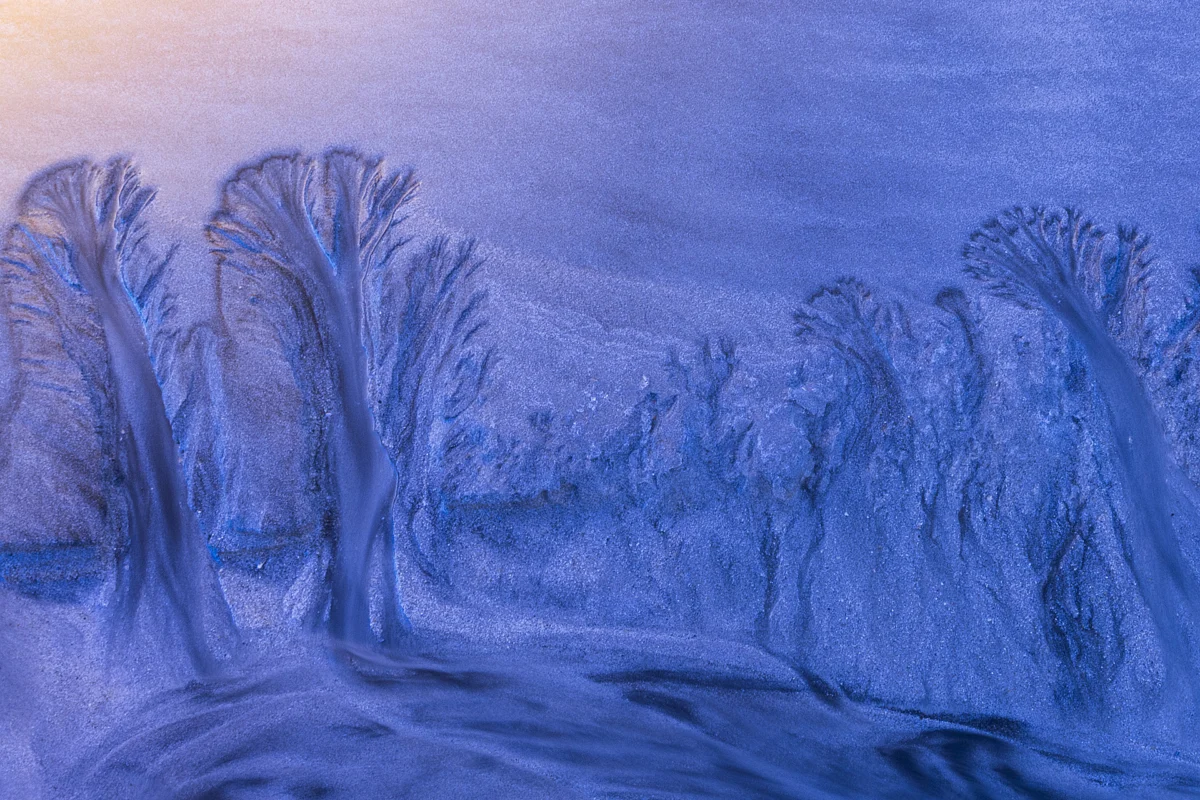
The exploration of ephemeral water formations forms the basis of the photo essay titled Ephemeral, the Language of Water. Capturing these fleeting aquatic sculptures requires precise timing and an acute awareness of coastal geomorphology.

Location and Execution
Working along the dynamic sands of Skagsanden beach in Norway during the initial hours of dawn, the photographer sought out micro-compositions where receding tides sketched temporary, forest-like patterns into the sand. Utilizing a 16mm wide-angle lens mounted on a stable tripod, the capture relied on a slow shutter speed of 0.8 seconds. This duration introduced a deliberate blur to the moving water at the frame’s lower boundary, creating a stark textural contrast against the granular roughness of the static sand.
Optical Control and Color Grading
To establish a cold, otherworldly ambiance, the white balance was intentionally anchored at 3,500 Kelvin, casting a pervasive blue hue over the scene. To manage the intense glare of morning sunlight reflecting off the wet sand, a Singh-Ray Gold-N-Blue polarizer was introduced. This optical filter effectively neutralized the harsh highlights while injecting warm, golden tones into the upper portion of the frame. The resulting tonal juxtaposition bridges the gap between a cold, austere arctic morning and the subtle warmth of a rising sun.

Case Study 2: Plant Designs and Symmetries in Río Negro
Moving from coastal Norway to the riverbanks of Viedma in the Río Negro province of Argentina, the focus shifts toward botanical geometries. Part of the broader essay Plant Designs, this work examines the architectural structures found within local flora during overcast atmospheric conditions.
Isolating Botanical Forms
Along the banks of the river, black alders (Alnus glutinosa) presented distinctive visual motifs, with small, cone-like fruits dangling from branches against the bright, reflective backdrop of the water. To isolate these details, a telephoto lens was deployed on a rigid tripod support.

The Mechanics of In-Camera Symmetry
The defining technical characteristic of this image is the use of the camera’s "double exposure in the shadows" mode. This setting intelligently superimposes the darker tonal areas of sequential frames. By executing a primary exposure, rotating the camera precisely 180 degrees via the lens mounting ring, and capturing a secondary exposure at a warm white balance setting of 8,000 Kelvin, the artist generated a complex plant design. The resulting composition merges reality with abstraction, offering a balanced rhythm of interweaving shadows and reflected botanical structures.
Case Study 3: The Jungle Bokeh of Puerto Iguazú
Subtropical environments present unique photographic challenges, particularly regarding high-contrast lighting and chaotic background elements that can distract from the intended subject.

Navigating the Misiones Jungle
During a steady drizzle along a jungle trail in Puerto Iguazú, Misiones, Argentina, damp ferns exhibited vibrant green hues against a cluttered forest floor. To eliminate the visual noise of scattered debris and decaying vegetation, the photographer employed an additive double-exposure technique paired with a vintage Helios 44-2 lens.
Creating the Cosmic Bokeh
The creation of the signature background effect involved two distinct steps. First, the vintage lens was focused on the dense jungle canopy overhead, capturing filtered sunlight breaking through the foliage. By intentionally positioning the brightest glints at the periphery while leaving the center dark, a luminous, swirling bokeh was formed. A second exposure centered the damp fern within the frame. The in-camera combination of these two elements effectively dissolved the chaotic background, cloaking the botanical subject in a delicate halo of diffused light.

Case Study 4: Avian Dynamics in Escape and Evasion
Documenting wildlife within expansive ecosystems often requires narrative framing that extends beyond simple identification imagery. The essay Escape and Evasion uses avian behavior as a conceptual vehicle to explore themes of freedom and detachment from routine existence.
The Cliffside Habitat of El Cóndor
Situated at the El Cóndor beach resort in Argentina, sheer coastal cliffs rising over fifty meters support the largest colony of burrowing parrots (Cyanoliseus patagonus) in the world, numbering approximately 74,000 individuals. This hyper-dynamic environment provides a constant backdrop of movement and vocalization.

Dual-Layered Narrative Capture
To convey a sense of urgency and flight, a multi-step capture process was executed from the cliff summit using an 8,000 Kelvin white balance to enforce an ochre, warm aesthetic. The primary exposure utilized a 400mm telephoto lens to record the violent impact of ocean waves crashing onto the shore below. The secondary exposure captured backlight parrots against a partly cloudy sky. By removing the camera from the tripod for the second shot and shooting freehand with a wide aperture and fast shutter speed, the birds were positioned near the lower frame border. The resulting superimposition creates a dramatic visual tension in which the flock appears to flee from the chaotic rising tides behind them.
Case Study 5: Cosmic Metaphors in Domestic Spaces
Fine-art nature photography does not always require remote expeditions; sometimes, compelling subjects emerge in immediate, everyday surroundings.

The Accidental Discovery
Upon arriving at a cabin on the outskirts of Puerto Iguazú near the Paraná River, a small moth resting on a balcony glass pane offered an immediate compositional opportunity. Recognizing the potential for a visual metaphor, the photographer utilized dust and imperfections on the window surface to simulate a galactic field of stars.
Technical Execution and Lighting
Assisted by a family member illuminating the subject from the reverse side with a flashlight, the dust particles on the glass were rendered as luminous constellations. Working hand-held with a macro lens, the exposure was deliberately reduced by three stops, and the white balance was adjusted to 3,000 Kelvin to emphasize cold, cosmic tones. Through this controlled manipulation of light, dust, and subject, an ordinary insect was elevated into a solitary celestial body suspended within an artificial universe.

Broader Implications and Artistic Evolution
The methodologies highlighted across these diverse projects underscore a broader philosophical shift in contemporary nature photography. By prioritizing personal interpretation over strict documentary realism, practitioners challenge viewers to reconsider the visual potential of familiar environments.
As camera technology increasingly incorporates advanced computational photography features—such as multi-frame stacking, customizable white balance algorithms, and native double-exposure controls—the barrier to entry for in-camera artistic manipulation continues to lower. However, the core requirement remains human vision: the ability to pre-visualize a final image from an ordinary moment and execute the necessary technical choices to bring that internal narrative to life.
