
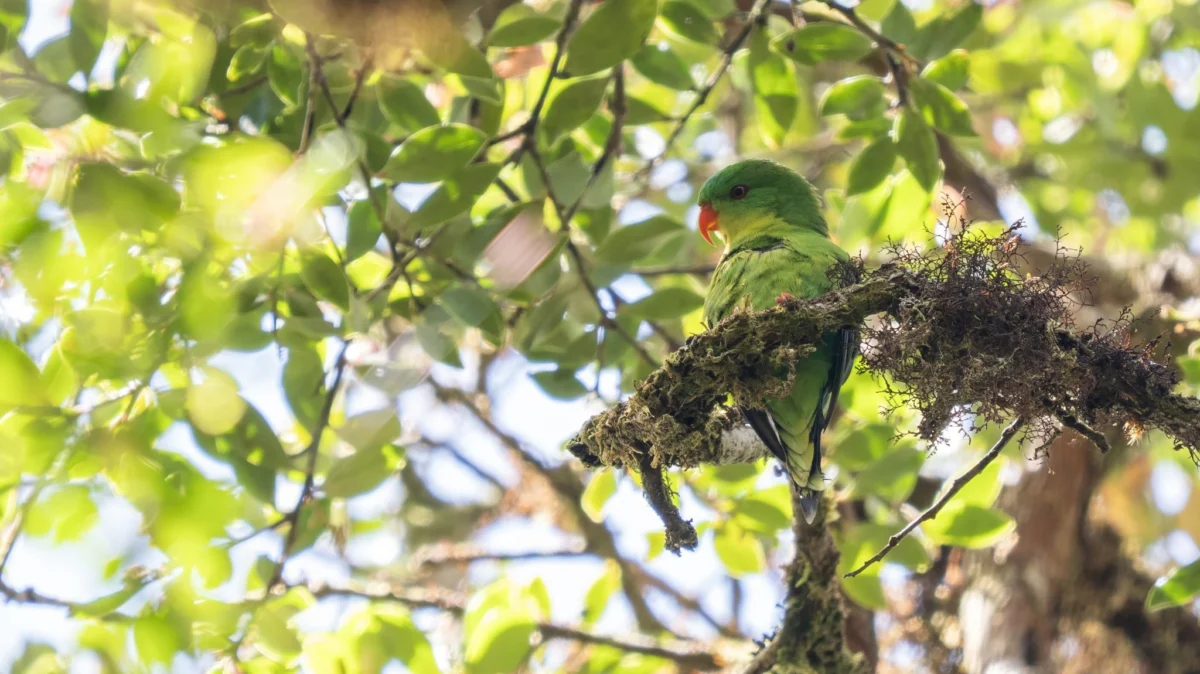
For over a century, the vibrant Blue-fronted Lorikeet (Charmosyna toxopei), a species known for its striking lime-green plumage, orange bill, and distinctive blue hindcrown, has eluded all but the most persistent observers. Endemic solely to Buru, one of the larger islands within Indonesia’s Maluku archipelago, this small parrot had become a symbol of the planet’s hidden biodiversity—a species known only from a handful of historical specimens and a single, fleeting modern sighting. Its recent re-emergence, documented with the first verifiable photographs and sound recordings in over a decade, represents a monumental achievement in conservation and ornithological exploration. The rediscovery journey, an arduous 14-day trek into the island’s most challenging and unexplored terrain, confirms earlier hypotheses that this elusive bird persists in the higher elevations of Mount Kapalatmada.
A Century of Elusiveness: The Blue-fronted Lorikeet’s History
The scientific world first encountered the Blue-fronted Lorikeet in the 1920s, when a series of seven specimens were collected, forming the basis for its initial description. These early records placed the species within the lowland and mid-elevation forests of Buru. However, after this initial collection, the lorikeet vanished from scientific records. Extensive surveys conducted over the subsequent decades failed to yield further sightings, leading to widespread concern about its fate. For nearly a century, the species remained a phantom, inspiring both dedicated searches and fears of its potential extinction.
The first hint of its continued existence in modern times came in 2014 when renowned birder Craig Robson, during a Birdquest tour, managed to capture a photograph of the species. This fleeting encounter, while offering a glimmer of hope, was not followed by sustained observations or detailed ecological data, leaving many questions unanswered about its population, distribution, and habitat requirements. Despite the lack of definitive information, the species was initially classified as Critically Endangered on the IUCN Red List, reflecting the assumption of a small, declining population threatened by habitat loss. However, due to the extreme scarcity of data, its status was later revised in 2024 to Data Deficient, a classification indicating insufficient information to assess its risk of extinction accurately. The same year, the Blue-fronted Lorikeet was officially recognized as a ‘lost species’ by the "Search for Lost Birds," a global initiative spearheaded by the American Bird Conservancy (ABC), Re:wild, and BirdLife International, aiming to rediscover species unseen for decades. This designation underscored the urgent need for targeted expeditions to ascertain its status.

Buru Island: A Biodiversity Hotspot Under Pressure
Buru Island, part of the Wallacea biogeographical region, is a critically important area for global biodiversity. Its isolation has fostered the evolution of numerous endemic species, found nowhere else on Earth. Mount Kapalatmada, Buru’s highest peak soaring to an elevation of 8,900 feet (approximately 2,713 meters), is at the heart of this unique ecosystem. Its slopes are characterized by diverse habitats, transitioning from dense lowland rainforests to unique mossy cloud forests at higher altitudes. These montane forests, often shrouded in mist and difficult to access, are frequently ecological refugia, providing sanctuary for species sensitive to disturbance or specialized to specific climatic conditions.
However, Buru’s rich natural heritage is under continuous and severe threat. As Benny A. Siregar, Maluku Coordinator at Burung Indonesia, a local partner of BirdLife International, starkly noted, "This bird inhabits areas under continuous pressure from deforestation, with a population estimated to be exceedingly small and vulnerable." The island faces significant pressures from logging companies, expanding agricultural frontiers, and mining operations. These activities lead to widespread habitat destruction, fragmentation, and degradation, directly impacting forest-dependent species like the Blue-fronted Lorikeet. Moreover, surveys conducted by Konservasi Kakatua Indonesia (KKI) between 2023 and early 2025 documented potential threats from hunting, both for consumption and for the illegal pet trade, adding another layer of vulnerability to an already fragile population.
The Quest for Lost Birds: A Global Initiative
The "Search for Lost Birds" initiative emerged from a critical need to address the knowledge gaps surrounding species that have seemingly vanished from the planet. With an estimated 1,000 to 2,000 species of birds considered "lost" (not seen for at least a decade), the initiative seeks to fund and coordinate expeditions to areas where these species might persist. Its core philosophy is that rediscovering these species is not only a scientific triumph but also a powerful tool to galvanize conservation efforts. By identifying surviving populations, conservationists can develop targeted protection strategies, raise public awareness, and secure funding for critical habitat preservation. The Blue-fronted Lorikeet, with its long period of absence and the intriguing speculation about its high-elevation refuge, was a prime candidate for such a search, embodying the initiative’s mission to explore the planet’s least-known corners for its most elusive inhabitants.

Charting the Uncharted: The Expedition to Mount Kapalatmada
The groundwork for the recent rediscovery was laid in the autumn prior to the expedition, when local climbers from the Indonesian mountaineering group Kanal Buru successfully mapped a new, accessible route to Mount Kapalatmada’s summit. This pioneering effort opened up previously impenetrable areas of the highlands, transforming the daunting prospect of exploration into a tangible possibility for ornithological research.
Building on this breakthrough, an international expedition team embarked on a 14-day trek in April. The team comprised members from Kanal Buru, led by the experienced Handoko, alongside experts from the American Bird Conservancy (ABC), Birdtour Asia, and Yayasan Planet Indonesia. The journey was physically demanding, characterized by challenging terrain that transitioned from jagged limestone formations, notoriously difficult to navigate and often covered in piercing vegetation and insects, to the more hospitable, charming mossy cloud forests and park-like clearings higher up. These montane environments, rich with birdsong, hinted at the unique biodiversity that lay within. The expedition’s primary goal was clear: to systematically search the speculated high-elevation habitats for any sign of the Blue-fronted Lorikeet.
Moments of Rediscovery: First Glimpses and Scientific Documentation
The expedition’s efforts culminated in a series of breathtaking encounters that brought the "lost" lorikeet back into the scientific light. After six days of arduous climbing, as the team transitioned into the high-altitude mossy cloud forest, the landscape began to sing with avian life. It was here that the first thrilling glimpse occurred. John Mittermeier, Director of the Search for Lost Birds at ABC, recounted the moment: "We noticed two small birds fly into a nearby tree so I picked up my binoculars to see what one of them was. I short-circuited with excitement when I realised it was a Blue-fronted Lorikeet." Despite the initial surge of adrenaline and the profound significance of the sighting, the birds quickly departed before any photographs could be captured.

Undeterred, the team maintained their vigil. Two days later, while gathered for breakfast, another lorikeet made a dramatic appearance. This time, its bright green feathers glistened unmistakably in the morning sun. The team, reacting swiftly, managed to capture the first photographic documentation of the species in over a decade, confirming its persistence. This pivotal moment provided irrefutable proof, transforming a century of speculation into tangible reality.
The final morning in the highlands brought even more scientific success. The group spotted two additional lorikeets darting between flowering trees, offering a rare opportunity to observe their behavior. Crucially, during this encounter, the team successfully captured the first-ever sound recordings of the lorikeet’s distinctive high-pitched calls. These recordings are invaluable, providing crucial data for future identification and monitoring efforts. Beyond the lorikeet, the expedition yielded further treasures, including sightings and recordings of a Madanga, one of the region’s most unusual songbirds, and a potential new taxon of Island Thrush, underscoring the rich, unexplored biodiversity of Buru’s highlands. These additional discoveries highlight the ecological importance of the area and the potential for many more unrecorded species.
Conservation Status and Mounting Threats
The rediscovery of the Blue-fronted Lorikeet confirms the hypothesis that the species is indeed restricted to Buru’s high-elevation habitats. While this isolation has historically offered some protection due to the inaccessibility of Mount Kapalatmada, it also makes the species inherently vulnerable. As Benny A. Siregar emphasized, "Rare sighting records suggest a highly restricted habitat use. The primary challenge facing the Blue-fronted Lorikeet is that they are facing threats that remain largely unknown." This limited range means any localized disturbance could have catastrophic effects on the entire population, which is estimated to be exceedingly small.
The threats looming over Buru’s forests, and consequently the lorikeet, are severe and multifaceted. Deforestation for logging, agriculture, and infrastructure development continues unabated, eroding critical habitat. Mining operations, often associated with widespread environmental degradation, pose another significant danger. Dwi Agustina, Conservation Program Coordinator for Konservasi Kakatua Indonesia (KKI), highlighted these concerns: "Buru is home to many endemic birds, and the logging and mining companies that have acquired much of the island’s forest represent a major threat to their survival and wildlife." Furthermore, the documented threats of hunting for the pet trade and local consumption add direct pressure to an already small and vulnerable population. The current classification of "Data Deficient" by the IUCN Red List underscores the urgent need for comprehensive research to accurately assess population numbers, distribution, and the specific impacts of these threats, enabling a more precise conservation status designation and the development of effective protective measures.

A Beacon of Hope: Broader Implications for Conservation
The rediscovery of the Blue-fronted Lorikeet is far more than an isolated ornithological success; it serves as a powerful beacon of hope for global biodiversity conservation. It demonstrates that some species, long feared lost or even extinct, may still persist in unexplored or highly inaccessible landscapes, particularly in montane refugia. This success story offers renewed impetus for the "Search for Lost Birds" initiative and encourages further expeditions to similar remote regions worldwide.
The implications extend to other critically endangered and ‘lost’ lorikeet species, such as the New Caledonian Lorikeet (Charmosyna diadema) and the Red-throated Lorikeet (Charmosyna amabilis), both of which are also feared to be on the brink of extinction and are targets for similar searches. The Buru expedition provides a tangible example that with dedicated effort, strategic planning, and collaboration with local communities, even the most elusive species can be found. It underscores the importance of investing in scientific exploration and conservation efforts in areas that have historically received insufficient attention. The very inaccessibility that has long shielded the Blue-fronted Lorikeet from human-induced pressures now offers a blueprint for understanding how to protect similar remote habitats as natural sanctuaries.
Forging a Path Forward: Stewardship and Community Engagement
The future of the Blue-fronted Lorikeet, and indeed the unique biodiversity of Buru Island, hinges on thoughtful stewardship and robust collaboration among all stakeholders. The success of this expedition was deeply rooted in the involvement of local groups like Kanal Buru, whose intimate knowledge of the terrain and local context was indispensable. Handoko, the expedition leader from Kanal Buru, emphasized this: "This expedition helped me and the members of Kanal Buru gain new perspectives and knowledge about Mount Kapalatmada, especially about the birds and the ecosystems there. I hope to share these experiences to empower people in Buru to protect this unique area."

Conservation efforts must move beyond mere documentation to proactive protection. This includes establishing and enforcing protected areas, implementing sustainable land-use practices, and educating local communities about the ecological and economic value of their natural heritage. Dwi Agustina’s call for a "collective approach and action from all stakeholders to protect the remaining habitat" is paramount. The long-term survival of the lorikeet requires mitigating the pervasive threats of deforestation, mining, and hunting through policy changes, law enforcement, and community-based conservation initiatives.
Sumaraja, the Birdtour Asia guide, expressed both joy and a clear vision for the future: "In the future, I certainly hope more people will be able to see and learn more about these birds. At the same time, I sincerely hope more people will care about and participate in preserving the remaining forests on Buru Island." The rediscovery offers a unique opportunity to channel global attention and resources towards Buru, fostering a future where scientific discovery, local empowerment, and robust conservation efforts converge to safeguard this extraordinary island’s natural treasures for generations to come. Further research is now critical to estimate the lorikeet’s population size, refine its distribution maps, and monitor its ecological needs to ensure this vibrant bird, once lost, can truly thrive.
