
Fifty years have passed since Donald Griffin’s groundbreaking 1976 book, The Question of Animal Awareness, proposed a revolutionary idea: that non-human animals possess consciousness, exhibiting levels of self-awareness comparable to humans. At the time, this assertion stood in stark contrast to the prevailing scientific consensus, which largely viewed non-human animals as instinct-driven automatons or beings whose actions were primarily shaped by learned responses to rewards and punishments. Today, while the debate surrounding non-human consciousness, particularly in non-primate species like birds, remains a complex and evolving field, there is a growing body of scientific evidence and a significant shift in perspective. A recent declaration signed by hundreds of scientists underscores this evolution, asserting "strong scientific support" for consciousness in mammals, birds, and potentially all vertebrates. However, the definitive establishment of such consciousness, whether in humans or animals, continues to elude concrete proof, presenting a profound challenge for researchers.
The scientific community has increasingly focused on "sentience" – the capacity to experience emotions and sensations – as a key indicator of consciousness. Yet, this approach introduces its own set of complexities. Evaluating emotions and sensations in non-human animals is inherently difficult, especially given the acknowledged struggles humans face in fully articulating their own internal states. This diagnostic hurdle amplifies the challenge of objectively assessing the subjective experiences of other species.
While sensitivity to pain offers a seemingly more quantifiable metric, it is widely recognized as a rudimentary indicator, a necessary but not sufficient condition for arguing human-like consciousness. The quest for a comprehensive understanding of animal consciousness necessitates the development of more sophisticated evaluative frameworks.
Over the decades, researchers have proposed intricate metrics, such as those developed by Birch et al. (2020) and Bayne et al. (2024). While intellectually stimulating, these frameworks often lean heavily on human cognitive capacities, potentially creating a bias that overlooks unique forms of non-human awareness. As far back as the late 20th century, researchers like Dr. Irene Pepperberg, in collaboration with her graduate student S. K. Lynn, posited the existence of varying "levels" of consciousness, directly correlating these levels with quantifiable cognitive abilities within a species (Pepperberg & Lynn, 2000). Their argument suggested that these cognitive hierarchies are likely shaped by a combination of evolutionary processes, including homologous and convergent brain development, perceptual structures, and learning mechanisms. This perspective paved the way for exploring parallels between human and non-human cognitive processes and the elusive "neural correlates of consciousness" (NCC). The ongoing search for NCCs in humans, itself a complex endeavor (Cognitive Consortium, 2025), further complicates the identification of such correlates in non-human species.
The advent and rapid advancement of Artificial Intelligence (AI) systems have introduced another layer of complexity to this discussion. If mere processing power were the sole determinant of consciousness, then sophisticated AI might be considered conscious. However, current AI, despite its impressive cognitive processing capabilities, lacks self-awareness, prompting a re-evaluation of whether sentience, rather than higher-order cognitive processing, should be the primary focus (Block, 2025).
The Evolving Scientific Landscape of Animal Consciousness
The scientific discourse surrounding animal consciousness has undergone a significant transformation since Griffin’s initial proposals. What was once a fringe idea is now a subject of intense academic inquiry, fueled by advancements in neuroscience, ethology, and comparative psychology. The New York Declaration on Animal Consciousness, endorsed by hundreds of scientists in April 2024, signifies a pivotal moment in this ongoing conversation. This declaration explicitly states that there is "strong scientific evidence" supporting consciousness in a broad range of animal species, moving the discussion from a theoretical possibility to a scientifically supported hypothesis.
However, the core challenge remains: how to definitively prove consciousness in beings that cannot articulate their subjective experiences through language. While researchers can observe behavior, physiological responses, and cognitive abilities, the leap from these observable phenomena to the internal, subjective experience of consciousness is a significant one.
The concept of "full consciousness" is generally understood to encompass more than just sensory input processing and emotional experiences. It includes executive control over decision-making, voluntary actions, and, crucially, metacognition – the awareness of one’s own thoughts and the understanding that one is aware. It is this latter aspect, self-awareness, that presents the most formidable obstacle in non-human animals. Even species with sophisticated communication abilities often lack the symbolic language necessary to convey instances of self-awareness to human observers.
Behavioral Indicators: The Case of Delayed Gratification
Given these inherent difficulties, researchers are increasingly turning to observable behaviors that, when exhibited by humans, are considered strong indicators of self-awareness. One such behavior is delayed gratification, the ability to forgo an immediate reward in favor of a larger or better reward at a later time. This capacity, extensively studied in avian species, particularly Grey parrots, offers compelling insights into cognitive processes that likely underpin conscious awareness.
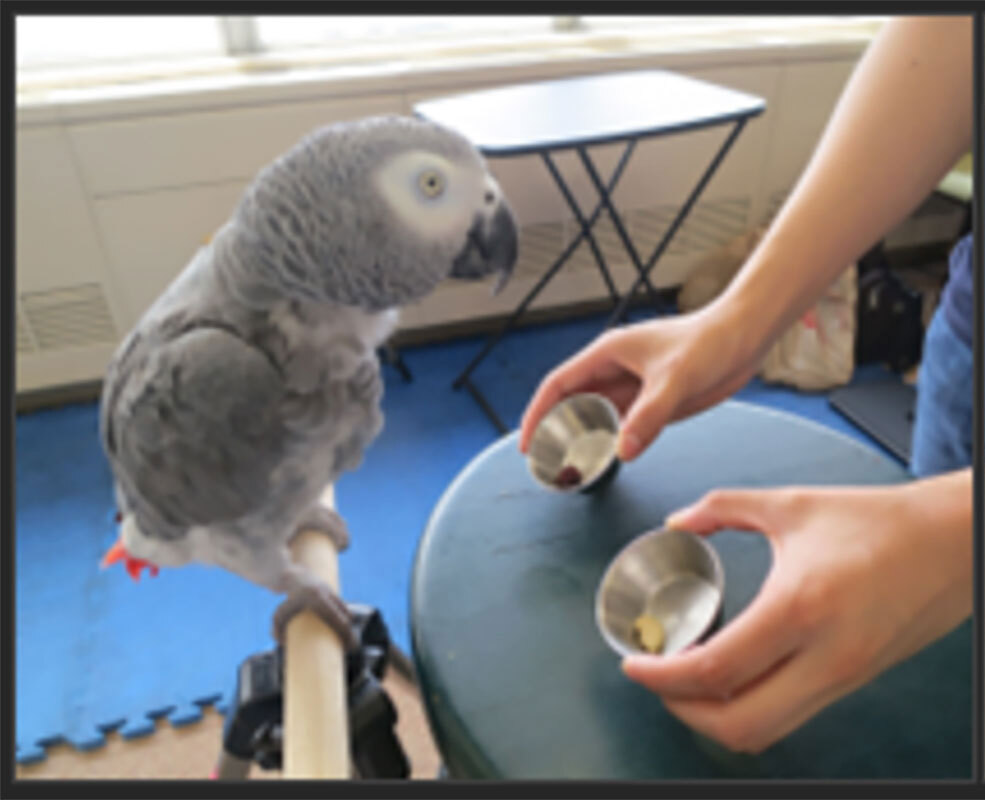
Studies involving Grey parrots, such as those conducted by Koepke et al. (2015), Pepperberg and Hartsfield (2023), and Pepperberg and Rosenberger (2022), have demonstrated remarkable success in delayed gratification tasks. In these experiments, birds are presented with a choice between an immediate, less desirable treat and a future, more appealing treat. To succeed, the animal must:
- Recognize and suppress immediate impulses: The bird must overcome the urge to consume the readily available reward.
- Understand the conflict: It must grasp the trade-off between immediate satisfaction and a future benefit.
- Maintain the future goal in memory: The concept of the larger reward must remain accessible throughout the waiting period.
- Devise a strategy: The bird might engage in cognitive activities to manage its impulses and maintain focus on the future reward.
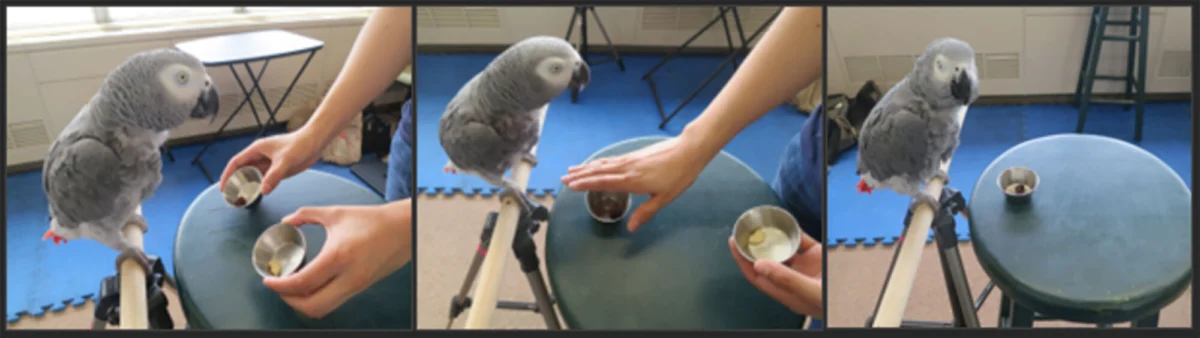
The capacity of Grey parrots to consistently succeed in these tasks suggests a level of cognitive sophistication that aligns with some facets of self-awareness. The image provided, depicting the Grey parrot Griffin during a delayed gratification experiment, illustrates this process: Griffin is shown the available rewards, then presented with a delay period during which he must wait for a preferred option. His ability to wait, as documented in these studies, provides behavioral evidence of executive control and forward planning, traits strongly associated with conscious thought.
While these behavioral demonstrations, including the complex executive functions required for delayed gratification, do not constitute definitive "proof" of avian consciousness, they offer valuable, potential insights. They contribute to a broader picture that must be considered alongside neurological and other cognitive assessments when evaluating the levels and qualities of conscious behavior in birds and other non-human animals.
Implications for Animal Welfare and Conservation
The ongoing debate and evolving scientific understanding of animal consciousness carry significant implications for how humans interact with and treat non-human species. While the stringent criteria for scientific proof of consciousness may remain elusive, the principle of "do no harm," as advocated by proponents of the New York Declaration on Animal Consciousness, suggests a prudent approach.
In the context of animal welfare, humane treatment, and conservation efforts, a degree of caution is warranted. Evidence that is merely indicative of consciousness, rather than definitively proving it, should be taken seriously. This suggests that protocols designed to ensure the well-being of animals should be informed by the possibility of their subjective experiences, even in the absence of absolute certainty.
The historical trajectory of this debate, from Griffin’s radical proposition to the current widespread scientific acknowledgment of the likelihood of non-human consciousness, underscores a profound shift in our understanding of the animal kingdom. As research continues to push the boundaries of what we can measure and infer, the ethical and practical considerations of our relationship with other sentient beings will undoubtedly continue to evolve. The quest to understand animal consciousness is not merely an academic pursuit; it is a fundamental re-evaluation of our place within the broader tapestry of life on Earth.
References
Andrews, K., Birch, J., Sebo, J., & Sims, T. (2024, April 19). Background to the New York Declaration on Animal Consciousness. nydeclaration.com
Bayne, T., Seth, A. K., Massimini, M., Shepherd, J., et al. (2024). Tests for consciousness in humans and beyond. Trends in Cognitive Science, 28(5), 454–466.
Birch, J., Schnell, A. K., & Clayton, N. S. (2020). Dimensions of animal consciousness. Trends in Cognitive Science, 24(10), 789–801.
Block, N. (2025). Can only meat machines be conscious?. Trends in Cognitive Sciences, 30(4), 298–308.
Cogitate Consortium. (2025). Adversarial testing of global neuronal workspace and integrated information theories of consciousness. Nature, 6422(8066), 133–142.
Griffin, D.R. (1976). The Question of Animal Awareness. Rockefeller University Press.
Koepke, A. E., Gray, S. L., & Pepperberg, I. M. (2015). Delayed gratification: A Grey parrot (Psittacus erithacus) will wait for a better reward. Journal of Comparative Psychology, 129(4), 339–346.
Pepperberg, I.M. (1999). The Alex Studies. Harvard University Press.
Pepperberg, I.M. (2026). Comments on consciousness in Grey parrots. Comparative Cognition and Behavior Reviews. DOI:10.3819/CCBR.2026.210011.
Pepperberg, I. M., & Hartsfield, L-A. (2023). A study of executive function in Grey parrots: Experience can affect delay of gratification. Journal of Comparative Psychology, 138(1), 8–19.
Pepperberg, I. M., & Lynn, S. K. (2000). Possible levels of animal consciousness with reference to Grey parrots (Psittacus erithacus). American Zoologist, 40(6), 893–901.
Pepperberg, I. M., & Rosenberger, V. A. (2022). Delayed gratification: A Grey parrot (Psittacus erithacus) will wait for more tokens. Journal of Comparative Psychology, 136(1), 79–89.
Plutchik, R. (2001). The nature of emotions: Human emotions have deep evolutionary roots, a fact that may explain their complexity and provide tools for clinical practice. American Scientist, 89(4), 344–350.
